Longnose Chimaera
Harriotta raleighana
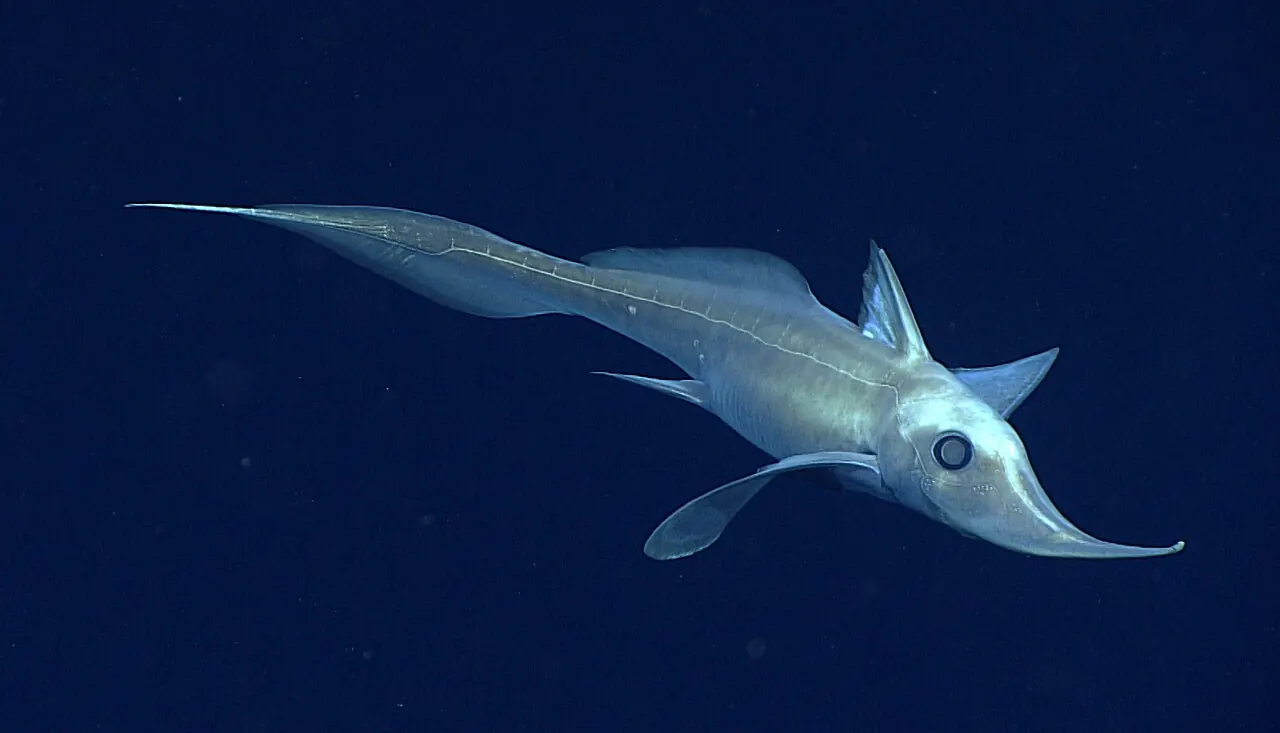
A deep-sea chimaera of the Atlantic slopes with a long, pointed, upturned snout and a tail that ends in a thin filament.
Photo: NOAA Office of Ocean Exploration and Research, Gulf of Mexico 2017 / CC BY-SA 2.0
3 things to know
- Its scientific name honors Thomas Harriott and Sir Walter Raleigh, two Englishmen tied to the Roanoke voyages.
- Its tail can end in a filament up to a third of the fish's total length.
- In 2024, longnose chimaeras from Australia and New Zealand were described as a separate species.
- Scientific name
- Harriotta raleighana
- Depth
- 360 m – 2,000 m
1,181 – 6,562 ft - Size
- Up to about 1.2 m (3.9 ft) total length
- Weight
- Not well known
- Lifespan
- Unknown
- Diet
- Not well known
- Where
- Continental slopes on both sides of the Atlantic, from Greenland, Iceland and Norway south to Brazil and South Africa, including US waters and the Gulf of Mexico
- IUCN status
- Least Concern
- Depth zones
- Twilight · Midnight
A long, pointed snout, bent slightly upward at the tip, sets the longnose chimaera apart. Behind it are a convex forehead, moderate-sized eyes and tooth plates with ridges and knobs. A strong spine with serrated rear edges stands in front of the first dorsal fin, the pectoral fins are long and wide, and the tail ends in a thin filament that can make up a third of the fish's length when it is intact. Adults are a uniform brown with darker fin edges and reach about 1.2 meters (3.9 feet) in total length. Like the spotted ratfish, it is a chimaera, a cartilaginous fish in the same class as sharks and rays.
It lives near the bottom on continental slopes, at about 360 to 2,000 meters (1,180 to 6,560 feet). The IUCN lists it on both sides of the Atlantic, from Greenland, Iceland and Norway south to Brazil, Namibia and South Africa, and it occurs in the western North Atlantic between Nova Scotia and Chesapeake Bay. NOAA ocean exploration expeditions photographed one in the Gulf of Mexico in 2012 and another in 2017, when the expedition team noted it was the first time many on board had seen one.
Goode and Bean described the species in 1895. According to FishBase, its genus honors Thomas Harriott, who published the first English work on American natural history in 1588, and its species name honors Sir Walter Raleigh, who funded the 1585 expedition to Roanoke Island in what is now North Carolina.
Much of its biology is unknown. A guide to the fishes of the northeast Atlantic hosted by the Naturalis museum in the Netherlands lists no data on its diet, and says only that it lays eggs, with the smallest known young about 10 centimeters (4 inches) long, not counting the tail. Older sources, FishBase among them, treat the species as worldwide, and reports that it eats shellfish and crustaceans come from Australian waters. In 2024 Finucci and colleagues described the Australian and New Zealand fish as a separate species, Harriotta avia. The IUCN's 2024 assessment treats H. raleighana as an Atlantic fish and lists it as Least Concern, with a stable population. FishBase notes that it is caught as bycatch in deep-water trawl fisheries.
Sources
- iucnredlist.org/species/278016856/268401245
- fishes-fnam.linnaeus.naturalis.nl/linnaeus_ng/app/views/species/taxon.php
- fishbase.se/summary/Harriotta-raleighana.html
- fishesofaustralia.net.au/home/species/3290
- commons.wikimedia.org/wiki/File:Hariotta_(Harriotta)_raleighana.jpg
- commons.wikimedia.org/wiki/File:Expl8199_(9664173682).jpg