Sea Squirt
Class Ascidiacea (about 2,800 described species)
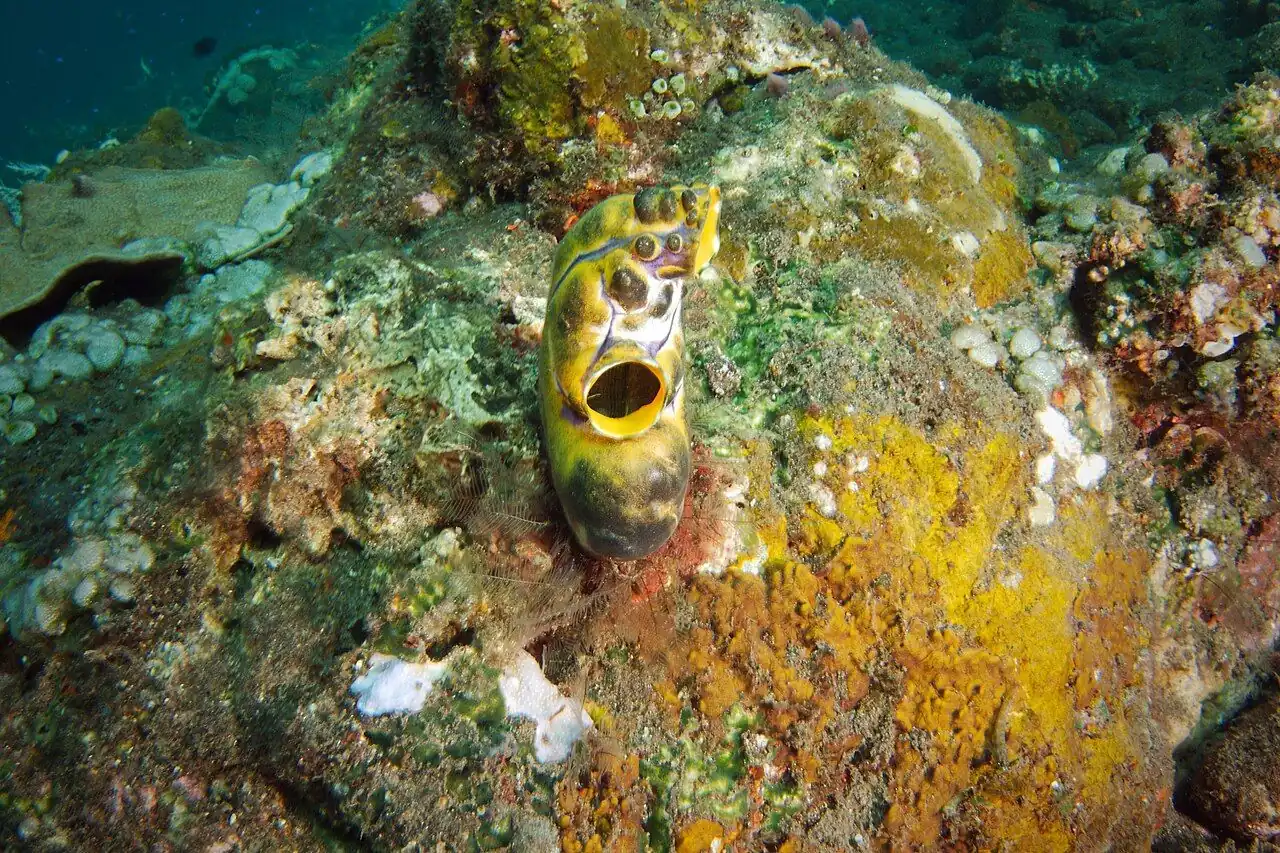
Bag-shaped filter feeders fixed to rocks, reefs and docks. Their swimming larvae carry a notochord, which makes sea squirts relatives of vertebrates.
Photo: Paul Kli / CC BY-SA 2.0
3 things to know
- Tunicates, the group that includes sea squirts, are the only animals known to make cellulose.
- Many sea squirt larvae have a notochord, a nerve cord along the back, gill slits and a tail.
- A predatory tunicate has been filmed 8,077 m (26,500 ft) down in the Izu-Ogasawara Trench.
- Scientific name
- Class Ascidiacea (about 2,800 described species)
- Depth
- 0 m – 8,077 m
0 – 26,501 ft - Size
- Varies by species; colonies are built of many small individuals, and solitary species such as Australia's cunjevoi reach about 30 cm (12 in)
- Weight
- Varies by species
- Lifespan
- Not well known for most species
- Diet
- Plankton and fine particles filtered from seawater; some deep-sea species catch small crustaceans
- Where
- All oceans, from the shore to the deep sea
- IUCN status
- Not Evaluated (for the species we checked)
- Depth zones
- Sunlight · Twilight · Midnight · Abyss · Hadal
Strip a sea squirt down and you have a bag with two openings, called siphons. Water flows in through one, passes a filter inside the body that strains out plankton and other fine particles, and leaves through the other. The body is wrapped in a tough coat, the tunic, built largely of cellulose. In 2004 Ann Matthysse of the University of North Carolina and colleagues described a cellulose-making gene from a sea squirt and noted that, among animals, tunicates are the only ones known to make cellulose.
Many species start life as a free-swimming tadpole larva with a notochord, a nerve cord along its back, gill slits and a tail, the features that define chordates, the group that includes vertebrates. After swimming for a while it attaches to a hard surface, loses its tail and much of its nervous system, and becomes a sessile adult. In 2006 Frédéric Delsuc and colleagues compared 146 genes and concluded that tunicates, and not lancelets, are the closest living relatives of vertebrates.
Noa Shenkar and Billie Swalla counted 2,815 described species in 2011, about 60 percent of them colonial. Sea squirts live in all marine habitats from shallow water to the deep sea, on soft sediment, coral and rock, and on docks and ship hulls. The Australian Museum says the name comes from the jet of water some squirt when they are uncovered at low tide and stepped on or near.
Some have spread into new waters. A colonial sea squirt in the genus Didemnum was first seen on the US northeast coast in the late 1980s, and in 2002 large colonies turned up offshore on Georges Bank, off New England. A 2005 survey, reported by the US Geological Survey, found it in two gravel areas totaling more than 230 square kilometers (89 square miles), with mats over more than half the seabed along some survey lines.
Other sea squirts live far deeper. MBARI describes predatory tunicates (Megalodicopia) in the North Pacific at 200 to 3,900 meters (660 to 12,800 feet), whose mouth siphon works like a pair of lips that snaps shut on small crustaceans. In 2023 Alan Jamieson and colleagues reported a predatory tunicate filmed 8,077 meters (26,500 feet) down in the Izu-Ogasawara Trench, which the authors report as the deepest record for any tunicate. None of the species we checked has been assessed by the IUCN.
Sources
- Study: doi:10.1371/journal.pone.0020657
- ucmp.berkeley.edu/chordata/urochordata.html
- Study: doi:10.1073/pnas.0303623101
- Study: doi:10.1038/nature04336
- australian.museum/learn/animals/sea-squirts
- australian.museum/learn/animals/sea-squirts/cunjevoi
- pubs.usgs.gov/publication/70030137
- pubs.usgs.gov/publication/70030017
- mbari.org/animal/predatory-tunicate
- Study: doi:10.1007/s00227-023-04177-5