Sea Lily
Stalked crinoids in several families, including Isocrinidae, Hyocrinidae and Bathycrinidae
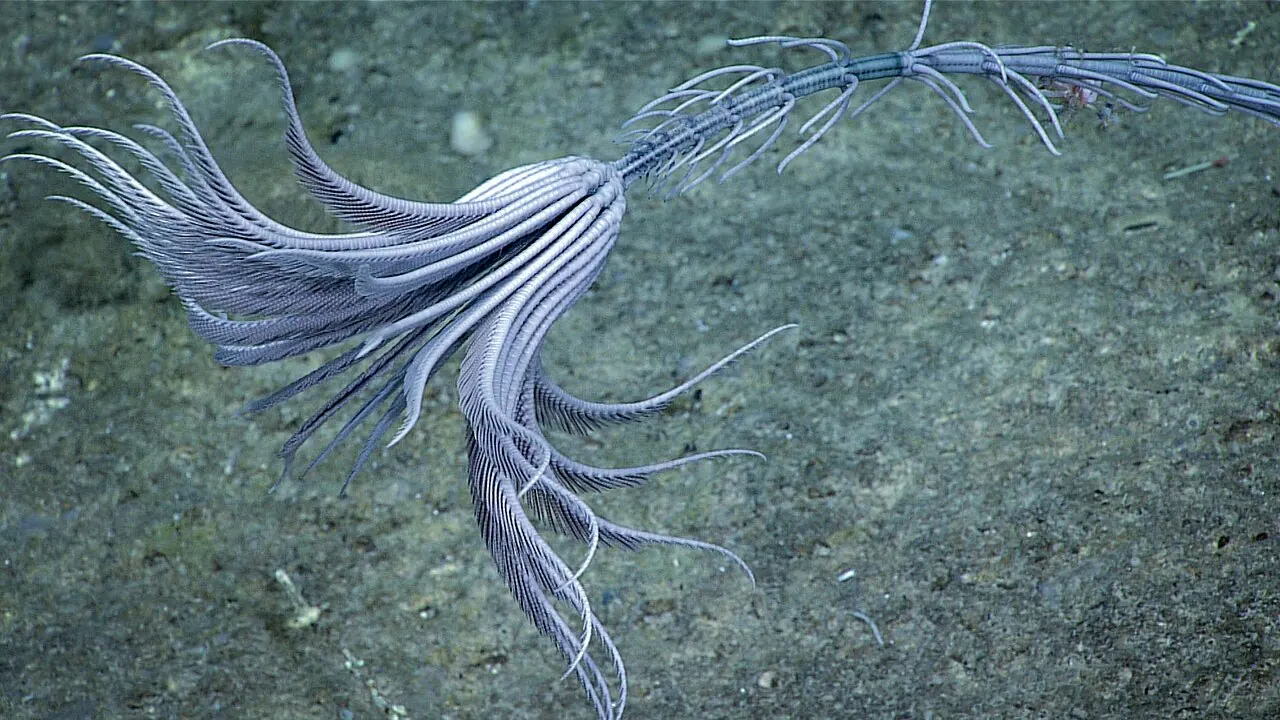
Feathery crinoids on long stalks, survivors of an ancient group, that can crawl across the deep seafloor dragging their stalk behind them.
Photo: NOAA Okeanos Explorer / Public domain
3 things to know
- Today sea lilies live only deeper than about 100 m (330 ft).
- One filmed off Grand Bahama crawled more than 3 m (10 ft) in just under 5 minutes.
- Pencil urchins eat them, and similar bite marks appear on sea lily fossils from the Triassic.
- Scientific name
- Stalked crinoids in several families, including Isocrinidae, Hyocrinidae and Bathycrinidae
- Depth
- 100 m – 9,000 m
328 – 29,529 ft - Size
- Stalks from a few centimeters to more than 1 m (3.3 ft) long
- Weight
- Not well known
- Lifespan
- Not well known
- Diet
- Food particles carried by the current, caught on sticky tube feet along the arms
- Where
- Deep water worldwide, from the Caribbean and the Bahamas to Monterey Canyon, Antarctica and the Izu-Ogasawara Trench off Japan
- IUCN status
- Not Evaluated (for the species we checked)
- Depth zones
- Sunlight · Twilight · Midnight · Abyss · Hadal
A sea lily looks like a feathery flower on a stem, but it is a crinoid, an animal related to sea stars. Five branching arms sit atop a stalk built from stacked disc- or star-shaped skeletal pieces. Stalks run from a few centimeters to more than a meter (3.3 feet) long and may have more than 350 segments. More than 5,000 fossil crinoid species have been described, going back over 400 million years, and most had stalks.
Sea lilies were once common in shallow seas, but today they live only deeper than about 100 meters (330 feet). Charles Messing of Nova Southeastern University in Florida counts just over a hundred living species in his online guide; a 2007 paper he co-wrote put the number below 100. They hold their arms up in the current and catch drifting particles on sticky tube feet. In 2009, Tatsuo Oji and colleagues reported dense meadows of stalked crinoids on rocks deeper than 9,000 meters (29,500 feet) in the Izu-Ogasawara Trench off Japan, then the deepest sea lilies seen alive. No usual depth range has been published; 100 and 9,000 meters are the outer records. Even there, Messing notes, they feed from currents, not from sinking particles.
Sea lilies were thought to stay put, but some isocrinids can let go and crawl on their arms, dragging the stalk behind. In lab tanks they managed about 0.1 millimeter per second, almost too slow to see. Tomasz Baumiller and Messing later analyzed video from Harbor Branch Oceanographic Institute's Johnson Sea Link submersibles, taken about 400 meters (1,300 feet) down off Grand Bahama Island. One Neocrinus decorus covered more than 3 meters (10 feet) in just under 5 minutes, about 36 meters (118 feet) an hour, with spurts near 3 centimeters (1.2 inches) a second.
One likely reason to hurry is pencil urchins. Submersible crews have seen these cidaroid urchins among sea lily meadows and perched on a toppled crinoid's stalk, and their guts can hold as much as 70% crinoid skeleton. In 2010, Baumiller and colleagues examined more than 2,500 fragments of Triassic crinoid stalks from Poland and found bite marks like those the urchins leave today. Baumiller and Messing describe stalk shedding and crawling as a lizard-tail escape, and Oji has argued that heavier predation in shallow water helped push stalked crinoids offshore. None of the species we checked has been assessed by the IUCN.
Sources
- libguides.nova.edu/crinoids
- libguides.nova.edu/crinoids/stalk
- libguides.nova.edu/crinoids/mechanisms
- libguides.nova.edu/crinoids/predation
- palaeo-electronica.org/2007_1/crinoid/intro.htm
- palaeo-electronica.org/2007_1/crinoid/material.htm
- palaeo-electronica.org/2007_1/crinoid/crawl.htm
- palaeo-electronica.org/2007_1/crinoid/discus.htm
- Study: doi:10.1073/pnas.0914199107
- pmc.ncbi.nlm.nih.gov/articles/PMC2851891
- Study: doi:10.2108/zsj.26.406
- Study: doi:10.1017/s0094837300016328
- Study: doi:10.11646/zootaxa.3425.1.1
- Study: doi:10.1130/g52179.1
- api.gbif.org/v1/species/4340656/iucnRedListCategory
- api.gbif.org/v1/species/6474158/iucnRedListCategory