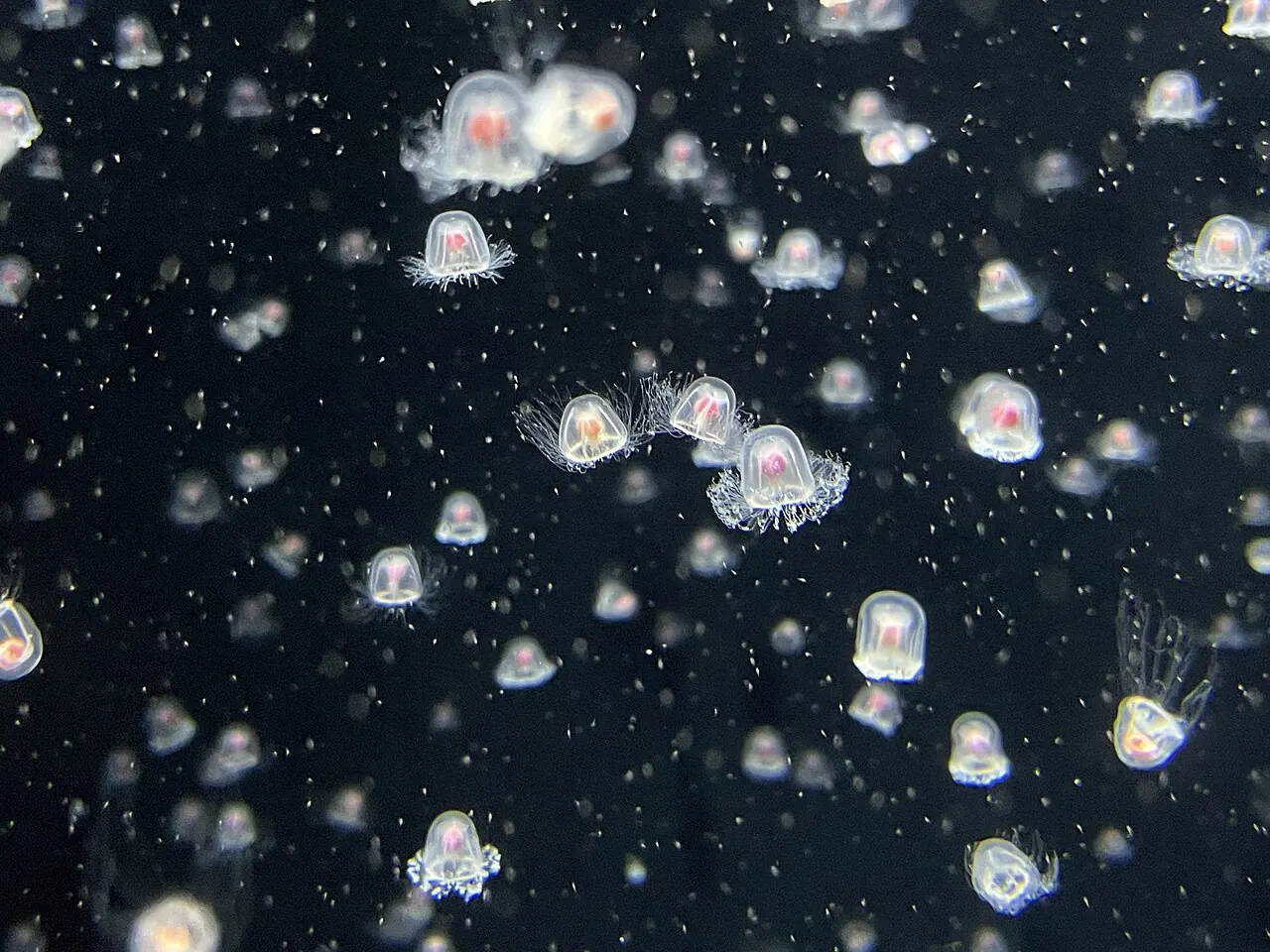
Sunlight Zone · 0–200 m
The Jellyfish That Can Turn Back Its Own Clock
When life gets hard, Turritopsis dohrnii can turn its adult body back into a baby form and start again.
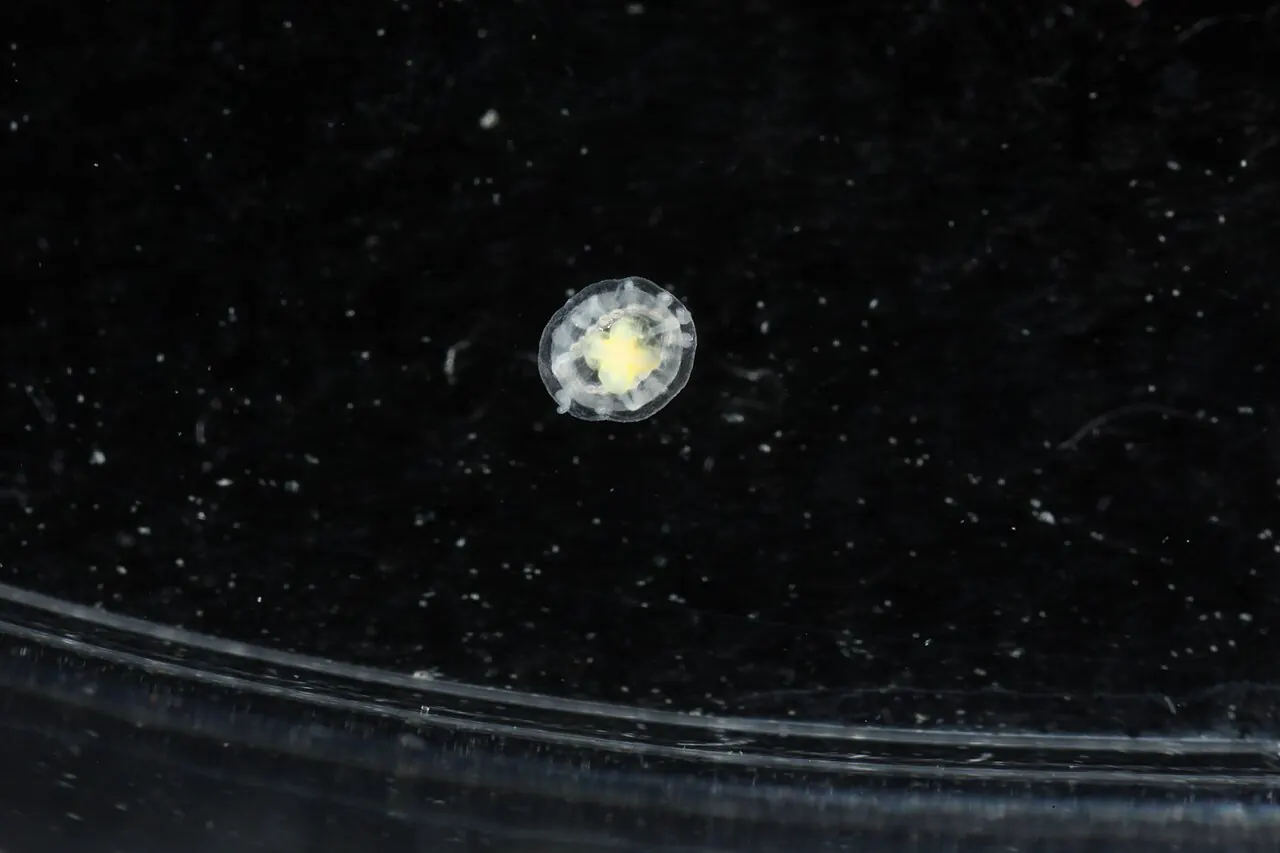
Turritopsis dohrnii
A jellyfish a few millimeters wide that can turn its adult body back into a polyp when starved or hurt, then grow up all over again.
Photo: Karen J. Osborn, Smithsonian National Museum of Natural History / CC0
Turritopsis dohrnii is a hydrozoan, a small relative of the familiar jellyfish, and its free-swimming adult stage, the medusa, is tiny. A standard description puts the bell at about 3.3 millimeters across, and London's Natural History Museum gives about 4.5 millimeters, either way smaller than a little fingernail. The bell is see-through with a red stomach at its center. Tentacle counts in adult medusae vary by place: 8 in Bocas del Toro, Panama, 12 to 24 in Italy and 14 to 24 in Japan.
Its life starts like that of many hydrozoans. Fertilized eggs become larvae that settle and grow into branching polyp colonies up to about 35 millimeters (1.4 inches) tall, on rocks, docks, pilings and ship hulls. The polyps bud off medusae, which drift in the plankton. In the Mediterranean, where the species was first described, the polyps live on rocky shores from the surface to about 20 meters (66 feet) deep, often under overhangs. What the medusae eat in the wild has been little studied; Japanese researcher Shin Kubota feeds his captive colonies brine shrimp eggs sliced small under a microscope.
The nickname comes from what happens under stress. A starved or damaged medusa can shrink, absorb its tentacles and settle as a blob-like cyst, which over the next 24 to 36 hours develops into a new polyp. That polyp can then bud fresh medusae, genetically identical to the old one. Experiments published in 1996 showed that medusae at every stage, from newly released to fully mature, can make the switch. None of this protects it from being eaten: fish and turtles eat the medusae, and sea slugs and crustaceans eat the polyps.
The same ability may make it a hardy traveler. Maria Pia Miglietta and Harilaos Lessios found near-identical DNA in Turritopsis collected from Japan, both coasts of Panama, Florida, Spain and Italy, and called it a human-mediated worldwide introduction, likely through ships and their ballast water. In the US, medusae and polyps were collected in Florida's Indian River Lagoon in 2006, and colonies from Newport Beach, California, were identified in 2019. The species has not been assessed for the IUCN Red List.



