Sunlight Zone · 0–200 m
Warm Sand Is Turning Some Sea Turtle Populations Almost All Female
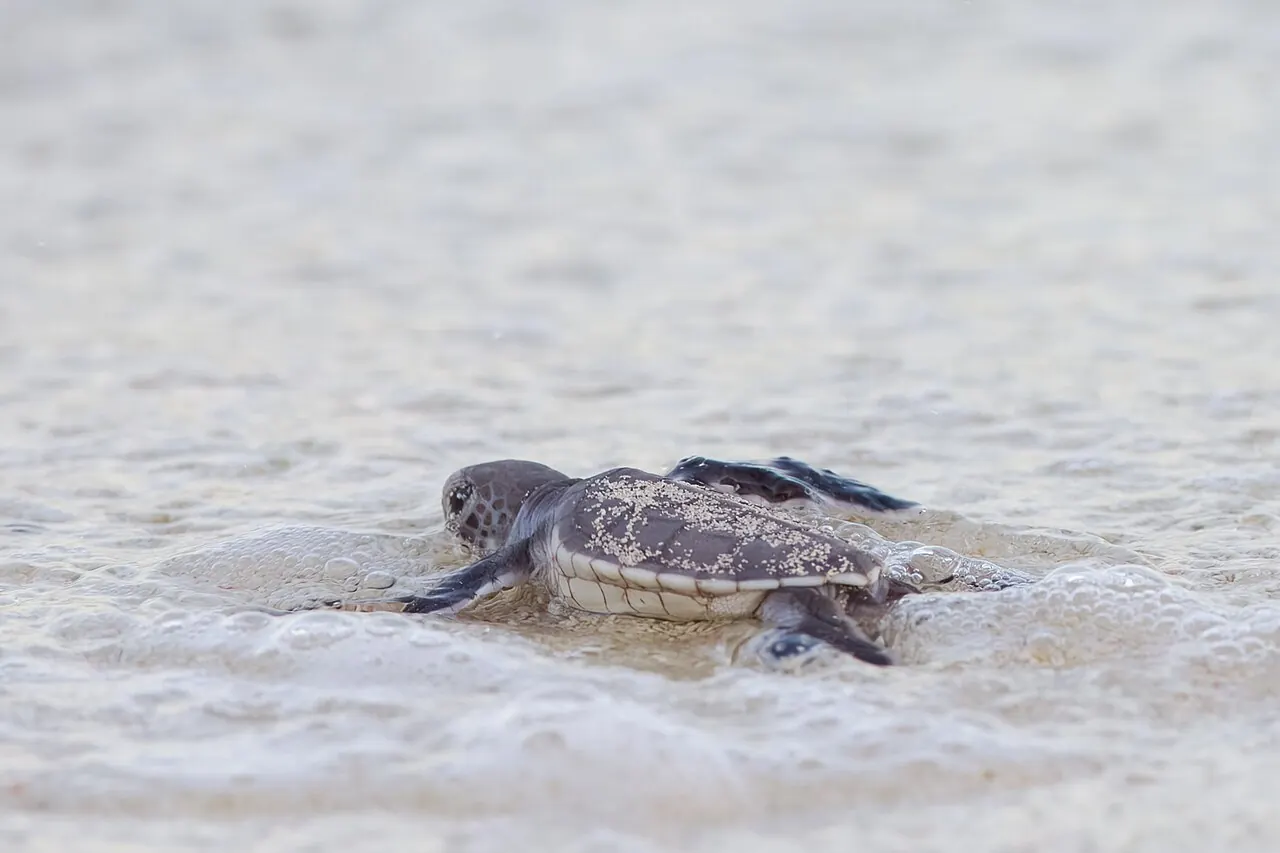
A turtle's sex is set by nest temperature. On the northern Great Barrier Reef, 99% of young green turtles studied were female.
Chelonia mydas
The largest hard-shelled sea turtle, a seagrass grazer whose nest temperature decides whether each hatchling is male or female.
Photo: PotMart186 / CC BY-SA 4.0
Green turtles are the largest of the hard-shelled sea turtles, though their heads are small for their size. A typical adult is about 90 to 120 centimeters (3 to 4 feet) long and weighs 136 to 159 kilograms (300 to 350 pounds). The shell is dark brown, gray or olive above and yellow to white below, and the edge of the beak is serrated, like a bread knife.
They live in subtropical and temperate waters of the Atlantic, Pacific and Indian oceans and in the Mediterranean. In US waters they turn up from Texas to Maine, in Puerto Rico and the US Virgin Islands, and around Hawaii, American Samoa and Guam. After hatching they spend several years in the open ocean, feeding on plants and small animals in drifting rafts of Sargassum seaweed, then settle in shallow coastal feeding grounds. Green turtles tracked from Ascension Island to Brazil mostly made shallow dives, reaching 10 to 20 meters (33 to 66 feet) only on longer ones.
Adults are the only herbivorous sea turtles, grazing mainly on seagrasses and algae. Females mature at 25 to 35 years and migrate every two to five years to nest in the region where they hatched. Each nest holds about 110 eggs, and a female nests every two weeks for several months. The eggs incubate in the sand for about two months.
That sand decides each hatchling's sex. Warmer nests produce females and cooler ones males, so a warming climate can tilt whole populations. A 2018 study in Current Biology traced green turtles feeding on the Great Barrier Reef back to their birth beaches and found that 99.1 percent of the juveniles from the warmer northern beaches were female.
The species as a whole is recovering. In October 2025 the IUCN moved the green turtle from Endangered to Least Concern, noting that the global population has grown by roughly 28 percent since the 1970s. Some groups are still in trouble: the North Indian Ocean subpopulation is listed as Vulnerable and the Central South Pacific one as Endangered. Bycatch, harvest of turtles and eggs, disease and loss of nesting and feeding habitat remain on NOAA's list of threats.



