Giant Sea Spider
Colossendeis megalonyx
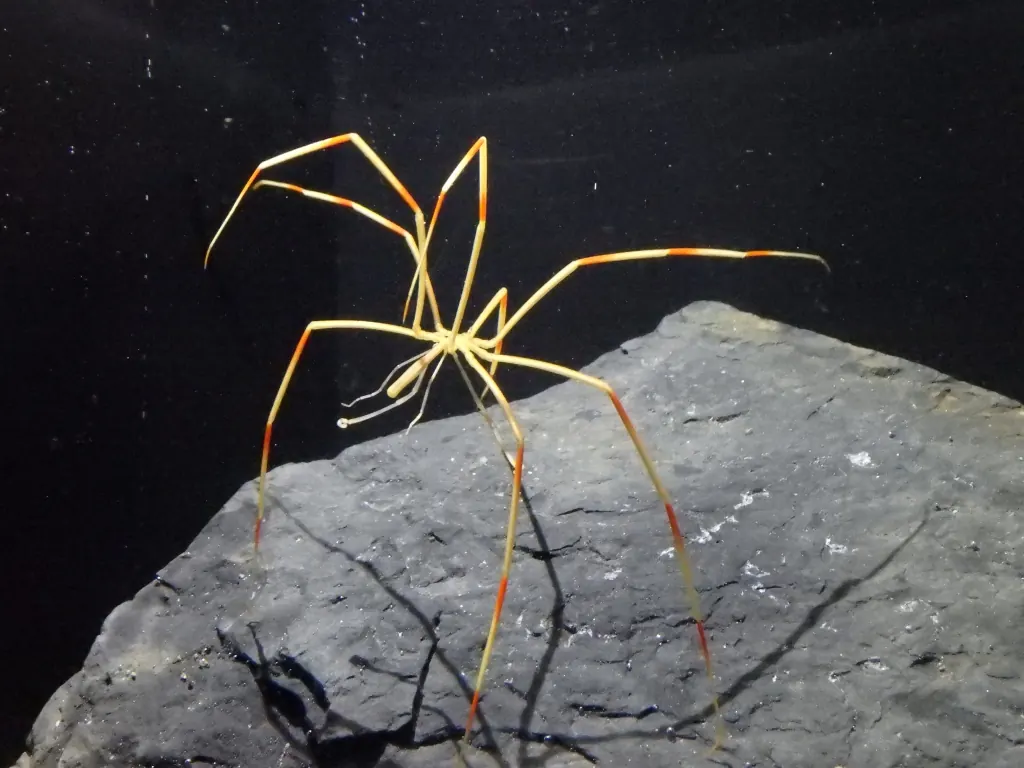
A long-legged Antarctic sea spider, a pycnogonid rather than a true spider, that takes in oxygen through its skin and pumps it with its gut.
Photo: Amy Osborne / CC BY-SA 4.0
3 things to know
- Sea spiders are pycnogonids, a separate class of marine arthropods, not true spiders.
- It has no gills or lungs; oxygen passes in through pores in its outer covering.
- In 2021, researchers in Antarctica watched a parent spend two days attaching thousands of eggs to the bottom of a tank.
- Scientific name
- Colossendeis megalonyx
- Depth
- 3 m – 5,000 m
10 – 16,405 ft - Size
- Leg span up to about 51 cm (20 in), as reported by Live Science
- Weight
- Not well known
- Lifespan
- Unknown
- Diet
- Hydroids, per SeaLifeBase; near McMurdo Station divers saw it catch drifting animals, especially the pteropod Clione antarctica
- Where
- Southern Ocean around Antarctica
- IUCN status
- Not Evaluated
- Depth zones
- Sunlight · Twilight · Midnight · Abyss
Eight long legs earned it the name, but a giant sea spider is not a spider. Colossendeis megalonyx is a pycnogonid, a member of Pycnogonida, a class of marine arthropods separate from true spiders. Its body is a slim trunk with a long, tube-shaped proboscis in front, and Live Science has reported leg spans of up to 51 centimeters (20 inches).
Most sea spiders are smaller than a fingernail, according to the University of Hawaiʻi at Mānoa. This one is a famous case of polar gigantism, in which some polar animals grow far larger than their relatives in warmer seas. It lives on the seafloor around Antarctica, from about 3 to 5,000 meters (10 to 16,400 feet) deep, and divers have collected it near McMurdo Station at 10 to 40 meters. A 2015 genetic study of more than 500 specimens, led by Lars Dietz of Ruhr University Bochum, found 15 to 20 mitochondrial lineages, though nuclear DNA suggested several of them interbreed.
Sea spiders have no gills, lungs or oxygen-carrying pigments. Oxygen diffuses in through the cuticle, and in 2017 H. Arthur Woods of the University of Montana, Amy Moran of the University of Hawaiʻi and colleagues reported in Current Biology that sea spiders move it partly with the gut, whose branches run into the legs and contract in waves, pushing gut fluid and blood along. A 2019 study from Moran's group, led by Caitlin Shishido, found that the cuticle of larger C. megalonyx is more porous, which may help a big animal get enough oxygen.
SeaLifeBase says it feeds only on hydroids, but Moran's team, diving at McMurdo over three seasons, saw it eat many drifting animals, especially the pteropod Clione antarctica. In lab tests it kept up its activity at 7 °C (45 °F), well above the summer peak of about -0.5 °C (31 °F) in McMurdo Sound.
How it breeds was unknown for more than 140 years. In most sea spiders the father carries the eggs. In October 2021, Moran and her students Graham Lobert and Aaron Toh collected apparent mating groups under the ice and kept them in tanks. Two groups produced thousands of tiny eggs, and one parent, probably the father, spent two days attaching them to the bottom, where they were soon overgrown with algae and took months to hatch. The IUCN has not assessed the species.
Sources
- pmc.ncbi.nlm.nih.gov/articles/PMC6501676
- Study: doi:10.1098/rspb.2019.0124
- Study: doi:10.1016/j.cub.2017.05.062
- Study: doi:10.1111/ivb.12210
- Study: doi:10.1002/ecy.4258
- manoa.hawaii.edu/news/article.php
- livescience.com/animals/secrets-of-giant-antarctic-sea-spiders-and-their-tiny-eggs-reve…
- Study: doi:10.1098/rsos.140424
- sealifebase.se/summary/Colossendeis-megalonyx.html
- par.nsf.gov/servlets/purl/10553379