Sunlight Zone · 0–200 m
Three Hearts, Blue Blood and Arms That Think for Themselves
The octopus is built so differently from us that it is the closest thing to an alien we can meet on Earth.
Enteroctopus dofleini
The largest octopus species, a color-changing hunter of North Pacific coasts that lives only three to five years.
Photo: Erin McKittrick / CC BY 4.0
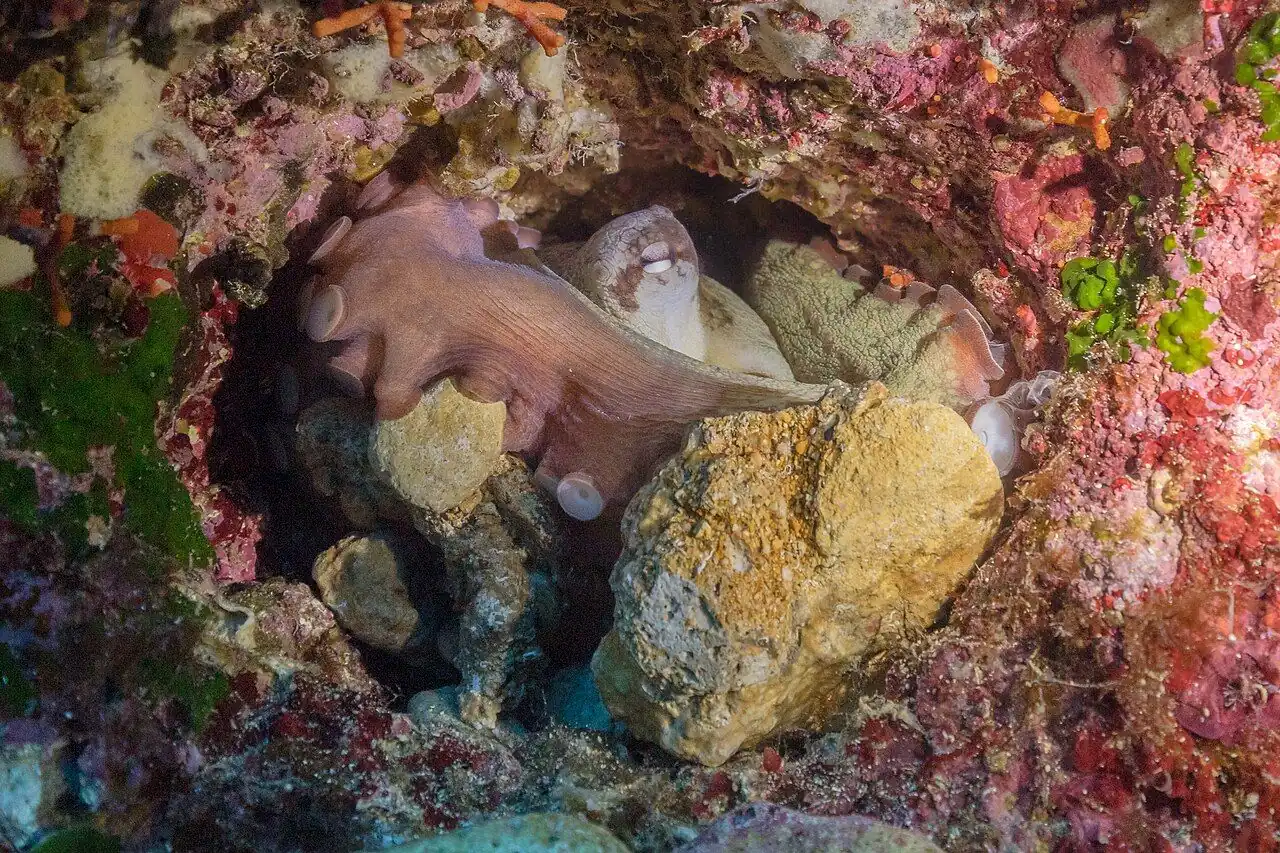
Up close, a giant Pacific octopus is usually reddish-pink with a fine, veinlike pattern, fading to white under the arms. Pigment cells let it shift from pale gray to dark red, and it can change the texture of its skin too. It is the largest octopus species. Most adults weigh 10 to 50 kilograms (22 to 110 pounds), and the Alaska Department of Fish and Game notes one of 71 kilograms (156 pounds) recorded by Canadian researchers. Stretched tip to tip, the arms can span up to about 4.9 meters (16 feet).
It lives around the rim of the North Pacific, from Baja California north to Alaska and the Aleutians and west to Japan and Korea, in water of 16°C (60°F) or colder. It ranges from the intertidal zone to at least 100 meters (328 feet) in the north and down to 1,500 meters (4,921 feet) in the south. It shelters in rocky dens.
It eats crabs, clams, scallops, shrimp, lobsters and fish, taking prey by surprise and carrying it home. There it pulls a shell apart, bites it open with its beak, or drills it: saliva softens the shell, a rough tongue called a radula scrapes a tiny hole, and a toxin goes in that paralyzes the prey. Empty shells pile up outside, and divers find dens by these middens.
For a time, recreational divers knew more about this animal than scientists did, William High of NOAA's Northwest Fisheries Center wrote in a 1976 review. By 1956, hundreds of them were gathering in Puget Sound, Washington, for an Octopus Wrestling Championship of the World. High also described how an engineer, Bruce Edney, made 39 dives over nine months to watch one brooding female. Her eggs, apparently laid in May, hung in strings from the cave roof. She stayed with them until they hatched in November, and in January she was found dead.
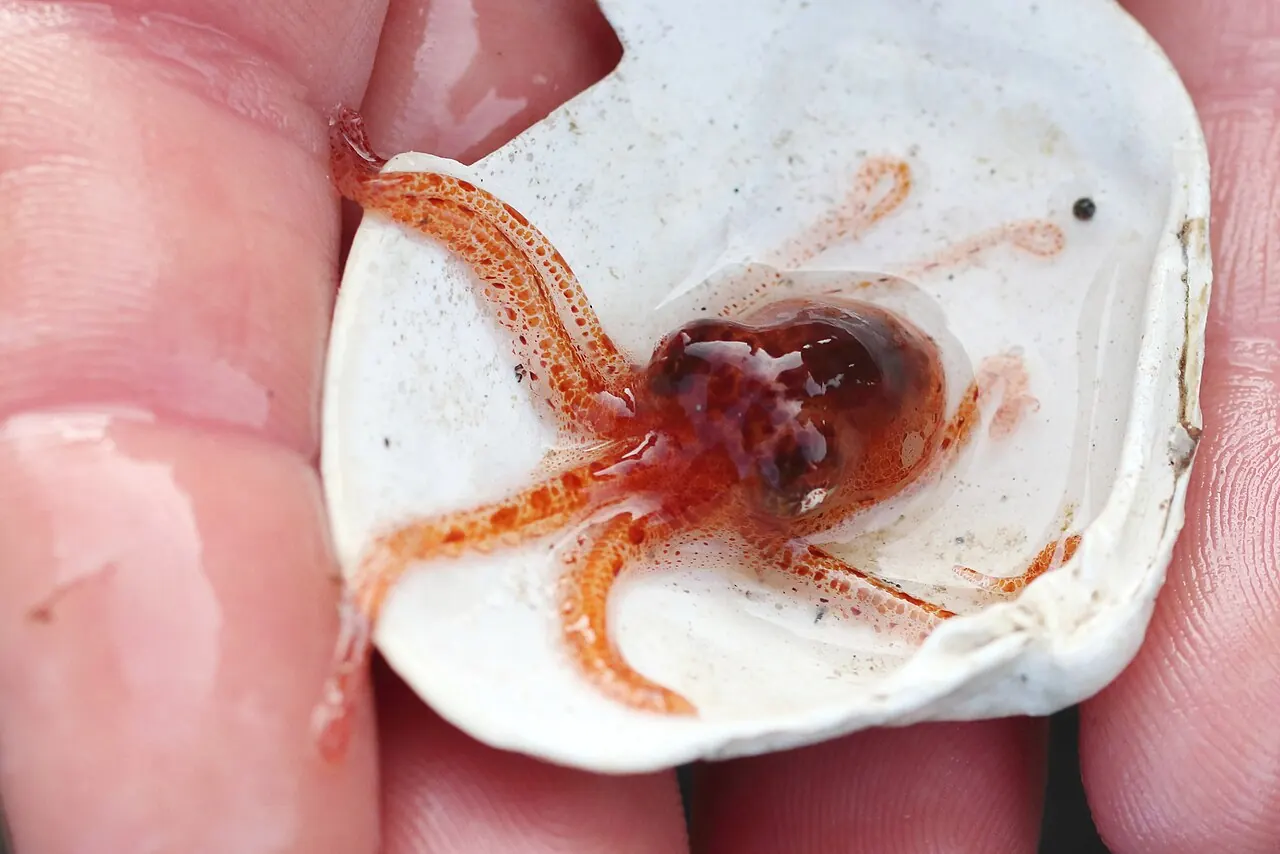
About 40 days after mating, a female lays up to 100,000 eggs and then cleans and guards them for up to six months without eating; the male dies a few weeks after mating. Hatchlings the size of a grain of rice drift as plankton before settling on the seafloor, and the whole life lasts about three to five years. The IUCN lists the species as Least Concern, though nobody has a population estimate, and demand for it as food and halibut bait has raised the catch.



