Twilight Zone · 200–1,000 m
The 'Extinct' Fish Found in 1938 May Live to Be 100
Known only from fossils until a curator spotted one in a South African catch, the coelacanth lives five times longer than thought, a 2021 study says.
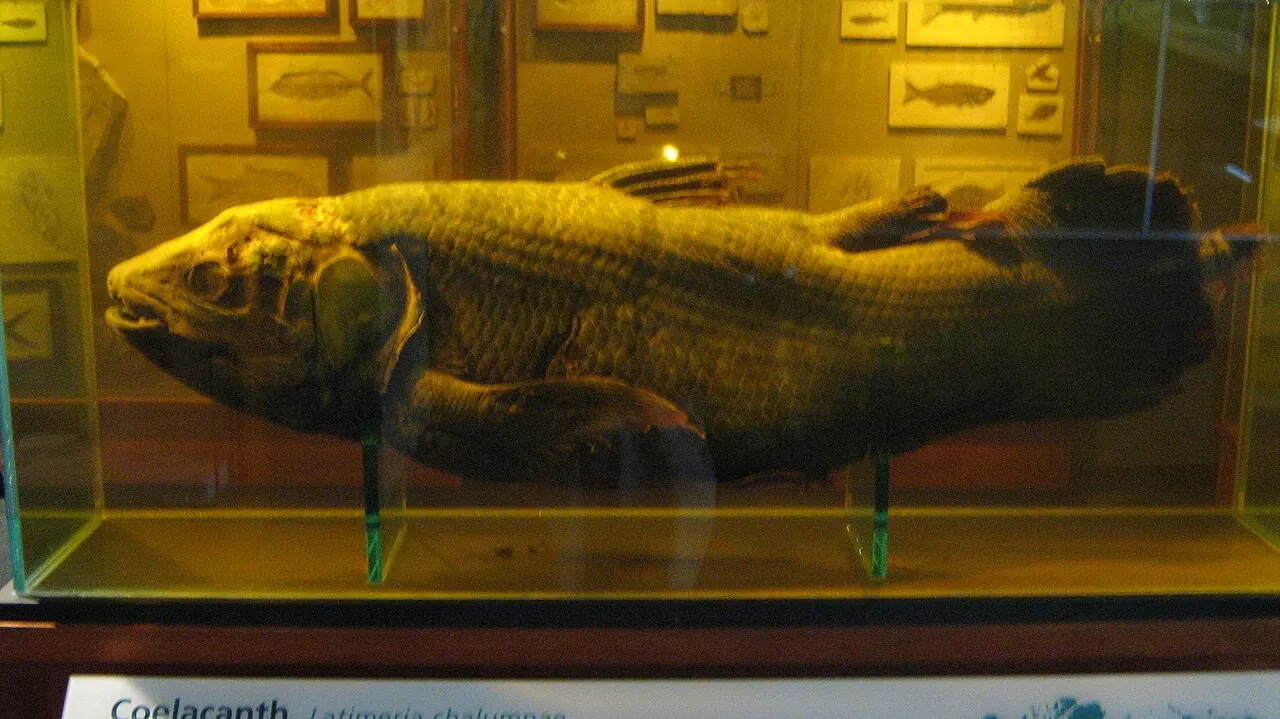
Latimeria chalumnae
A lobe-finned fish known only from fossils until 1938, which drifts through deep water at night and may live about 100 years.
Photo: David Starner / CC BY 3.0
Thick, fleshy lobed fins mark the coelacanth, a living member of a group once known only from fossils. In life it is dark metallic blue with irregular white spots, which fade to brownish black after death, and the spot pattern is distinct enough that researchers in submersibles have used it to recognize individual fish. Females grow to about 2 meters (6.6 feet).
Coelacanths appear in the fossil record almost 400 million years ago and seemed to vanish about 80 million years ago, so a live one caught off South Africa in 1938 caused a sensation. The species' main home turned out to be the Comoros in the western Indian Ocean, where about 200 have been caught, with a few more off Madagascar, Mozambique and South Africa. Coelacanths found off Sulawesi, Indonesia, in 1997 and 1998 were later named a separate species.
Off the Comoros, coelacanths live on steep, rocky lava slopes, usually 180 to 250 meters (590 to 820 feet) down. Hans Fricke's submersible dives found them between about 120 and 400 meters, and FishBase gives a depth range reaching 700 meters. By day they shelter in caves, as many as 14 to a cave. After sunset they drift slowly over the bottom looking for fish and squid, traveling up to 8 kilometers (5 miles) in a night. When a coelacanth swims slowly, its paired fins move in an alternating pattern like the legs of a walking four-legged animal, yet it does not walk on the bottom.
Coelacanths give birth to live young. A 98-kilogram (216-pound) female caught off Mozambique in 1991 carried 26 nearly full-term pups, and newborns are probably about 35 to 38 centimeters (14 to 15 inches) long. A 2021 study of growth rings on the scales of 27 fish, led by Kélig Mahé, concluded that the species probably lives around 100 years, matures between 40 and 69 years old and carries its young for around five years, which may be the longest pregnancy of any fish.
The IUCN lists the coelacanth as Critically Endangered. Mahé's team warned that an animal that breeds this late and this slowly may be even more threatened than thought.



