Sunlight Zone · 0–200 m
A Blue Whale's Heart Can Slow to Two Beats a Minute
Scientists stuck a sensor on the largest animal that has ever lived and listened to its heart for eight and a half hours.
Balaenoptera musculus
The largest animal known to have ever lived, fueled almost entirely by krill, tiny shrimp-like animals it filters from the sea.
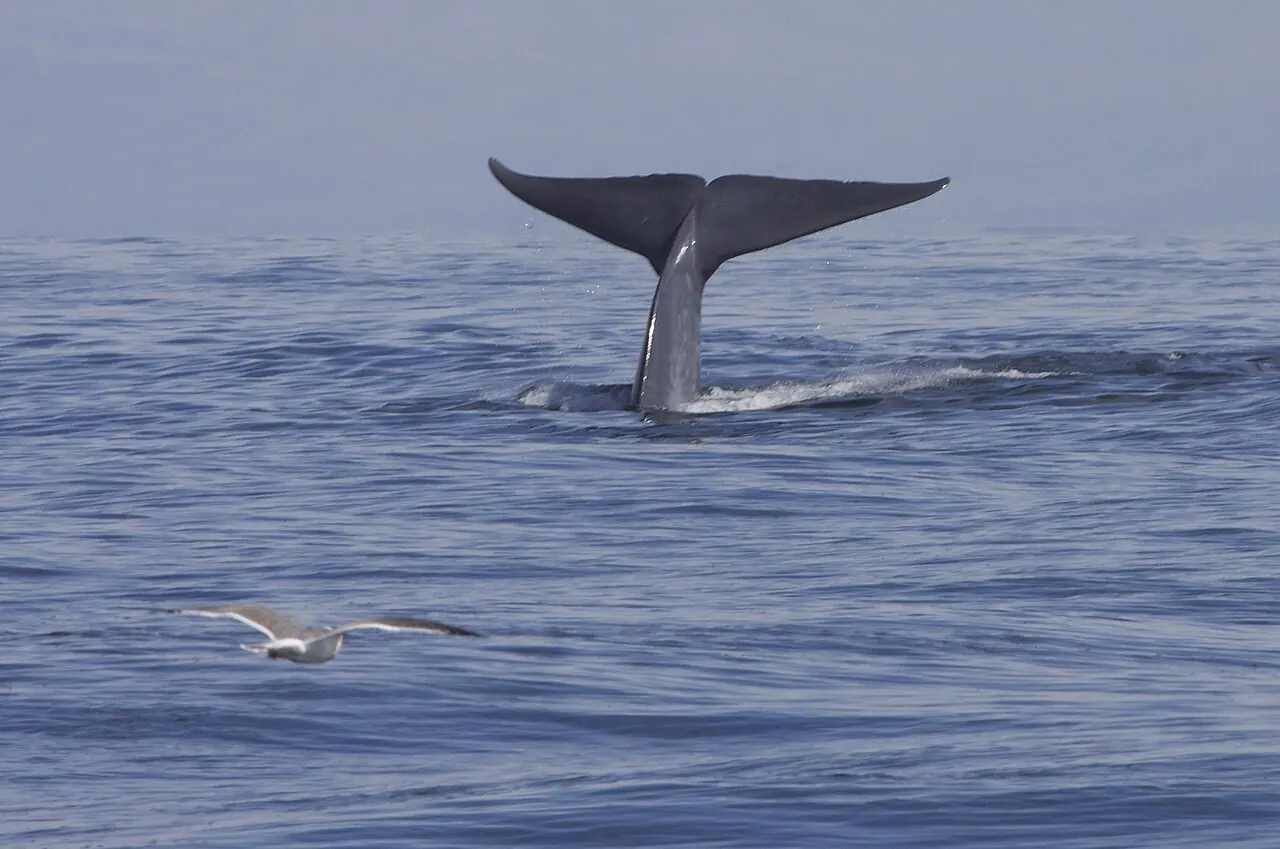
Photo: Gregory "Slobirdr" Smith / CC BY-SA 2.0
A blue whale's long, slender body is mottled blue-gray and looks light blue under water, which is how it got its name. The mottling differs from whale to whale, so researchers use it to identify individuals. Size depends on the ocean. In the North Atlantic and North Pacific, NOAA Fisheries puts adults at up to about 27 meters (90 feet) and over 45 metric tons (100,000 pounds). Antarctic blue whales reach about 33.5 meters (110 feet) and more than 150 metric tons (330,000 pounds), and females are generally larger than males.
Blue whales eat almost nothing but krill, and they go where the krill gather. A feeding whale swims at a swarm with its mouth open, inflating the pleated skin of its throat, then closes its mouth and uses its tongue to push the water out through its baleen plates, which keep the krill inside. Off Southern California, video tags placed by John Calambokidis and colleagues between 1999 and 2003 showed whales feeding consistently at 250 to 300 meters (820 to 980 feet), deeper than had been reported for the species.
Those dives are hard work for the heart. In a 2019 study, Jeremy Goldbogen's team recorded a tagged blue whale on dives as deep as 184 meters: underwater its heart usually beat 4 to 8 times a minute and sometimes only twice, then raced to 25 to 37 beats a minute at the surface.
NOAA gives a pregnancy of about 10 to 12 months, a calf every 2 to 3 years, and maturity somewhere between 5 and 15 years. Ages come from counting layers in the waxy earplugs of dead whales, and lifespan is estimated at 80 to 90 years. Its pulses, groans and moans are among the loudest sounds any animal makes.
Whaling took an enormous toll: according to London's Natural History Museum, more than 340,000 blue whales were killed in the first half of the 20th century, and the species got complete protection from commercial whaling only in 1966. The IUCN's 2018 assessment lists it as Endangered, with an estimated 5,000 to 15,000 mature animals, and the IUCN rates the Antarctic subspecies Critically Endangered. NOAA reports that numbers are increasing globally. Today's main threats are ship strikes and fishing gear, and off the US West Coast, NOAA's WhaleWatch project predicts where blue whales are likely to be so that those risks can be reduced.



