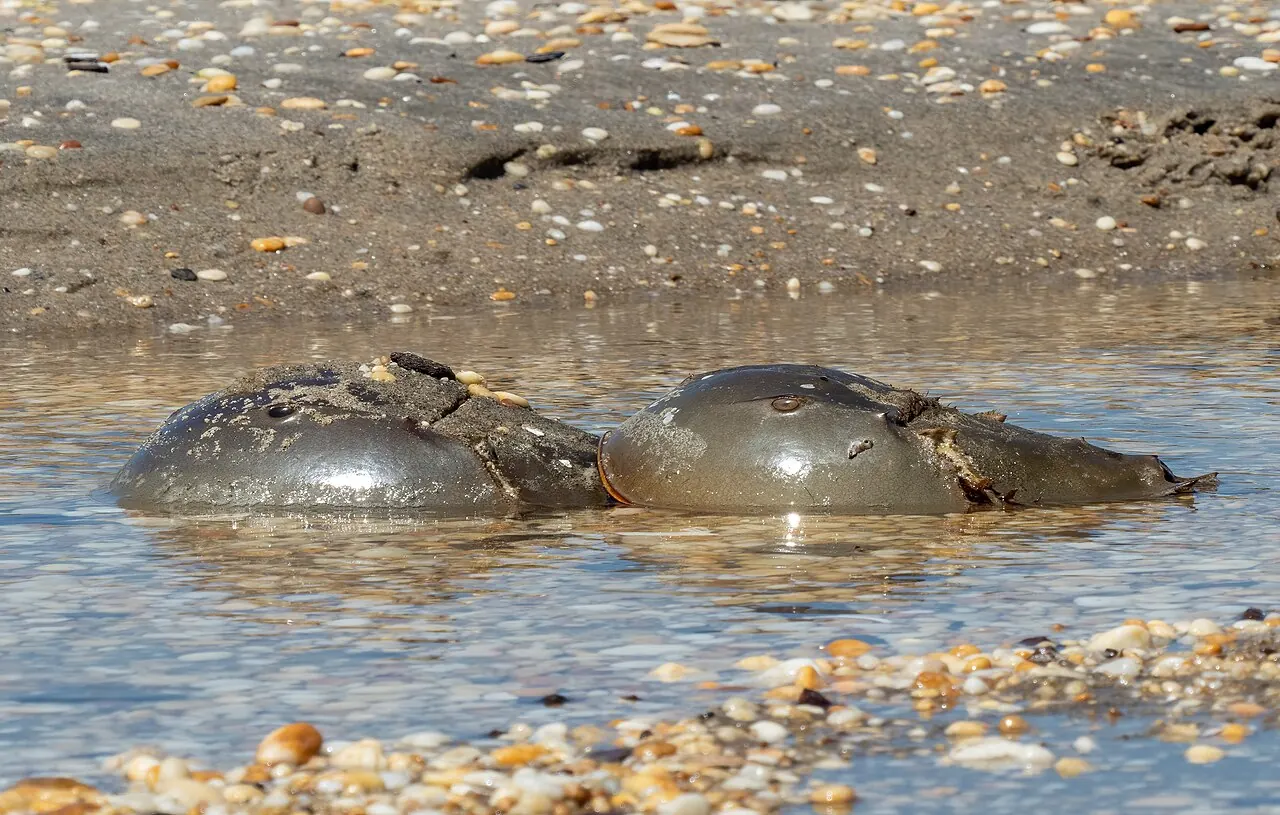
It is more closely related to spiders and scorpions than to crabs.
Delaware Bay hosts the largest spawning population in the world.
A female can lay about 90,000 eggs or more in a year.
Scientific name
Limulus polyphemus
Depth
0 m – 290 m 0 – 951 ft
Size
Largest females about 30 cm (12 in) across the front of the shell and about 60 cm (24 in) long with the tail; males 25 to 30% smaller
Weight
Up to about 1.8 kg (4 lb)
Lifespan
More than 20 years
Diet
Worms, small mollusks and algae dug from sand and mud
Where
Atlantic coast of North America from Maine to Florida, and the eastern Gulf of Mexico to the Yucatan Peninsula
IUCN status
Vulnerable
Depth zones
Sunlight · Twilight
Despite the name, the Atlantic horseshoe crab is more closely related to scorpions and spiders than to crabs. Most of what you see is a broad shell shaped like a horseshoe, with a stiff, spike-like tail behind it. The largest females, on the Georgia coast, reach about 30 centimeters (12 inches) across the front of the shell and roughly 60 centimeters (2 feet) including the tail, and males are 25 to 30 percent smaller. The group has survived nearly unchanged for an estimated 200 million years.
It lives along the Atlantic coast from Maine to Florida and around the eastern Gulf of Mexico to Mexico's Yucatan Peninsula. Adults spend the winter in estuaries or out on the continental shelf, and have been recorded as deep as 290 meters (950 feet). They feed mostly at night, digging in sand and mud for worms, small mollusks and algae, and they chew by passing food back to the bristly bases of their legs.
In spring they move onto sheltered beaches to spawn, most heavily on high tides around the full and new moons, and more at night. Delaware Bay supports the largest spawning population in the world. A female buries her eggs in clusters along the beach, around 90,000 a year by the Atlantic States Marine Fisheries Commission's estimate, and those eggs fuel hundreds of thousands of migrating shorebirds. Young crabs spend their first two years close to shore, molting as they grow, and adults can live more than 20 years.
People take them in large numbers. Crabs are used as bait in eel and whelk fisheries, and their light blue blood is the source of a test that drug and medical-device makers rely on to detect bacterial toxins. Crabs are caught, partly bled and returned, and the number delivered to US bleeding facilities rose from 343,126 in 2004 to 611,827 in 2012, according to a 2018 review. The IUCN lists the species as Vulnerable, in a 2016 assessment that projected declines of at least 30 percent over three generations. In the US, the commission sets catch limits, including bait quotas for Delaware Bay.