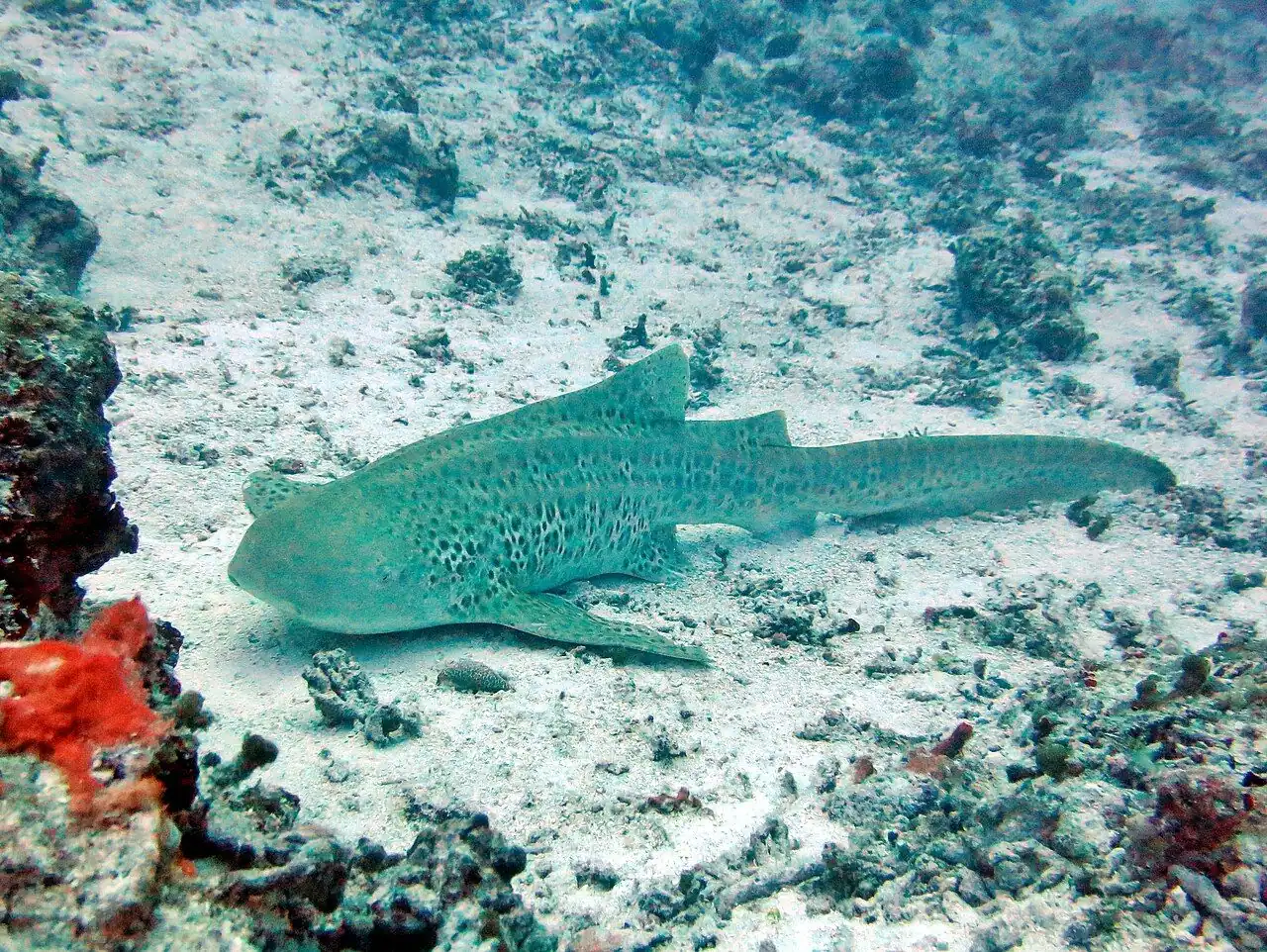
Zebra Shark
Stegostoma tigrinum
An Endangered reef shark, striped as a pup and spotted as an adult, now at the center of the first project to return aquarium-bred sharks to the wild.
Photo: Julien Bidet / CC BY-SA 4.0
3 things to know
- Pups are dark brown with pale bands, while adults are pale with dark spots, so the zebra name fits only the young.
- A captive female in Townsville, Australia, switched from mating to producing young with no father, the first such switch shown in a shark.
- An IUCN population analysis estimated that only about 20 zebra sharks were left in Indonesia's Raja Ampat islands.
- Scientific name
- Stegostoma tigrinum
- Depth
- 5 m – 30 m
16 – 98 ft - Size
- Matures at about 1.7 m (5.6 ft); possibly up to about 3.5 m (11.5 ft)
- Weight
- Not well known
- Lifespan
- Not well known
- Diet
- Mainly snails and other molluscs; also small bony fishes, crabs, shrimp and sea snakes
- Where
- Tropical Indo-West Pacific, from the Red Sea and East Africa to New Caledonia and Fiji, north to southern Japan and south to New South Wales
- IUCN status
- Endangered
- Depth zones
- Sunlight
In Australia and Britain this animal is sometimes called a leopard shark, and the IUCN Red List uses the name Indo-Pacific leopard shark, because adults are beige to yellow and covered in dark spots. The zebra name comes from the young: hatchlings are dark brown with cream bands, and the stripes break up into spots as the shark grows. Its tail makes up about half its length, and ridges run along its back. Adults mature at about 1.7 meters (5.6 feet) and may reach about 3.5 meters (11.5 feet). Older books call it Stegostoma fasciatum. It is not California's leopard shark.
Zebra sharks live on sand, rubble and coral bottoms across the tropical Indo-West Pacific, from the Red Sea and East Africa to Fiji, north to southern Japan and south to New South Wales. They are usually found 5 to 30 meters (16 to 98 feet) down and have been recorded to 90 meters (295 feet). Sluggish by day, they probably feed at night, squirming into reef cracks after snails and other molluscs, small fish, crabs, shrimp and even sea snakes. Females lay large, dark egg cases, and the young hatch at 20 to 26 centimeters (8 to 10 inches).
A wild-caught female at Reef HQ Aquarium in Townsville, Australia, had young with a male for several years, until he was moved out for good after mating in 2012. She kept laying eggs, and three pups hatched between February and April 2016. DNA tests by Christine Dudgeon and colleagues, published in 2017, showed the pups had no father, the first demonstrated switch from sexual to virgin reproduction in a shark. Her daughter, which had never mated, produced a pup the same way.
Fishing for meat, fins and livers has taken a heavy toll, and the IUCN's 2023 assessment lists the species as Endangered with a falling population. In Indonesia's Raja Ampat islands, more than 15,000 hours of in-water surveys by Conservation International from 2001 to 2021 found only three zebra sharks. The StAR project, launched in Raja Ampat in November 2022, ships eggs laid by aquarium sharks to hatcheries there, where the pups are raised and released into protected reefs. Eggs have come from SEA LIFE Sydney and from the Shark Reef Aquarium in Las Vegas, and Atlanta's Georgia Aquarium reports that the project released 50 pups in 2025.
Sources
- fishbase.se/summary/Stegostoma-tigrinum.html
- iucnredlist.org/species/41878/124425292
- Study: doi:10.1038/srep40537
- pmc.ncbi.nlm.nih.gov/articles/PMC5238396
- conservation.org/press/global-collaboration-star-to-re-establish-once-abundant-zebra-sh…
- news.mongabay.com/2024/04/rewilding-program-ships-eggs-around-the-world-to-restore-raja…
- georgiaaquarium.org/resource-center/stories/star-project-from-egg-to-ocean



