Yellowhead Jawfish
Opistognathus aurifrons
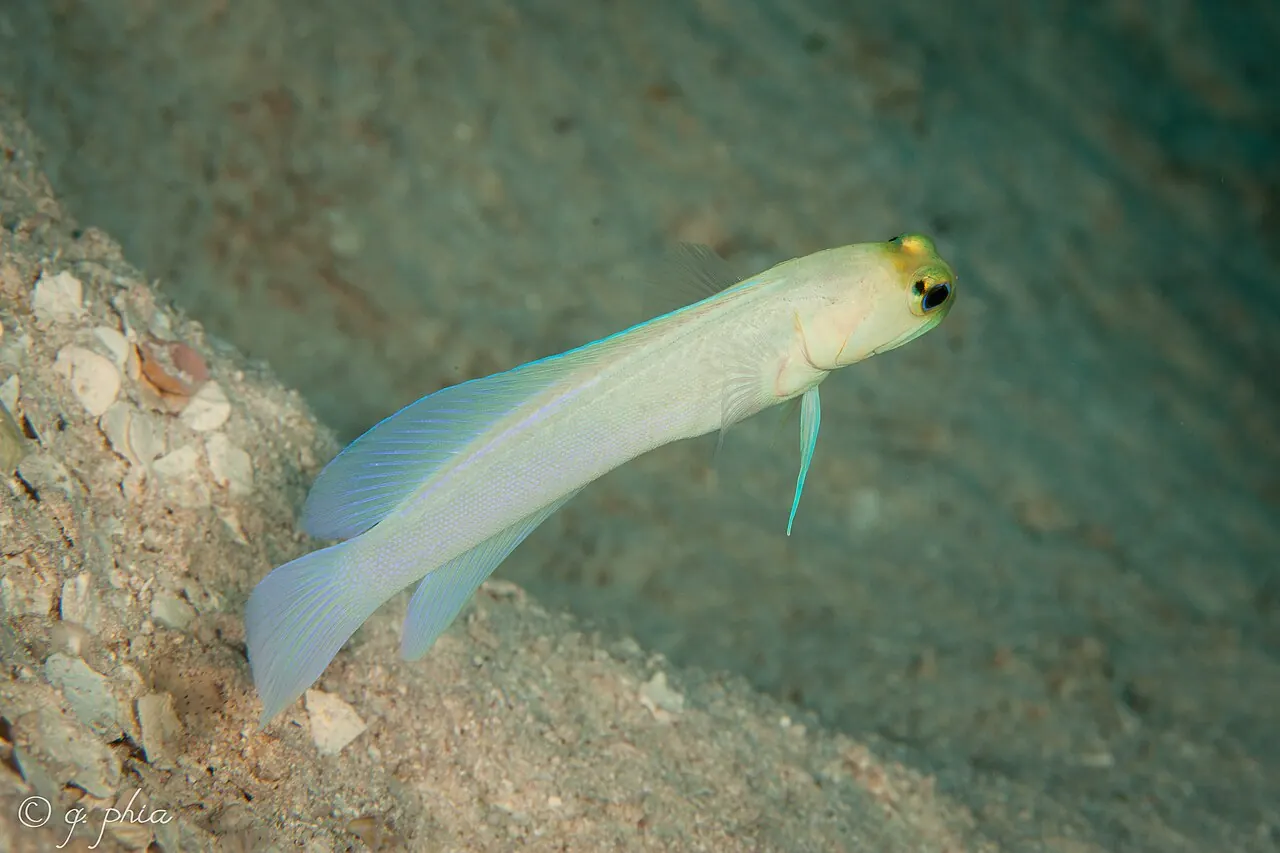
A pale Caribbean jawfish that hovers over its sand burrow by day, closes the door with a stone at night, and broods eggs in the male's mouth.
Photo: q phia / CC BY 2.0
3 things to know
- Each evening it pulls a small stone or shell over its burrow entrance.
- The male carries the eggs in his mouth.
- Stomachs of Virgin Islands fish held 85 percent copepods.
- Scientific name
- Opistognathus aurifrons
- Depth
- 3 m – 40 m
10 – 131 ft - Size
- Up to about 10 cm (4 in) long
- Weight
- Not well known
- Lifespan
- Unknown
- Diet
- Zooplankton, mostly copepods, snapped up while hovering above the burrow
- Where
- Western central Atlantic, from southern Florida and the Bahamas to Barbados and northern South America
- IUCN status
- Least Concern
- Depth zones
- Sunlight
For most of the day a yellowhead jawfish hangs upright in the water a short way above a hole in the sand, and at the first sign of danger it darts back into the hole. Its body is pale bluish gray dotted with pale blue, while the head, nape and front of the dorsal fin are yellow, and many fish have a pair of black spots on the chin. It grows to about 10 centimeters (4 inches).
It lives from southern Florida and the Bahamas to Barbados and northern South America, in colonies on patches of coral sand and rubble near reefs, usually 3 to 40 meters (10 to 130 feet) deep. The species was first described from a specimen collected at the Dry Tortugas, Florida.
The burrow is built and kept up with the mouth. A jawfish scoops sand inside the burrow and spits it out near the rim, and it moves small stones and shells. In a study published in the early 1970s, Patrick Colin of the University of Miami watched jawfish at Bimini, in the Bahamas, for 25 days through an underwater television system. In the evening each fish backed into its burrow, picked up a small stone or shell in its jaws on the way down and let it fall over the opening. In the morning it pushed the cover away, from about 10 minutes before sunrise to a few minutes after, earlier on clear days. Closing times ranged from 92 minutes before sunset to six minutes after, and when crowds of foraging wrasses and goatfish moved through, a jawfish often ducked inside and covered up early. Colin's night dives on colonies along the Florida reef tract found no activity after dark.
From its hover the jawfish snaps plankton out of the water. Randall examined the stomachs of 16 fish from the Virgin Islands and found 85 percent copepods, plus shrimp larvae and smaller amounts of fish eggs and other prey. Pairs are monogamous, and a male courts a female by swimming in an arched posture with his fins spread toward her. The eggs, clumped in a sticky ball, are brooded in the male's mouth.
The species is collected for the aquarium trade and has been reared in captivity. The IUCN lists it as Least Concern, from a 2012 assessment.



