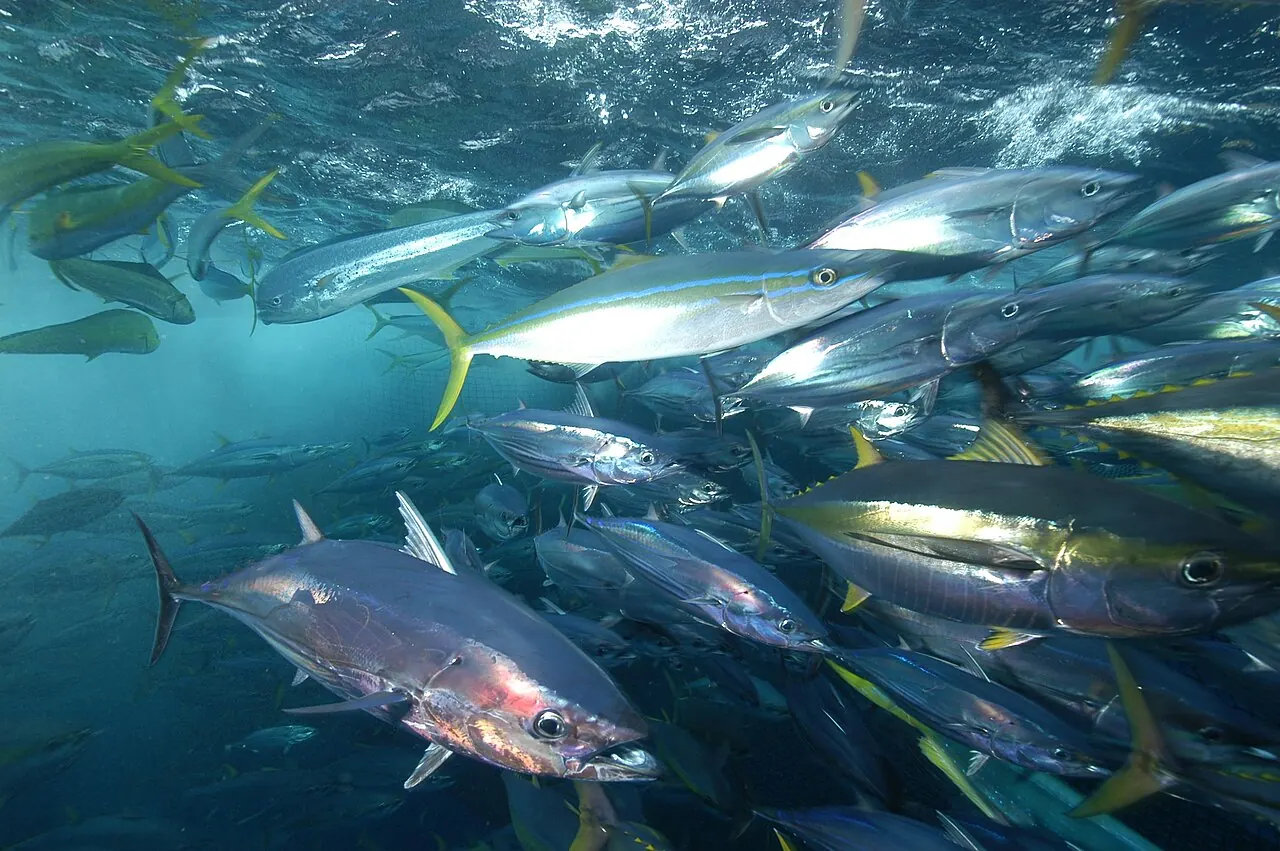
Yellowfin Tuna
Thunnus albacares
A fast-growing tropical tuna with long yellow fins, whose habit of swimming under dolphins shaped US law and the dolphin-safe label.
Photo: Marc Taquet / Ifremer / CC BY 4.0
3 things to know
- In large fish, the second dorsal and anal fins can grow longer than a fifth of the body.
- A female can spawn about every three days and release millions of eggs each time.
- In the eastern tropical Pacific, large yellowfin often swim with schools of dolphins.
- Scientific name
- Thunnus albacares
- Depth
- 0 m – 250 m
0 – 820 ft - Size
- Commonly about 1.5 m (5 ft); up to about 1.8 to 2.4 m (6 to 7.8 ft) long
- Weight
- Up to about 180 to 200 kg (400 to 440 lb)
- Lifespan
- Usually about 6 to 7 years; the oldest reported was 18
- Diet
- Fish, squid and crustaceans
- Where
- Tropical and subtropical seas worldwide, but not the Mediterranean
- IUCN status
- Least Concern
- Depth zones
- Sunlight · Twilight
Yellow marks this tuna wherever you look: a yellow stripe down the side, bright yellow dorsal and anal fins, and yellow finlets edged in black running to the tail. The back is metallic dark blue, and the silvery belly is often crossed by about 20 broken, nearly vertical lines. In big fish the second dorsal and anal fins sweep back into long sickles, sometimes more than a fifth of the fish's length. Also known as ahi, yellowfin are slimmer than bluefin and grow fast, to about 1.8 meters (6 feet) and 180 kilograms (400 pounds) according to NOAA. FishBase lists fish up to 2.4 meters and 200 kilograms.
They live in tropical and subtropical seas around the world, though not in the Mediterranean, and favor water between 64 and 88°F (18 to 31°C). Young fish stay in surface waters while older fish go deeper, but yellowfin are sensitive to low oxygen and are rarely caught below about 250 meters (820 feet) in the tropics. They eat fish, squid and crustaceans. Most can breed by age 2 or 3, and in the Atlantic a female spawns about every three days in season, releasing 1 million to 4 million eggs each time. NOAA puts the usual lifespan at 6 to 7 years, though FishBase lists one fish aged 18.
Yellowfin gather around drifting debris, buoys and other floating objects, and in the eastern tropical Pacific, large ones swim beneath schools of dolphins. Purse-seine crews learned to find the tuna by setting their nets around the dolphins. A 2021 review led by Lisa Ballance of Oregon State University records an estimated 550,000 dolphins killed in 1961 alone. By 1993, eastern spinner dolphins were estimated at 44% and northeastern offshore spotted dolphins at 19% of their pre-fishery numbers.
The response ran through US law: the Marine Mammal Protection Act in 1972, then the Dolphin Protection Consumer Information Act in 1990, which set the rules for labeling tuna dolphin-safe. Release methods, such as backing the net down so dolphins spill over the top, plus observers on large boats, cut recorded entanglement deaths by more than 99%. The review's authors note that whether those dolphin populations have recovered is still unclear.
The IUCN moved the yellowfin from Near Threatened to Least Concern in 2021, while noting it is still overfished in the Indian Ocean.
Sources
- fisheries.noaa.gov/species/pacific-yellowfin-tuna
- fisheries.noaa.gov/species/atlantic-yellowfin-tuna
- fishbase.se/summary/Thunnus-albacares.html
- Study: doi:10.3389/fmars.2021.754755
- fisheries.noaa.gov/national/marine-mammal-protection/dolphin-safe
- iucn.org/news/species/202109/tuna-species-recovering-despite-growing-pressures-marine-l…



