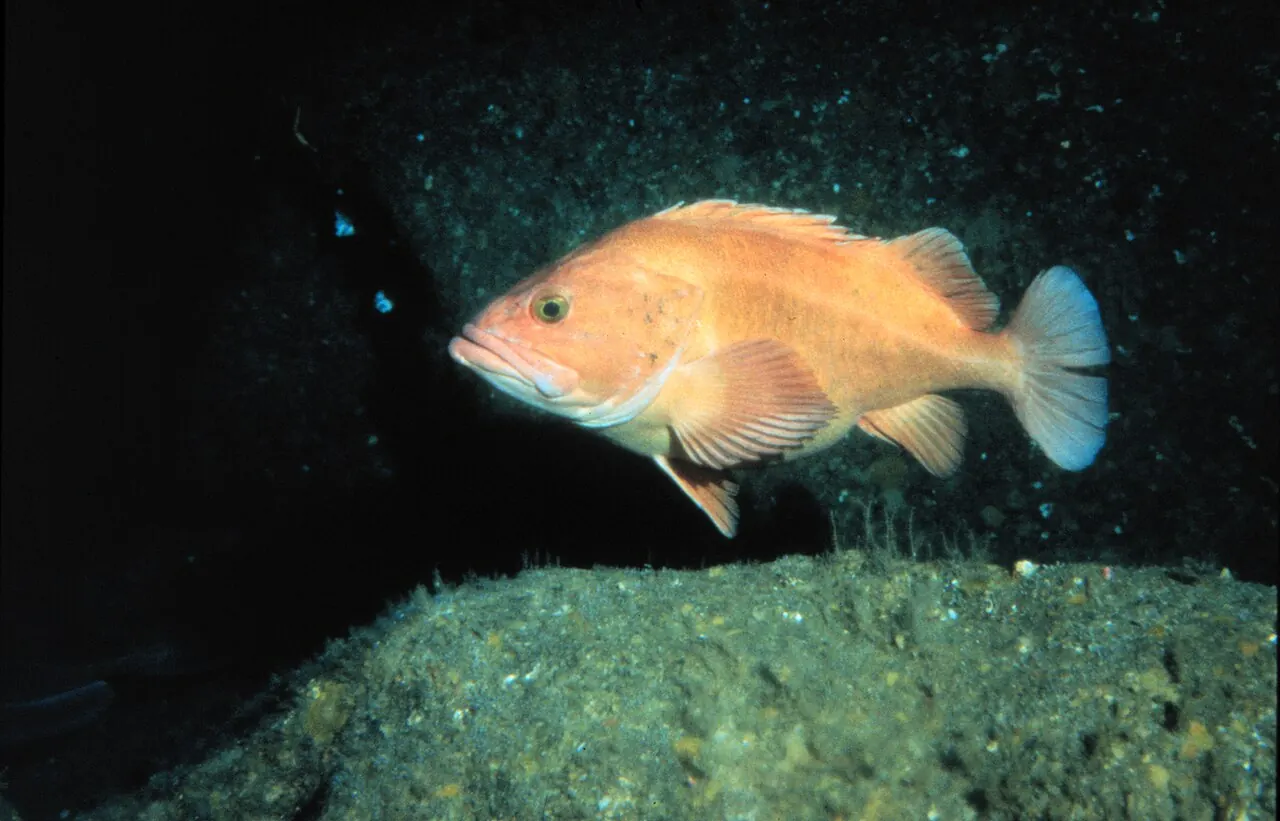
Yelloweye Rockfish
Sebastes ruberrimus
A bright orange Pacific rockfish with golden eyes that can live more than a century and gives birth to live young.
Photo: V. O'Connell, NOAA / Public domain
3 things to know
- One yelloweye rockfish from Alaska was aged at 121 years.
- Females produce up to 2.7 million eggs and give birth to live larvae.
- In 2026, NOAA declared the US West Coast stock rebuilt, 24 years after it was declared overfished.
- Scientific name
- Sebastes ruberrimus
- Depth
- 91 m – 183 m
299 – 600 ft - Size
- Up to about 91 cm (36 in); FishBase lists 104 cm (41 in)
- Weight
- FishBase lists a maximum of 17.8 kg (39 lb)
- Lifespan
- Well over 100 years; one Alaska fish was aged at 121, and NOAA cites reported maximums of up to 150
- Diet
- Other rockfish, sand lance, herring, flatfish and crustaceans
- Where
- Eastern North Pacific, from the Aleutian Islands and Gulf of Alaska to northern Baja California, Mexico
- IUCN status
- Not Evaluated
- Depth zones
- Sunlight
The eye gives this one away. A yelloweye rockfish is orange-yellow to orange-red all over, with a bright yellow iris, a pale stripe along the lateral line and fins often tipped in black. Big adults grow a rough, raspy ridge on the head. Young fish look different, darker red-orange with two white stripes along the body. At up to about 91 centimeters (36 inches), it is one of the largest rockfishes, and Alaska's biologists say it is often called red snapper, though it is not the red snapper of the Gulf of Mexico.
Yelloweye live from the Aleutian Islands to northern Baja California. The Alaska Department of Fish and Game says they are most common between about 90 and 180 meters (300 and 600 feet), around steep rocky slopes full of crevices, and have been found from 15 to 550 meters (48 to 1,800 feet). Adults are often solitary, rarely stray far from shelter, and some spend their whole adult life on a single rock pile. They eat other rockfish, sand lance, herring, flatfish and crustaceans.
They are among the longest-lived rockfishes. Alaska biologists aged one fish at 121 years, and NOAA Fisheries says reported maximum ages reach 150. In Southeast Alaska males mature at around 18 and females at around 22. Fertilization is internal. A female produces up to 2.7 million eggs and gives birth to live larvae, which drift with the currents before settling on the bottom.
That slow pace made them easy to overfish. NOAA declared the West Coast stock overfished in 2002, and in 2010 the population in Puget Sound and the Georgia Basin was listed as threatened under the Endangered Species Act. Yelloweye have no vent on the swim bladder, so fish pulled up from depth often suffer bulging eyes and a stomach pushed out of the mouth, and many released fish die. NOAA has handed out descending devices, which return rockfish to depth, to recreational anglers around Puget Sound, and Alaska has tested them too.
A 2025 assessment put the West Coast stock at 40.1 percent of its unfished level, and according to the Federal Register, NOAA Fisheries formally changed its status from overfished to rebuilt on May 19, 2026. The Puget Sound and Georgia Basin population is still listed as threatened. The IUCN has not assessed the species.



