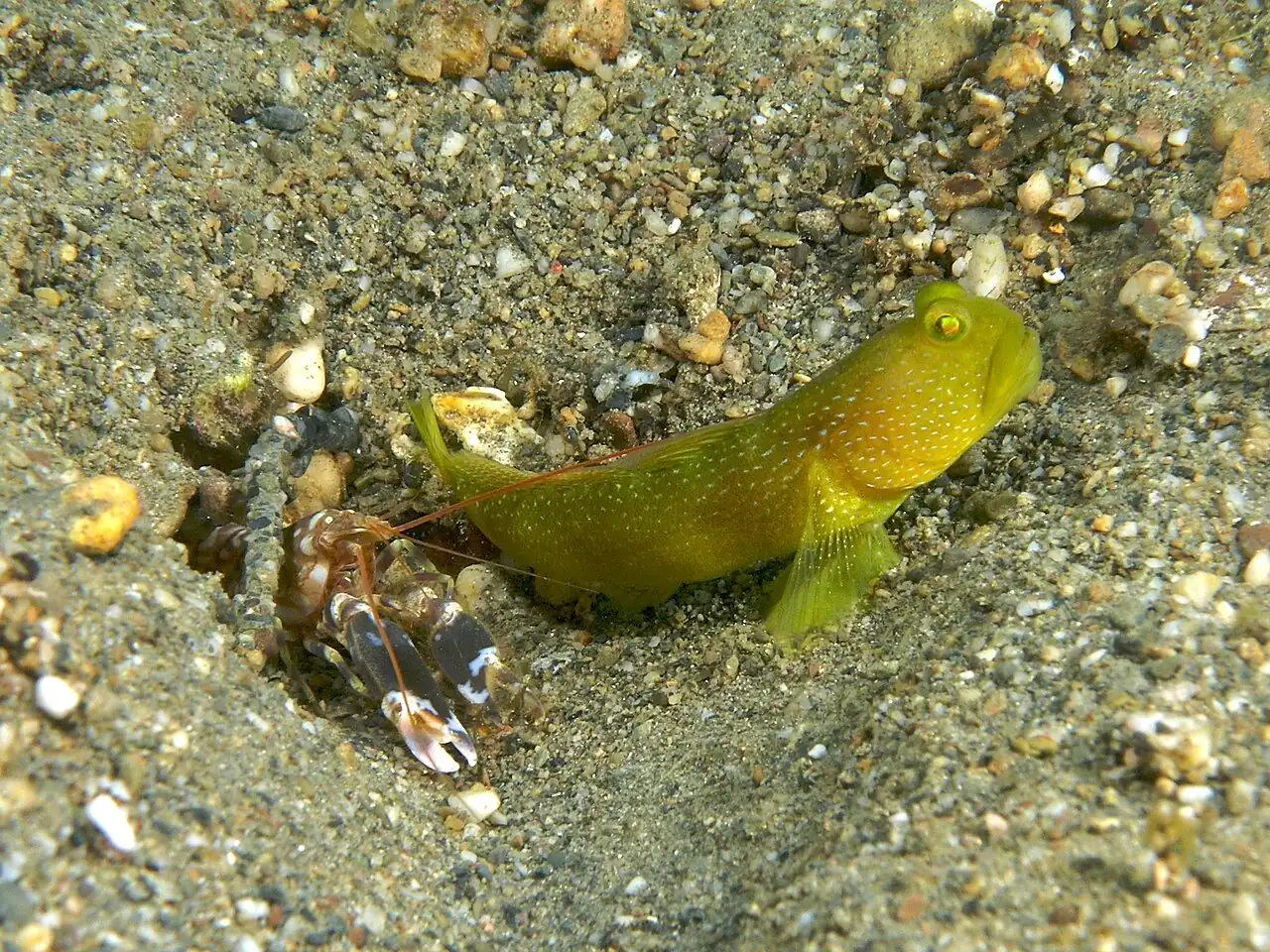
Yellow Watchman Goby
Cryptocentrus cinctus
A sand-dwelling goby that stands guard at a burrow dug by a near-blind snapping shrimp, warning it of danger by touch.
Photo: Nick Hobgood / CC BY-SA 3.0
3 things to know
- It shares its burrow with one or more snapping shrimps, which do the digging.
- A working shrimp keeps an antenna on the goby, which warns it with tail movements.
- Despite the name, the yellow form is not the most common color.
- Scientific name
- Cryptocentrus cinctus
- Depth
- 10 m – 25 m
33 – 82 ft - Size
- Up to about 10 cm (4 in) long
- Weight
- Not well known
- Lifespan
- Unknown
- Diet
- Small invertebrates such as amphipods, copepods and worms (recorded for watchman gobies as a group)
- Where
- Western Pacific, from Japan's Yaeyama Islands to Singapore and the southern Great Barrier Reef, east to Palau and Chuuk
- IUCN status
- Least Concern
- Depth zones
- Sunlight
The name fits only some of them. The yellow watchman goby comes in several color forms, from bright yellow to whitish and dark, and the Australian Museum notes that the yellow form is not the most common. Every form has four or five dusky bars, faint on yellow fish, fine pale blue or white spots on the head and front of the body, and a dark brown streak above the upper lip. It grows to about 10 centimeters (4 inches).
It lives in the western Pacific, from Japan's Yaeyama Islands to Singapore and the southern Great Barrier Reef, and east to Palau and Chuuk in Micronesia. Its home is open sand in clear coastal slopes, shallow lagoons and protected bays, usually 10 to 25 meters (33 to 82 feet) deep, though it has been found as shallow as 1 meter.
The burrow is not the goby's own work. Each goby shares a burrow with one or more alpheid snapping shrimps, which dig the tunnel and keep it open, while the goby sits at the entrance as a lookout. The shrimps see poorly and the goby sees well. Writing about shrimp gobies in general in DAN's Alert Diver, Ned and Anna DeLoach describe how a shrimp coming out to work keeps at least one antenna on the goby, usually near the tail. Warnings travel through that touch, from a slight twitch of the goby's tail to a thrashing alarm that sends both animals down the hole within tenths of a second. The Aquarium of the Pacific says that for watchman gobies in general, the whole group retreats into the burrow at night and the shrimp seal the opening.
The deal may include groceries. A 2014 note in the journal Coral Reefs put the number of goby species that associate with 13 species of Alpheus shrimps at about 120, and pointed to earlier reports that this goby carries items such as algae and bivalves into the burrow for its shrimp partners. Watchman gobies as a group feed on small invertebrates such as amphipods, copepods, bivalves and worms.
The species is collected for the aquarium trade. Its lifespan in the wild is unknown. The IUCN lists it as Least Concern, from a 2020 assessment.



