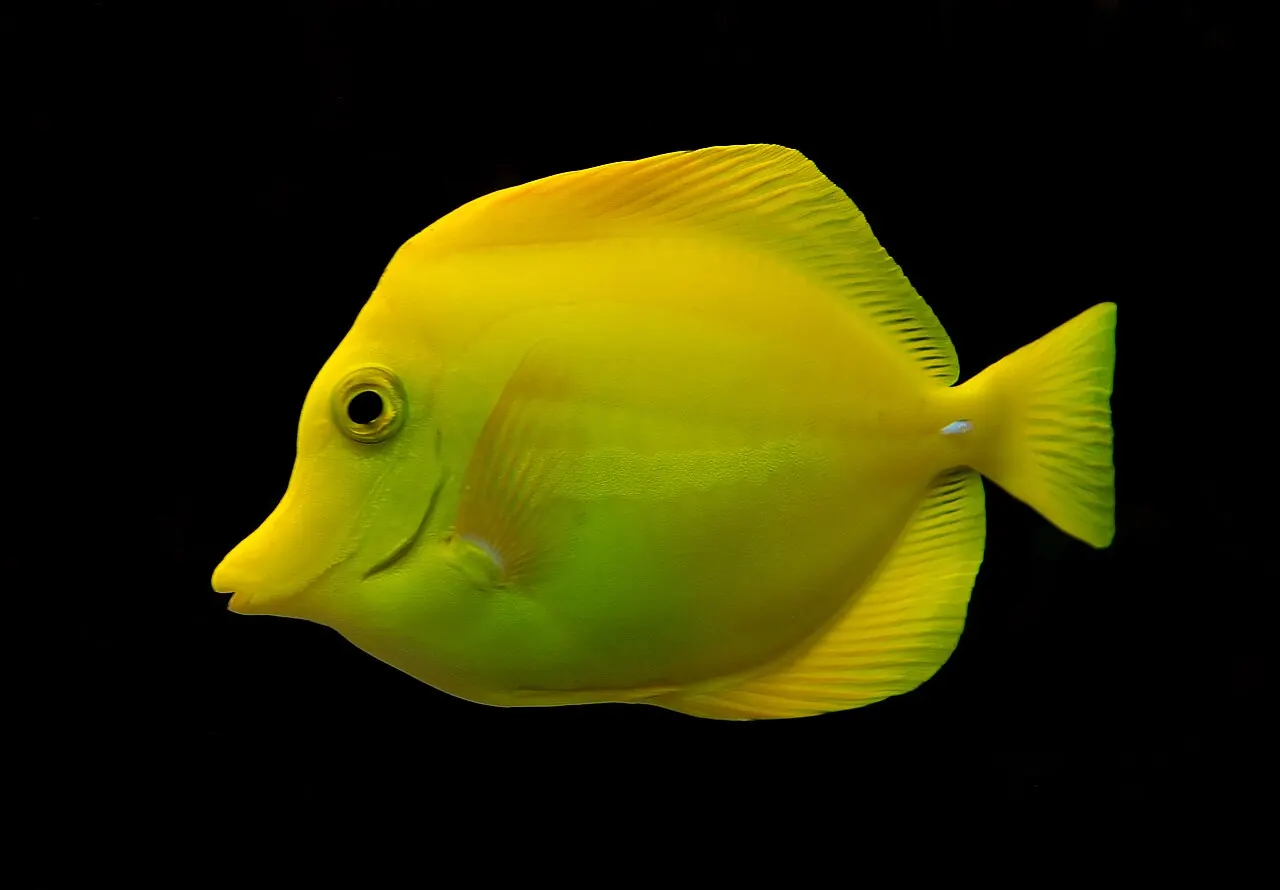
Yellow Tang
Zebrasoma flavescens
Hawaii's top aquarium fish export, a small algae-grazing surgeonfish that can live more than 40 years and was first bred in captivity in 2015.
Photo: Luc Viatour / CC BY-SA 3.0
3 things to know
- One yellow tang collected in Hawaii was 41 years old.
- It spawns around the full moon, in batches all year.
- A Hawaii team raised the first captive-bred yellow tangs in late 2015.
- Scientific name
- Zebrasoma flavescens
- Depth
- 2 m – 46 m
7 – 151 ft - Size
- Up to about 20 cm (8 in) long
- Weight
- Not well known
- Lifespan
- At least 41 years
- Diet
- Mainly filamentous algae
- Where
- Pacific: the Hawaiian, Ryukyu, Mariana, Marshall, Marcus and Wake islands
- IUCN status
- Least Concern
- Depth zones
- Sunlight
Bright yellow from its pointed snout to its tail, the yellow tang is a small, deep-bodied surgeonfish that reaches about 20 centimeters (8 inches). It lives on coral-rich lagoon and seaward reefs of the Pacific, from below the surge zone to about 46 meters (150 feet), around the Hawaiian, Ryukyu, Mariana, Marshall, Marcus and Wake islands. Alone or in loose groups, it browses filamentous algae with close-set, spatula-shaped teeth.
Spawning follows the moon. Yellow tangs spawn in batches all year, with activity concentrated around the full moon. Some spawn in groups; in other cases territorial males court females passing by and spawn with them in pairs.
Yellow tangs can live for decades. In 2009 a team led by J. T. Claisse published a study of yellow tang in Hawaii that aged fish by the growth rings in their ear stones, or otoliths. Marking otoliths with the antibiotic tetracycline showed that one ring forms each year, and the oldest fish collected was 41 years old. The study also found that young fish live in deeper, coral-rich habitat before moving to shallow reef dominated by turf algae, and that males grow faster and larger than females.
That research was part of an effort to manage Hawaii's aquarium fishery, because the yellow tang is the main coral reef fish taken in Hawaii for the aquarium trade and, according to FishBase, Hawaii's top marine fish export. The Oceanic Institute of Hawaii Pacific University says 280,000 were collected each year off the Kona coast. In September 2017 the Hawaii Supreme Court ruled that the state had to carry out environmental review before issuing aquarium collection permits, and ordered an injunction against commercial collection until it did. In August 2024 the court ruled 4 to 1 that the industry's environmental review for West Hawaii was valid, letting the state land board consider permits there. On August 28, 2026, the board rejected proposed rules that would have reopened West Hawaii under annual catch limits for five species, yellow tang among them, and as of September 2026 commercial aquarium collection was still banned in Hawaii.
Captive breeding offers another route. In late 2015 Chad Callan and his team in Hawaii raised the first captive-bred yellow tangs, and the Oceanic Institute says it is working with industry partners to bring the method to market. The IUCN lists the yellow tang as Least Concern, from a 2010 assessment.
Sources
- fishbase.se/summary/Zebrasoma-flavescens.html
- Study: doi:10.3354/meps08114
- earthjustice.org/press/2017/high-court-orders-halt-of-commercial-aquarium-fishery
- nsglc.olemiss.edu/blog/2024/sep/24/index.html
- earthjustice.org/experts/kylie-wager-cruz/the-latest-on-commercial-aquarium-collection-…
- bigislandnow.com/2026/09/01/board-of-land-and-natural-resources-rejects-proposed-rules-…
- alohastatedaily.com/2026/09/01/blnr-rejects-aquarium-fishing-rules-again
- hpu.edu/oi/yellow-tang.html
- blogs.ifas.ufl.edu/news/2016/07/20/finding-dory-ufifas-researchers-find-first-ever-meth…
- commons.wikimedia.org/wiki/File:Zebrasoma_flavescens_Luc_Viatour.jpg



