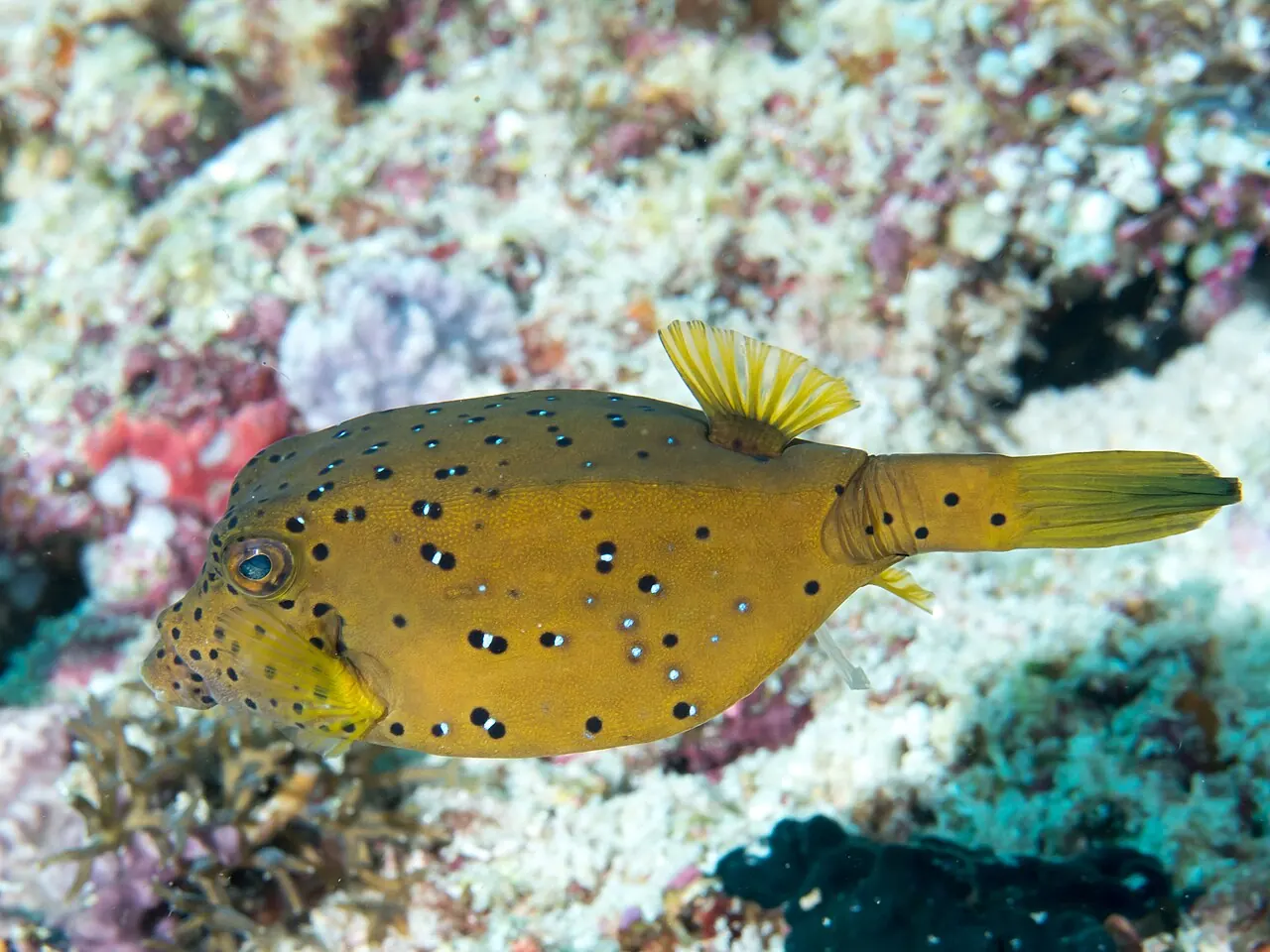
Yellow Boxfish
Ostracion cubicum
A cube-shaped reef fish sealed in bony armor, whose shape inspired a concept car and later turned out to be built for turning, not stability.
Photo: Rickard Zerpe / CC BY 2.0
3 things to know
- Its body is enclosed in a rigid box of six-sided bony plates.
- Bright yellow juveniles fade to mustard, and large adults turn bluish or purplish brown.
- A male may live with a harem of two to four females.
- Scientific name
- Ostracion cubicum
- Depth
- 1 m – 50 m
3 – 164 ft - Size
- Up to about 45 cm (18 in) long
- Weight
- Unknown
- Lifespan
- Unknown
- Diet
- Mainly algae, plus sponges, worms, crustaceans, mollusks, forams and small fishes
- Where
- Indo-Pacific from the Red Sea and East Africa to Hawaii and the Tuamotu Islands, north to the Ryukyu Islands and south to Lord Howe Island; also the south coast of South Africa
- IUCN status
- Least Concern
- Depth zones
- Sunlight
Young yellow boxfish look like small yellow dice with black spots. As they grow, the yellow fades to a dull mustard and the spots shrink, and big adults turn bluish or purplish brown with yellow seams between the plates of their armor and a bony bump above the mouth. Those six-sided plates lock together into a rigid case that is square in cross-section, which gave the species its name: cubicus is Latin for cube-shaped. (The IUCN, FishBase and the World Register of Marine Species now spell it cubicum.) Adults reach about 45 centimeters (18 inches).
It lives on lagoon and partly sheltered seaward reefs from the Red Sea and East Africa across the Indo-Pacific to Hawaii, mostly in the top 50 meters (164 feet), although FishBase has records as deep as 280 meters (920 feet). Small juveniles hide in narrow crevices and among branching Acropora corals. Adults usually swim alone, and a male may keep a harem of two to four females. Algae make up most of its diet, along with sponges, worms, crustaceans, mollusks, forams and small fishes.
In June 2005, Mercedes-Benz unveiled its Bionic concept car in Washington, D.C., with a body modeled on a boxfish, which the company called very streamlined despite its angular shape. Ten years later, Sam Van Wassenbergh and colleagues tested the idea with flow-tank measurements and computer simulations, using models built from scans of two species, including a preserved yellow boxfish from the natural history museum in Los Angeles. The boxfish shape turned out to be relatively poor at reducing drag compared with more ordinary fish shapes. Water flowing over the carapace also tended to swing the fish off course rather than steady it. The team concluded that this instability helps a boxfish turn and tilt quickly among the corals. A 2020 follow-up on the yellow boxfish found that its tail fin works as both a stabilizer and a rudder.
The yellow boxfish can also release a defensive secretion, which a 1992 study in the journal Toxicon examined in fish from the Red Sea. It is collected for the aquarium trade and taken in small fisheries. The IUCN lists it as Least Concern, from a 2023 assessment.
Sources
- fishbase.se/summary/Ostracion-cubicus.html
- fishesofaustralia.net.au/home/species/2474
- marinespecies.org/aphia.php
- Study: doi:10.2305/IUCN.UK.2024-1.RLTS.T193777A2275465.en
- Study: doi:10.1098/rsif.2014.1146
- Study: doi:10.1098/rsos.200129
- web.archive.org/web/20080604084044/http://www.daimler.com/dccom/0-5-7154-1-503502-1-0-0…
- web.archive.org/web/20080408212432/http://www.daimler.com:80/dccom/0-5-7154-1-503504-1-…
- web.archive.org/web/20131019205924/http://news.nationalgeographic.co.uk/news/2005/06/06…
- Study: doi:10.1016/0041-0101(92)90681-T
- commons.wikimedia.org/wiki/File:Yellow_boxfish_(Ostracion_cubicus)_(40814638873).jpg



