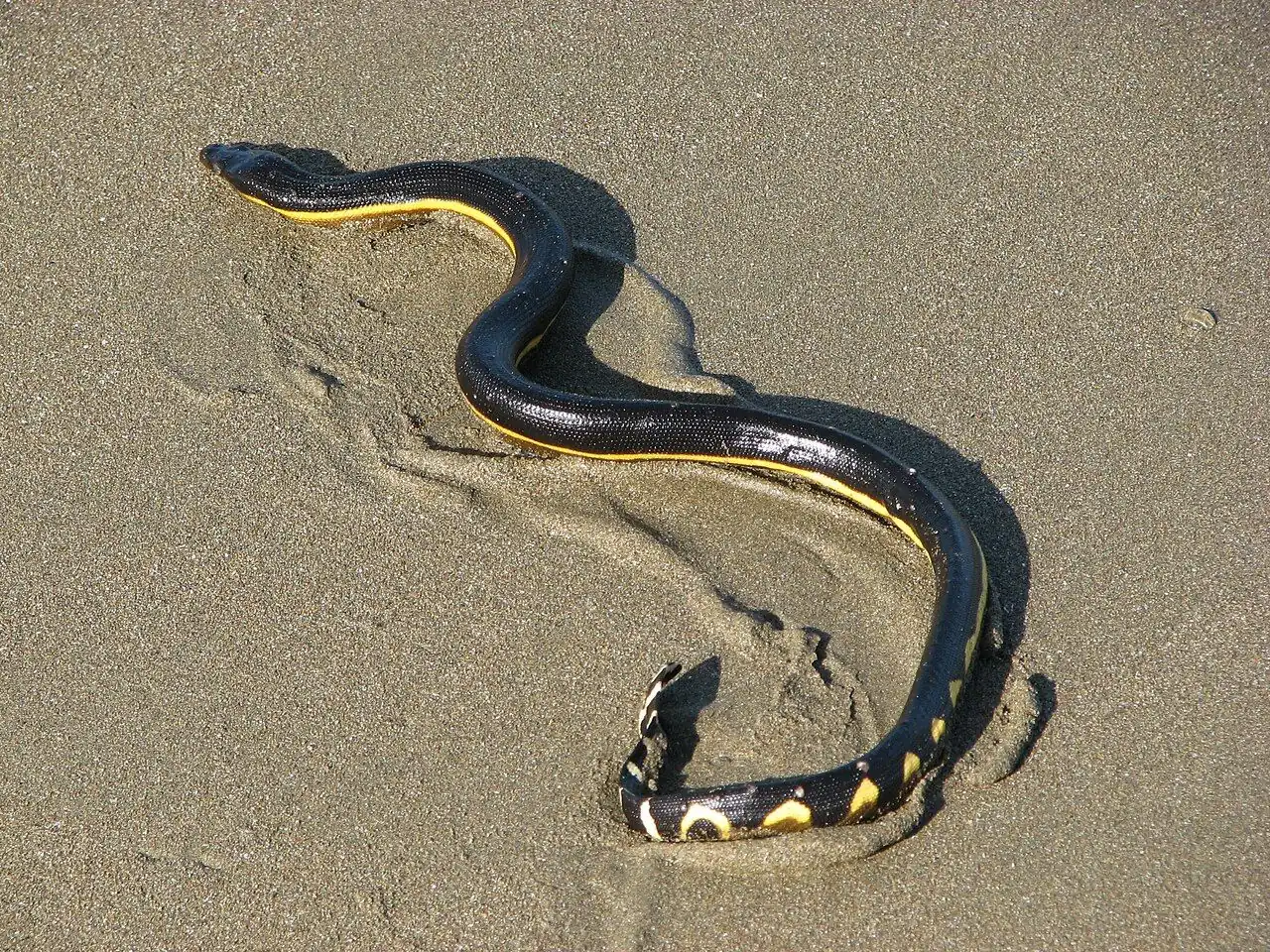
Yellow-bellied Sea Snake
Hydrophis platurus
The only sea snake that spends its whole life in the open ocean, drifting with lines of debris and drinking rainwater that floats on the sea.
Photo: Aloaiza / CC BY 3.0
3 things to know
- It is the only sea snake that has reached the Americas.
- It can swim backward to bring fish behind its head within striking range.
- Off Costa Rica, 80 percent of snakes caught at the end of the dry season drank fresh water soon after capture.
- Scientific name
- Hydrophis platurus
- Depth
- 0 m – 10 m
0 – 33 ft - Size
- Usually about 1 m (3.3 ft) long; the largest measured was 1.13 m (3.7 ft)
- Weight
- Unknown
- Lifespan
- Unknown
- Diet
- Small fish only, often ambushed as they shelter beneath the snake or floating debris
- Where
- Tropical Indian and Pacific oceans, from the coasts of eastern and southern Africa east to the Pacific coast of the Americas; strays have reached San Clemente, California
- IUCN status
- Least Concern
- Depth zones
- Sunlight
Black or dark brown on top and bright yellow underneath, with a flattened tail marked in dark spots or bars, the yellow-bellied sea snake is hard to mistake. Most are about 1 meter (3.3 feet) long. The Australian Museum calls it the most widely ranging snake in the world and the most aquatic: it never needs to touch land or the sea floor.
It lives in the tropical Indian and Pacific oceans, from the coasts of eastern and southern Africa, and is the only sea snake that has reached the Americas. Currents sometimes carry it into cooler water; in the eastern Pacific it has been found as far north as San Clemente, California. Its IUCN assessment gives a depth range of 0 to 10 meters (33 feet). SeaLifeBase lists dives to 15 meters (50 feet) and a range down to 50 meters (165 feet), but says it feeds no deeper than about 2 meters. In calm weather the snakes gather along slicks, long lines of foam and floating debris where currents meet; in the Gulf of Panama several thousand may share a single slick.
It eats only fish. A snake floats motionless, small fish gather beneath it as they would under driftwood, and it lunges sideways with its mouth open. It can even swim backward to bring fish that collected behind its head within reach. Females give birth at sea to 2 to 6 live young about 25 centimeters (10 inches) long. The venom is highly toxic, and the snake seems to have few predators: in experiments, predatory fish refused pieces of its flesh, and those that did swallow it soon threw it up.
Surrounded by salt water, it still needs fresh water to drink. Harvey Lillywhite of the University of Florida and colleagues study the snakes in Costa Rica's Golfo de Papagayo, where the dry season lasts about six months. In May 2017, just as the first rains arrived, they caught 99 snakes over eight mornings and offered each one fresh water. About 80 percent of the snakes caught on the first two days drank; as the rains went on, the share fell to 13 percent. The team concluded that the snakes, dehydrated by months of drought, had been drinking from lenses of rainwater floating on the sea.
The IUCN lists the species as Least Concern.



