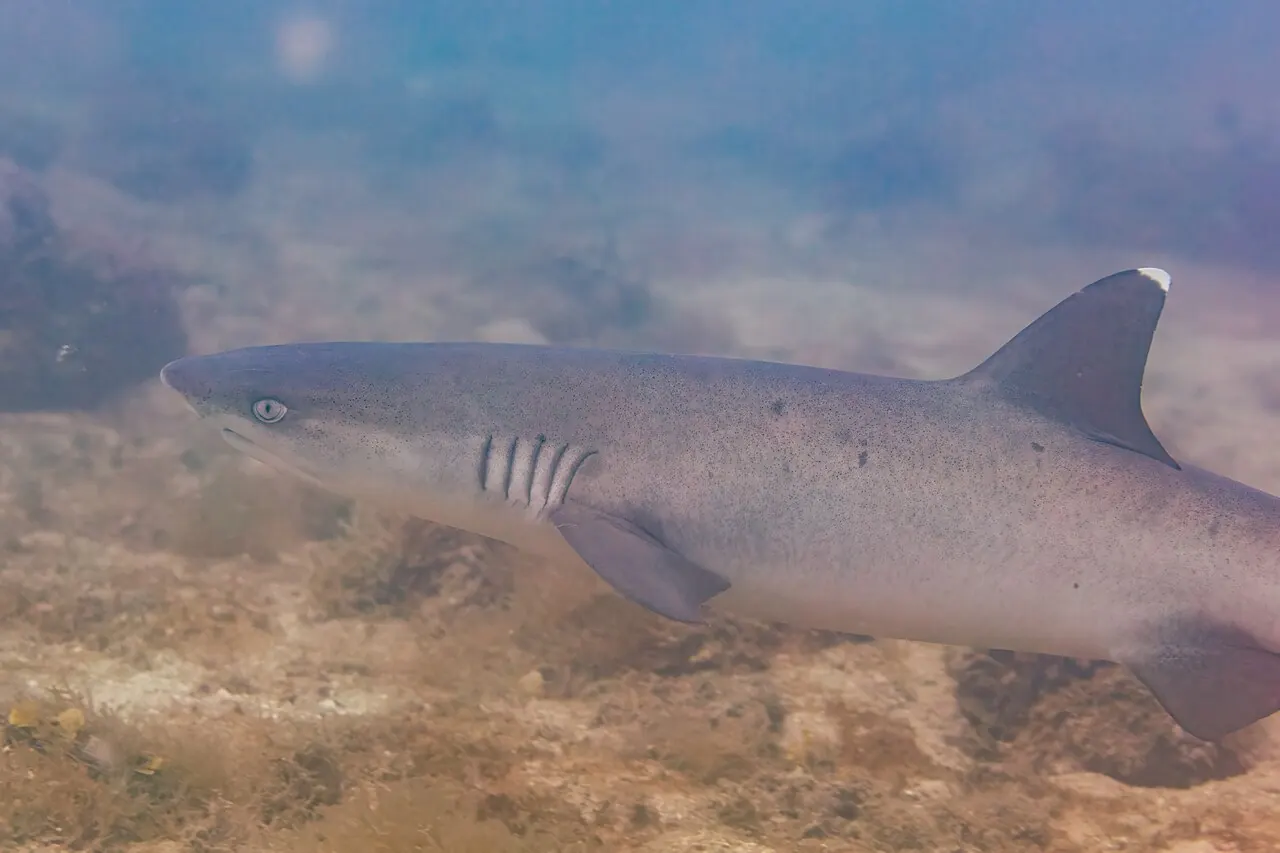
Whitetip Reef Shark
Triaenodon obesus
A slender reef shark that rests in caves by day and slips into cracks in the reef to hunt at night.
Photo: Diego Delso / CC BY-SA 4.0
3 things to know
- The tips of its first dorsal fin and upper tail lobe are bright white.
- Divers' photos in Hawaii showed some whitetips returning to the same spot over as long as seven years.
- Females give birth to 1 to 5 live pups, usually 2 or 3.
- Scientific name
- Triaenodon obesus
- Depth
- 0 m – 330 m
0 – 1,083 ft - Size
- Up to about 2.1 m (7 ft); adults rarely exceed about 1.8 m (6 ft)
- Weight
- Up to about 18 kg (40 lb)
- Lifespan
- About 25 years (maximum reported)
- Diet
- Bottom-dwelling fishes, octopus, spiny lobsters and crabs, often pulled from reef crevices at night
- Where
- Indo-Pacific from the Red Sea and East Africa to Hawaii and the Pitcairn Islands; eastern Pacific from Costa Rica and Panama to the Cocos and Galápagos islands
- IUCN status
- Vulnerable
- Depth zones
- Sunlight · Twilight
You can pick out a whitetip reef shark by the bright white tips on its first dorsal fin and the top of its tail. It is a slim gray shark, paler below and sometimes dotted with dark spots, with a very short, broad snout. It can reach about 2.1 meters (7 feet), but adults rarely grow past about 1.8 meters (6 feet), and FishBase gives a maximum reported age of 25 years.
Whitetips live on reefs across the Indo-Pacific, from the Red Sea and East Africa to Hawaii and the Pitcairn Islands, and in the eastern Pacific around Costa Rica, Panama and the Cocos and Galápagos islands. They are usually found 8 to 40 meters (26 to 131 feet) down, though one has been recorded at 330 meters (1,083 feet). By day a whitetip often rests in a cave, under a coral ledge or on a patch of sand. At night it hunts fishes, octopus, spiny lobsters and crabs, and it is adept at reaching into cracks in the reef for prey that other sharks cannot reach. Females give birth to 1 to 5 live pups, usually 2 or 3, each 52 to 60 centimeters (about 2 feet) long.
In 2005, University of Hawaiʻi zoologist Nick Whitney was asking Hawaii divers to send him their whitetip photos, because, as he told the Honolulu Advertiser, the dot patterns make it easy to tell sharks apart. Using community photos, Whitney, Richard Pyle, Kim Holland and Jessica Barcz identified at least 178 individual sharks. Some moved as far as 26.4 kilometers (16.4 miles), including trips across a channel 140 meters deep. Others barely moved: one shark was sighted 13 times at the same site, and some were seen again over periods of up to seven years. Females stayed put more than males. Two females were seen pregnant in consecutive years, even though pregnancy is thought to last about a year. Nine percent of the sharks carried fishing tackle or had jaw injuries from fishing.
Whitetips are caught in inshore longline and gillnet fisheries and are probably harmed by dynamite fishing. The IUCN's 2020 assessment lists the species as Vulnerable.
Sources
- fishbase.se/summary/Triaenodon-obesus.html
- floridamuseum.ufl.edu/discover-fish/species-profiles/triaenodon-obesus
- Study: doi:10.1007/s10641-011-9897-9
- archives-new.honoluluadvertiser.com/article/2005/Aug/18/ln/FP508180351.html
- api.gbif.org/v1/species/2418054/iucnRedListCategory
- iucnredlist.org/species/39384/173436715



