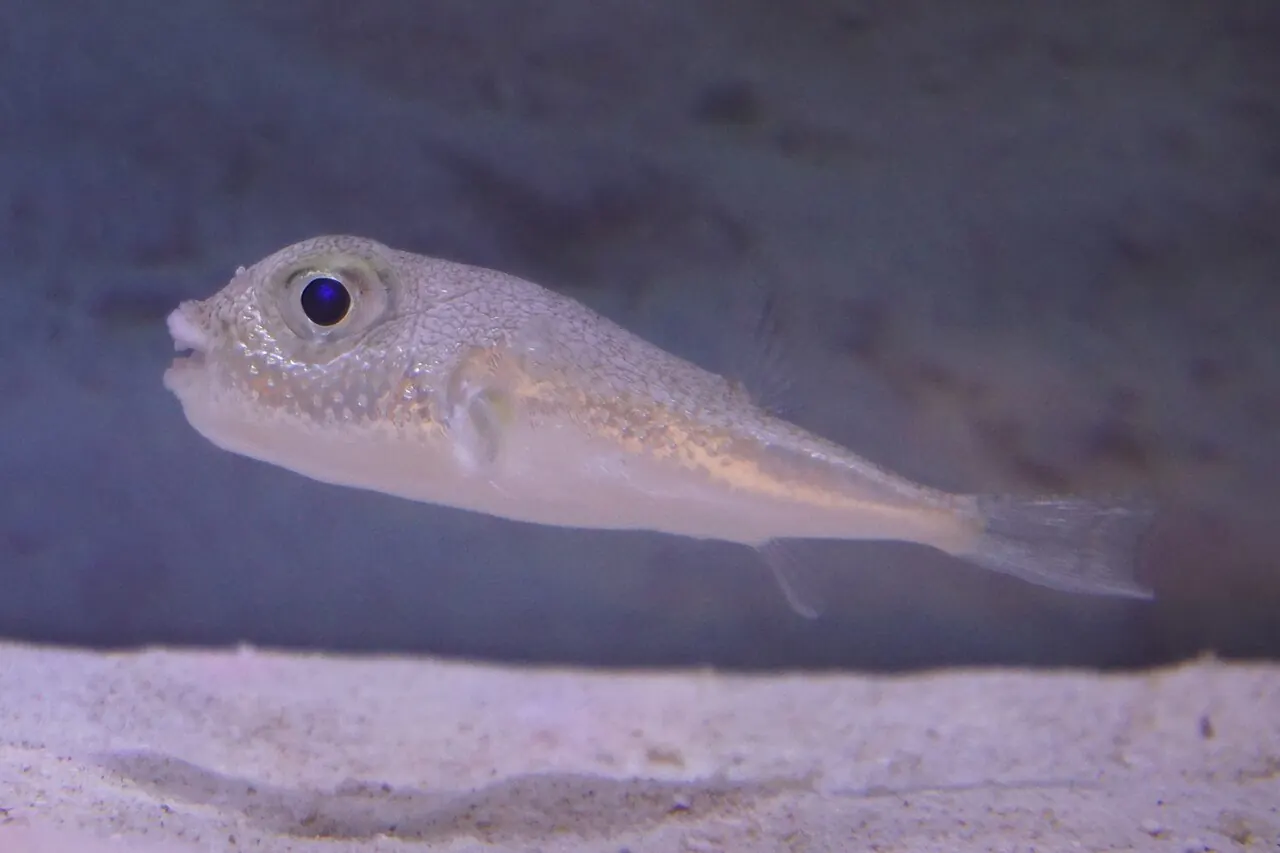
White-Spotted Pufferfish
Torquigener albomaculosus
A small Japanese pufferfish whose males spend about a week sculpting a patterned sand circle around 2 m across to attract a mate.
Photo: タウナギ (Taunagi) / CC0
3 things to know
- A male about 12 cm long builds a sand nest roughly 2 m across.
- Each circle takes 7 to 9 days to finish and is used for one spawning.
- Divers found the circles in 1995, years before anyone saw the fish building one.
- Scientific name
- Torquigener albomaculosus
- Depth
- 10 m – 30 m
33 – 98 ft - Size
- Up to about 12 cm (4.7 in) long
- Weight
- Not well known
- Lifespan
- Unknown
- Diet
- Not well known
- Where
- Ryukyu Islands of southern Japan, known mainly from Amami Oshima
- IUCN status
- Not Evaluated
- Depth zones
- Sunlight
Fine brown netting and many white spots cover the top half of the white-spotted pufferfish, while its underside is silvery white, also dotted with white spots. It grows to about 12 centimeters (4.7 inches), shorter than a dollar bill. The ichthyologist Keiichi Matsuura described it as a new species, Torquigener albomaculosus, in 2014.
The species is known from the Ryukyu Islands of southern Japan, and mainly from the waters off southern Amami Oshima. Divers have seen it on sandy bottoms 10 to 27 meters (33 to 89 feet) down, and another population lives at around 30 meters off the north of the island. Its diet and lifespan have not been described, and it has not been assessed for the IUCN Red List.
The male's nest is what made the fish famous. In 1995 divers found a circle in the sand about 2 meters (6.5 feet) across, with ridges running in toward the middle like the spokes of a wheel. In 2011 Hiroshi Kawase of the Natural History Museum and Institute, Chiba, and two colleagues saw a male building one. He plows the sand with his fins, swimming in straight lines from the edge toward the center over and over, and lays out a maze of fine sand in the middle. He then decorates the ridges with bits of shell and coral. Each circle takes 7 to 9 days.
Females visit only in the final stage of building. A pair spawns in the center, and the male stays for 6 days to care for the eggs while currents begin to flatten his circle. He never repairs it, and his next nest goes on a fresh patch of seafloor. Kawase's team found that the structure gathers fine sand into the center and that it plays a part in a female's choice of mate. In 2018 Ryo Mizuuchi and colleagues showed that a computer following a few simple digging rules, recorded from real males, could reproduce the outer ring.
In 2018 a robot sub surveying oil field equipment off Western Australia filmed 21 similar circles 129 to 137 meters (about 420 to 450 feet) down, with a Torquigener pufferfish nearby. The images were not clear enough to tell which species it was.



