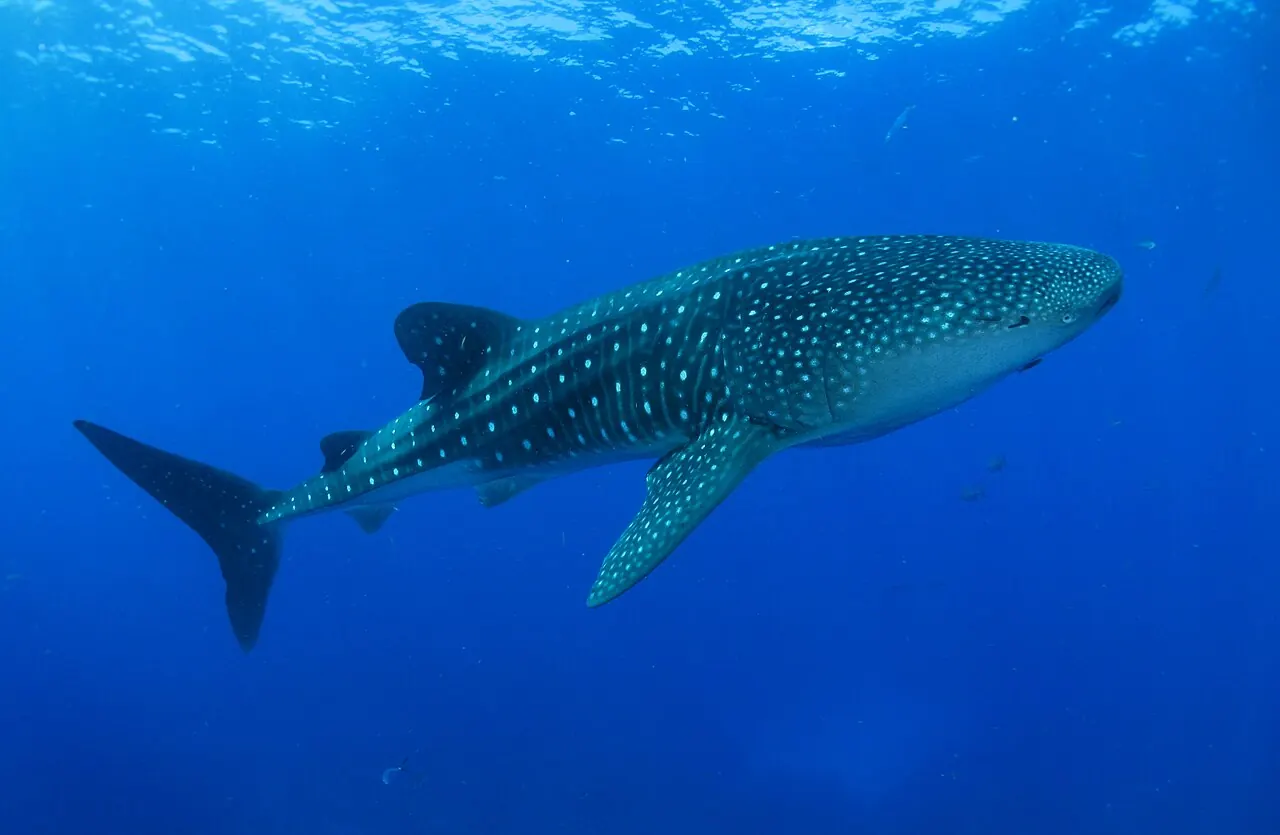
Whale Shark
Rhincodon typus
The biggest fish alive, a spotted filter feeder that grows to about 14 meters (46 feet) and lives on plankton and small fish.
Photo: Ryan Eckert/NOAA (National Marine Sanctuaries) / Public domain
3 things to know
- It has more than 3,000 tiny teeth but does not use them to feed.
- Each whale shark's pattern of spots is unique, like a fingerprint.
- Whale sharks have been recorded as deep as 1,928 meters (6,325 feet).
- Scientific name
- Rhincodon typus
- Depth
- 0 m – 100 m
0 – 328 ft - Size
- Up to about 14 m (46 ft) long, according to NOAA; the largest reliably measured was about 12 m (39 ft)
- Weight
- Up to nearly 11 metric tons (24,000 lb)
- Lifespan
- Not well known; reported maximum ages are 75 to 80 years
- Diet
- Plankton, krill, fish eggs and small fish
- Where
- Tropical and warm temperate seas worldwide, except the Mediterranean
- IUCN status
- Endangered
- Depth zones
- Sunlight
No living fish grows bigger than the whale shark, which can reach 46 feet (about 14 meters) and nearly 24,000 pounds, according to NOAA Fisheries. It has a broad, flat head with a huge mouth set almost at the tip of the snout, three ridges running along each side, and a back patterned like a checkerboard, with pale spots and stripes on gray, blue or brown skin. The belly is white.
Whale sharks live in tropical and warm temperate seas around the world, everywhere except the Mediterranean. They usually stay in the top 100 meters (330 feet), but one has been recorded as deep as 1,928 meters (6,325 feet). Every summer and fall they gather in the northern Gulf of Mexico, especially at Ewing Bank off Louisiana. When NOAA scientists put satellite tags on 42 of them between 2008 and 2014, all of the tracked sharks stayed inside the Gulf.
The whale shark has more than 3,000 tiny teeth and does not use them to eat. It is a filter feeder that takes in plankton, krill, fish eggs and small fish. Instead of cruising slowly with its mouth open, it often hangs upright with its head at the surface and gulps, opening and closing its mouth 7 to 28 times a minute while 20 filter pads inside sieve out the food.
Females give birth to live young that develop from eggs inside the mother, and one pregnant female carried 300 embryos. How long whale sharks live is uncertain. NOAA says the oldest documented one was 75 years old. The IUCN lists the whale shark as Endangered. It has been hunted for meat, fins and liver oil, is caught as bycatch, and is sometimes struck by boats while it feeds at the surface.
Each shark carries its own pattern of spots, which works like a fingerprint. Researchers match photos of the spots on a shark's flank using software adapted from a method astronomers built to compare star fields. In early tests, it paired photos of the same shark in more than 90% of cases.



