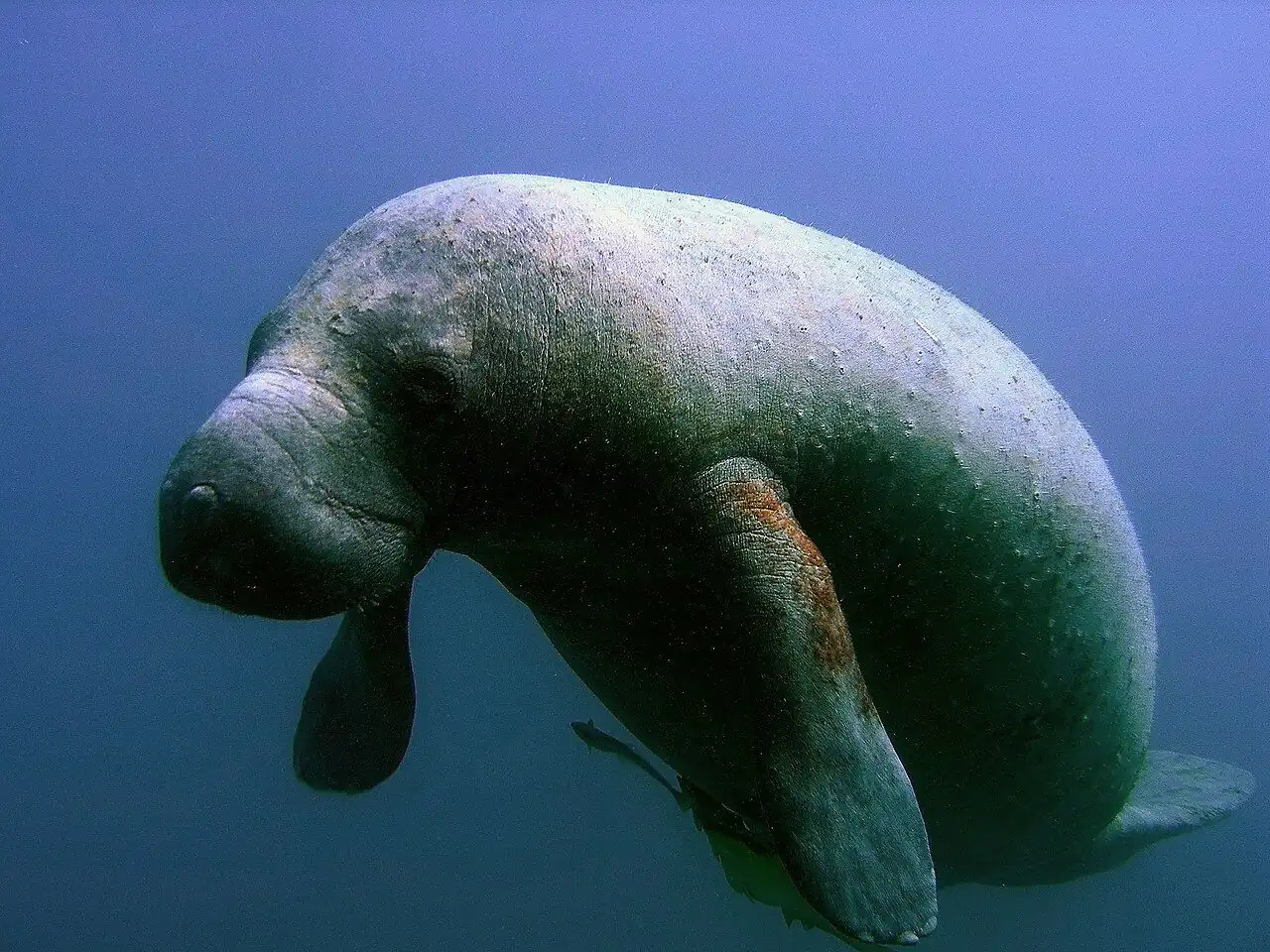
West Indian Manatee
Trichechus manatus
Florida's slow, plant-eating sea cow, which needs warm water in winter and lost 1,255 animals in a 2020–2022 starvation event.
Photo: NOAA / Public domain
3 things to know
- Its molars form at the back of the jaw, move forward, fall out and are replaced throughout life.
- It can eat up to 10 percent of its body weight in plants a day.
- Wildlife staff fed starving manatees at least 600,000 pounds of leafy greens over two winters.
- Scientific name
- Trichechus manatus
- Depth
- 0 m – 6 m
0 – 20 ft - Size
- Florida manatees usually 2.7–3 m (9–10 ft) long; can exceed 4 m (13 ft)
- Weight
- Florida manatees usually about 450 kg (1,000 lb); can exceed 1,590 kg (3,500 lb)
- Lifespan
- Over 65 years in captivity; about half of wild adults reach their early 20s
- Diet
- Seagrasses and other aquatic plants
- Where
- Southeastern US, the Caribbean, eastern Mexico and Central America, and northern South America
- IUCN status
- Vulnerable
- Depth zones
- Sunlight
Manatees chew through a lifetime of teeth. They have no front teeth, only molars, which form at the back of the jaw, slowly move forward and fall out at the front, to be replaced by new ones. Florida wildlife officials describe it as an adaptation to plants that grow in sandy soil. A flexible lip pad pulls food into the mouth, and the front flippers help hold it.
The Florida manatee, a subspecies, is typically 2.7 to 3 meters (9 to 10 feet) long and about 450 kilograms (1,000 pounds), but some pass 4 meters (13 feet) and 1,590 kilograms (3,500 pounds). The species as a whole lives along the southern United States, through the Caribbean, down eastern Mexico and Central America, and along northern South America. Manatees usually travel in water 3 to 5 meters (10 to 16 feet) deep and generally avoid water deeper than 6 meters (20 feet).
They graze up to eight hours a day on seagrass and other plants, eating as much as a tenth of their body weight. Resting, they can hold their breath for 20 minutes; active, they surface every three to five minutes. They cannot keep warm in cold water, so in winter Florida's manatees crowd into artesian springs and power plant discharge canals. In summer some travel as far as Georgia and the Carolinas.
Females carry a calf for about 13 months and give birth every three to five years. In captivity a manatee may live more than 65 years, but in the wild only about half of those reaching adulthood survive into their early 20s.
Between December 2020 and April 2022, after seagrass died off in the Indian River Lagoon, 1,255 manatee carcasses were documented along Florida's Atlantic coast, and investigators found that starvation caused the high death toll. In a feeding trial over the winters of 2021-22 and 2022-23, state and federal staff and volunteers supplied at least 600,000 pounds (272,000 kilograms) of leafy greens. The last starvation death linked to lack of food was recorded in March 2023, and the mortality event was officially closed in March 2025.
Boat strikes and loss of warm-water refuges remain the main threats. After the Florida population grew to at least 8,350 animals, the species was moved from endangered to threatened under the Endangered Species Act in May 2017. The IUCN lists it as Vulnerable.



