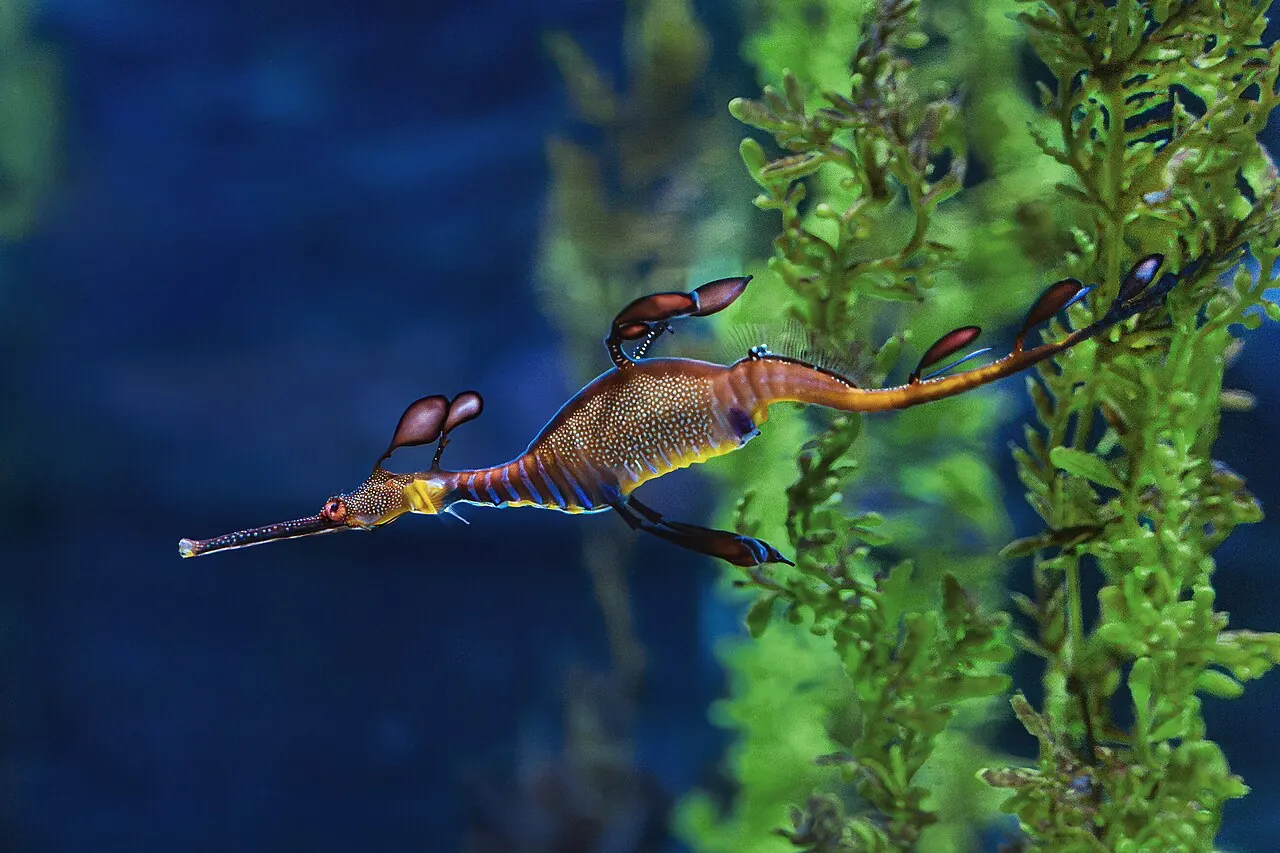
Weedy Seadragon
Phyllopteryx taeniolatus
A red and yellow seadragon of southern Australian kelp reefs, now listed as Vulnerable, whose males carry the eggs under their tails.
Photo: Aneta p / CC BY 4.0
3 things to know
- Males carry up to about 250 eggs under the tail for 30 to 38 days.
- In April 2022 more than 200 weedy seadragons washed up on beaches around Sydney after storms.
- It is the marine emblem of the Australian state of Victoria.
- Scientific name
- Phyllopteryx taeniolatus
- Depth
- 1 m – 50 m
3 – 164 ft - Size
- Up to about 45 cm (18 in) long
- Weight
- Not well known; newborns weigh less than 1 gram
- Lifespan
- Not well known; a 2024 note by Schlögl and Booth, citing tagging work by Sanchez-Camara and colleagues (2005), gives up to six years
- Diet
- Mysids and other tiny crustaceans, sucked in through the long snout
- Where
- Endemic to southern Australia, from about Newcastle, New South Wales, south to Tasmania and west to about Geraldton, Western Australia
- IUCN status
- Vulnerable
- Depth zones
- Sunlight
Reddish orange to purple, sprinkled with fine yellow spots and banded in blue along the sides, the weedy seadragon wears simpler leaf-like flaps than its relative the leafy seadragon. It has a long tubular snout and a tail that can grip. Females are deeper-bodied than males, and adults reach about 45 centimeters (18 inches). It is also called the common seadragon, and it is the marine emblem of Victoria.
It lives only in southern Australia, from around Newcastle in New South Wales south to Tasmania and west to about Geraldton in Western Australia, from shallow estuaries out to deeper reefs between about 1 and 50 meters (3 and 164 feet). Most live among kelp and other seaweed on rocky reefs or in seagrass beds, and each tends to stay within a home range. It feeds on mysids and other tiny crustaceans, sucking them in through its snout.
Breeding runs from June to January. The female transfers her eggs to the underside of the male's tail, and he broods up to about 250 of them for 30 to 38 days. Some males raise two broods in a season. In 2023 Birch Aquarium at Scripps in La Jolla, California, announced that more than 70 young had hatched from eggs carried by one of its males, each about an inch long and weighing less than a gram. A third seadragon, the red ruby seadragon of Western Australia, was described in 2015 by a Scripps team and is the weedy seadragon's closest relative.
The IUCN moved the weedy seadragon from Least Concern to Vulnerable in an assessment dated 2024. In April 2022 more than 200 weedy seadragons washed up on beaches around Sydney, a stranding that David Booth of the University of Technology Sydney and colleagues called unprecedented and linked most likely to a series of coastal storms with record wave heights. The long-term trend is disputed. A 2023 study of Australian reef surveys by Graham Edgar and colleagues reported that weedy seadragons declined by 59 percent from 2011 to 2021. Erik Schlögl and Booth reexamined the same survey data and argued that they were too sparse, especially for 2020 and 2021, to support that figure.
Sources
- fishbase.se/summary/Phyllopteryx-taeniolatus.html
- fishesofaustralia.net.au/home/species/3127
- Study: doi:10.2305/IUCN.UK.2025-1.RLTS.T17177A263199517.en
- uts.edu.au/news/2025/09/protecting-vulnerable-marine-icon
- Study: doi:10.1111/jfb.70019
- Study: doi:10.1038/s41586-023-05833-y
- Study: doi:10.7882/az.2025.024
- Study: doi:10.1101/2024.07.21.604472
- Study: doi:10.1111/j.0022-1112.2005.00720.x
- aquarium.ucsd.edu/sites/default/files/2023-03/NR-030323-Weedy%20Seadragon%20%20Babies.pdf
- Study: doi:10.1098/rsos.140458
- today.ucsd.edu/story/neither-myth-nor-legend-seadragon-mysteries-are-still-to-be-solved
- commons.wikimedia.org/wiki/File:Phyllopteryx_taeniolatus,_Poema_del_Mar.jpg



