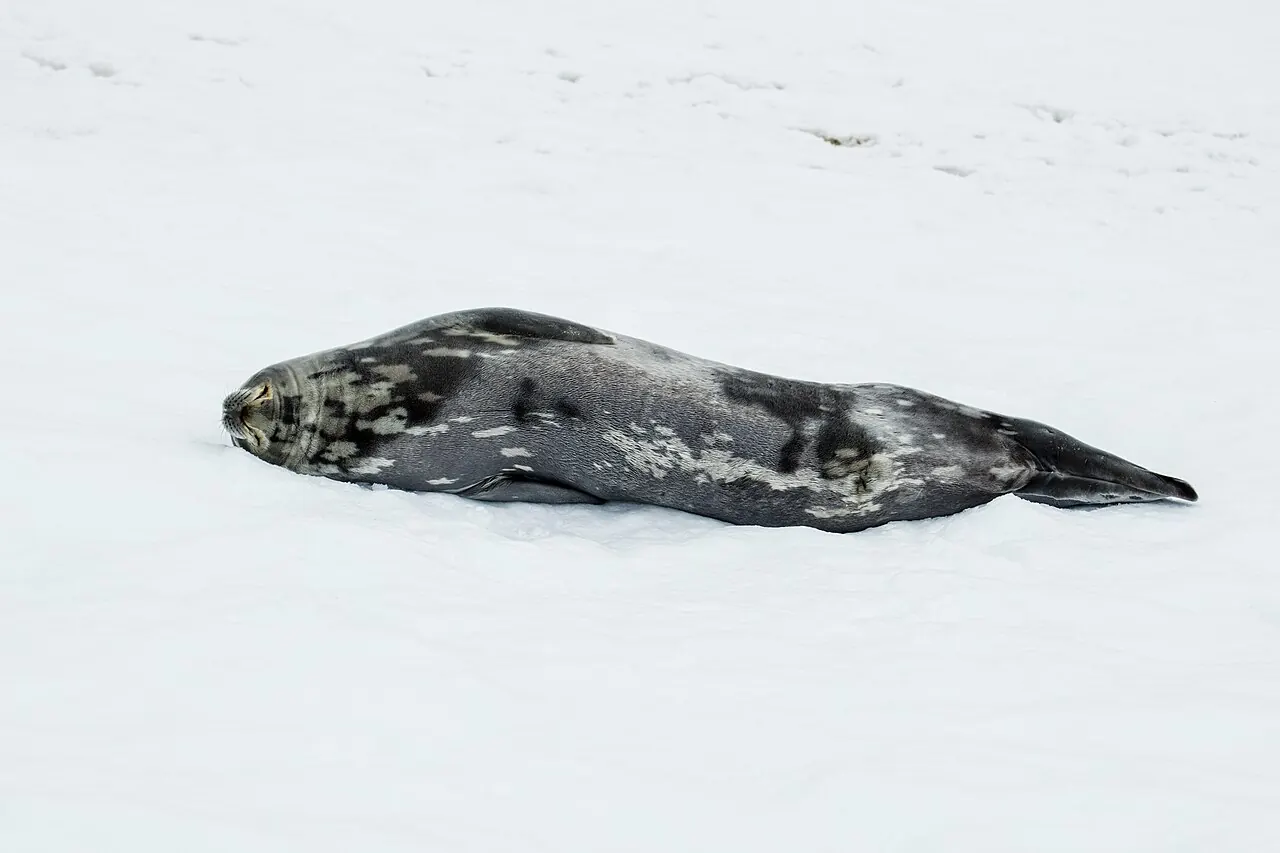
Weddell Seal
Leptonychotes weddellii
An Antarctic seal that lives farther south than any other mammal, spends winter under the ice and keeps its breathing holes open with its teeth.
Photo: Godot13 / CC BY-SA 4.0
3 things to know
- In winter it keeps breathing holes open by rasping at the ice with its teeth.
- Dives have been recorded to 904 m (2,966 ft) and as long as 96 minutes.
- A female in Antarctica's Erebus Bay had her 21st pup at about 30 years old.
- Scientific name
- Leptonychotes weddellii
- Depth
- 0 m – 400 m
0 – 1,312 ft - Size
- About 3 m (10 ft) long; females up to about 3.5 m (11.5 ft)
- Weight
- About 400–600 kg (880–1,320 lb)
- Lifespan
- Up to about 30 years; females that survive their first two years typically live about 15
- Diet
- Fish, squid, octopus and prawns
- Where
- Coastal fast ice all around Antarctica
- IUCN status
- Least Concern
- Depth zones
- Sunlight · Twilight
No mammal that lives in Antarctica year-round ranges farther south than the Weddell seal. Adults are about 3 meters (10 feet) long and weigh 400 to 600 kilograms (880 to 1,320 pounds), with a head that looks small for the bulky body. The back is dappled gray and black and the belly mostly white.
They stay close to the coast, around fast ice, the sea ice locked to the shore, and the Australian Antarctic Division says they venture only 15 to 20 kilometers (9 to 12 miles) out to feed. Under the ice they hunt fish, squid, octopus and prawns. Michelle Shero of Woods Hole Oceanographic Institution and colleagues tracked 59 adults in the western Ross Sea; midday dives averaged about 200 to 400 meters (660 to 1,310 feet) depending on season. The species has been recorded as deep as 904 meters (2,966 feet) and for as long as 96 minutes. One seal was repeatedly seen catching a fish of more than 40 kilograms (88 pounds).
They breathe through cracks and holes in the ice. In winter these freeze over, and the seals keep their breathing holes open by rasping at the new ice with their canine and incisor teeth. The work wears the teeth down, in some seals so far that they may eventually be unable to feed or keep the holes open. A seal also has to find its way back to a hole in the darkness of the polar winter before it runs out of oxygen.
Females aged 6 and older give birth to one pup a year on the ice in October. Pups weigh 25 to 30 kilograms (55 to 66 pounds) at birth and 110 to 140 kilograms (240 to 310 pounds) six weeks later, and mating takes place underwater.
Much of what is known comes from Erebus Bay in the Ross Sea, the most southerly breeding population of any mammal, which has been studied since 1968. The project, run by Montana State University with National Science Foundation funding and now led by Jay Rotella, holds records on more than 29,000 marked seals. In the 2013 to 2014 season a female known as SPENO 5970 gave birth to her 21st pup at about 30 years old, close to the upper limit for the species; most females that survive their first two years live about 15 years. The IUCN lists the Weddell seal as Least Concern.
Sources
- web.archive.org/web/20220706041337/https://www.antarctica.gov.au/about-antarctica/anima…
- animaldiversity.org/accounts/Leptonychotes_weddellii
- montana.edu/weddellseals
- web.archive.org/web/20250605015346/https://antarcticsun.usap.gov/science/2941
- Study: doi:10.2305/IUCN.UK.2015-4.RLTS.T11696A45226713.en
- Study: doi:10.1038/s42003-024-07029-0
- whoi.edu/press-room/news-release/seal-dives



