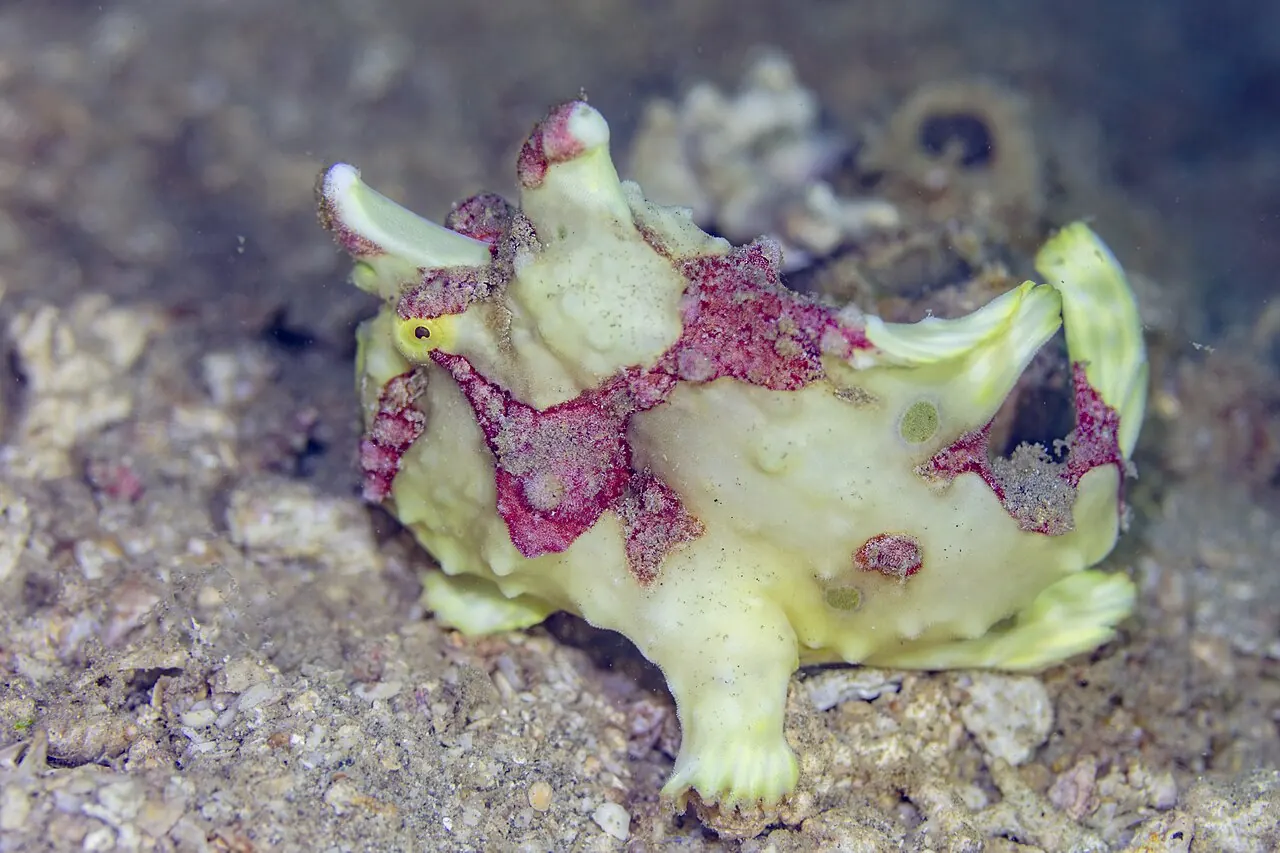
Warty Frogfish
Antennarius maculatus
A small, wart-covered anglerfish of shallow Indo-Pacific reefs that wiggles a lure shaped like a tiny fish and swallows prey in a flash.
Photo: Diego Delso / CC BY-SA 4.0
3 things to know
- The lure on its head looks like a tiny fish, complete with an eye-like spot.
- Its pectoral fins have an elbow-like joint, and frogfishes use them to walk over rocks and coral.
- High-speed film shows frogfishes in its genus engulf prey faster than any other fish measured at the time.
- Scientific name
- Antennarius maculatus
- Depth
- 1 m – 15 m
3 – 49 ft - Size
- Small; maximum given as 9 cm (3.5 in) by Fishes of Australia and 15 cm (6 in) by FishBase
- Weight
- Unknown
- Lifespan
- Unknown
- Diet
- Mostly small fishes, lured close and swallowed whole
- Where
- Indo-West Pacific from the Maldives and Mauritius east to Indonesia, the Philippines, Papua New Guinea, the Solomon Islands and New Caledonia
- IUCN status
- Least Concern
- Depth zones
- Sunlight
Bumps like warts cover the head, body and fins of the warty frogfish, and its colors vary enormously. Fishes of Australia lists shades from cream, pink and red to yellow, green, brown and black, often with darker spots, patches and saddles, and the fins often have red or orange edges. Small juveniles are whitish with reddish-brown saddles, and they sit out in the open on the reef looking like sea slugs. This is a small fish: Fishes of Australia gives a maximum of 9 centimeters (3.5 inches), while FishBase lists 15 centimeters (6 inches).
It lives on sheltered coastal and rocky reefs in the Indian and western Pacific oceans, from the Maldives and Mauritius east to the Solomon Islands and New Caledonia, down to about 15 meters (49 feet). Adults usually stay close to sponges, and also sit among seaweed and soft corals.
Like all frogfishes, it is an anglerfish. The first spine of its dorsal fin has become a banded rod, and on the tip sits a large lure that strongly resembles a tiny fish, with a dark spot near its base like an eye. The frogfish lies still, wiggles the lure, and engulfs whatever small fish comes to investigate. In 1979 David Grobecker and Theodore Pietsch filmed frogfishes of its genus, Antennarius, at 800 and 1,000 frames per second. Their mouths and gill chambers expanded so fast that the suction swallowed prey whole, at speeds well beyond those recorded for any other fish.
Its pectoral fins work almost like arms, with a joint that bends like an elbow. A 2020 University of Washington article on a book by Pietsch, a professor emeritus there, describes frogfishes walking and hopping across the bottom and clambering over rocks and coral, yet able to jet themselves through open water. In the same interview Pietsch said most frogfishes can shift from drab to highly colorful over days, weeks or months, usually to match their surroundings.
The female releases her eggs in a floating raft of jelly, and the larvae drift in the plankton for one to two months before settling on a reef. The warty frogfish is collected for the aquarium trade, and the IUCN lists it as Least Concern, from a 2021 assessment.
Sources
- fishbase.se/summary/Antennarius-maculatus.html
- fishesofaustralia.net.au/home/species/3833
- Study: doi:10.2305/IUCN.UK.2022-2.RLTS.T67968705A67970912.en
- Study: doi:10.1126/science.205.4411.1161
- washington.edu/news/2020/03/23/anatomy-of-a-frogfish-new-book-explores-world-of-fishes-…
- commons.wikimedia.org/wiki/File:Pez_sapo_payaso_(Antennarius_maculatus),_Anilao,_Filipi…



