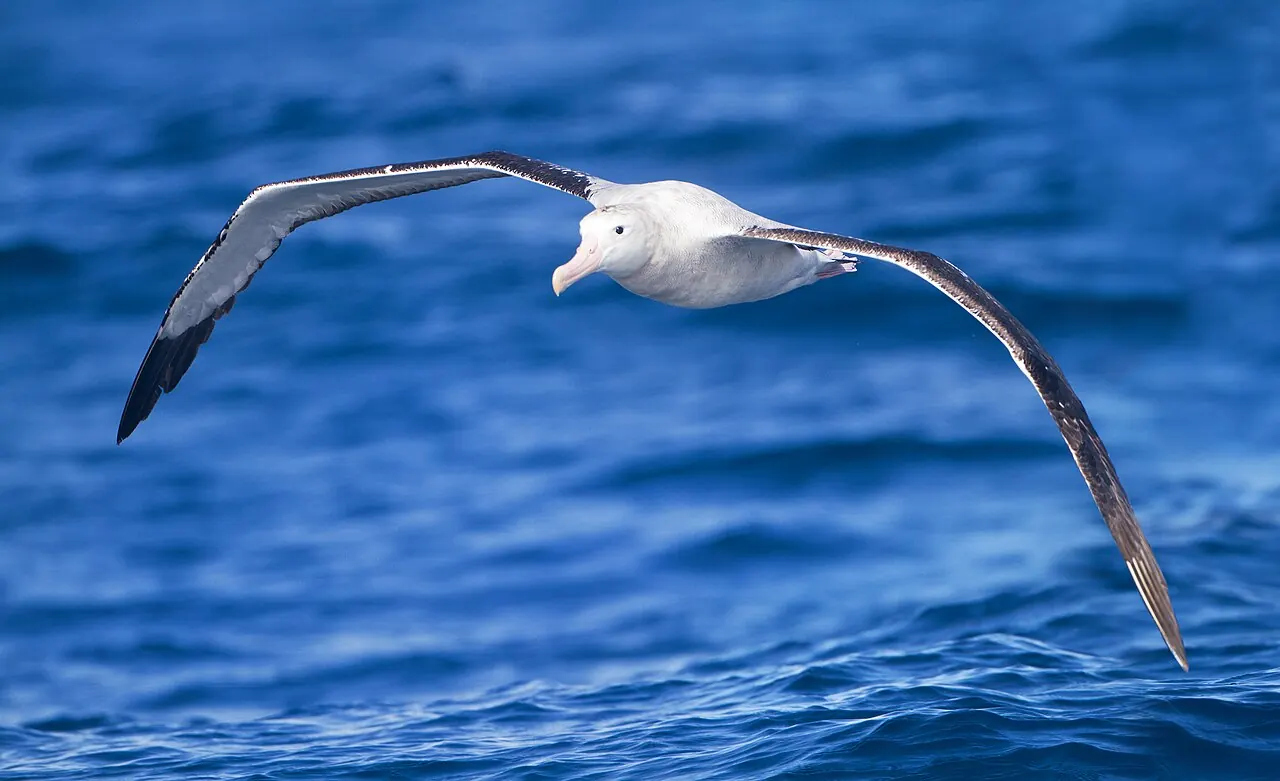
Wandering Albatross
Diomedea exulans
The bird with the widest wingspan alive, which circles the Southern Ocean and has been used to find boats with their identification signals off.
Photo: JJ Harrison / CC BY-SA 3.0
3 things to know
- Its wingspan of almost 3.5 m (11.5 ft) is the widest of any living bird.
- Some birds circle Antarctica two or three times in a single year away from the colony.
- Pairs breed at most once every two years and usually start at 11 to 15 years old.
- Scientific name
- Diomedea exulans
- Depth
- At the surface
- Size
- About 120 cm (47 in) long, with a wingspan of almost 3.5 m (11.5 ft)
- Weight
- About 8–10 kg (18–22 lb)
- Lifespan
- Decades; a bird ringed on South Georgia in 1962 was still recorded there in 2019, aged 57
- Diet
- Mainly squid and fish taken at the surface; also scavenges around fishing boats
- Where
- Southern Ocean; breeds on South Georgia and on the Crozet, Kerguelen, Prince Edward, Marion, Heard and Macquarie islands
- IUCN status
- Vulnerable
- Depth zones
- Sunlight
No living bird has a wider wingspan than the wandering albatross: BirdLife Australia puts it at almost 3.5 meters (11.5 feet). The body is about 120 centimeters (4 feet) long and weighs 8 to 10 kilograms (18 to 22 pounds), and females are a little smaller than males. From a distance adults look all white; up close they show fine black wavy lines on the breast, neck and upper back, a pinkish bill, and wings that turn from black to white with age. Young birds pass through a series of darker plumages, and full adult plumage can take up to nine years.
The species lives over the Southern Ocean and breeds on subantarctic islands: South Georgia, Crozet, Kerguelen, Marion and Prince Edward, Heard and Macquarie. Pairs mate for life and breed no more than once every two years. The single egg is laid in December or early January, both parents share about 11 weeks of incubation, and the chick needs another 7 to 9 months to fledge. Birds usually start breeding at 11 to 15 years old, and they can keep going for decades. One wandering albatross ringed on Bird Island, South Georgia, in 1962 was still being recorded there in 2019, at 57.
Food comes from the top of the sea. Wanderers take most of their prey, mainly squid and fish, by seizing it at the surface, and they readily scavenge scraps around fishing boats. When Henri Weimerskirch and colleagues tracked birds during their sabbatical year away from the colony, some flew with the westerly winds around Antarctica two to three times, covering more than 120,000 kilometers (74,000 miles) in that single year.
The pull of boats is also the main threat. Birds go after baited longline hooks and get caught, and losses in longline fisheries have been blamed for population declines. The IUCN lists the species as Vulnerable.
In a 2020 study, Weimerskirch's team put that habit to work. Between November 2018 and March 2019 they fitted 169 albatrosses, mostly wandering and Amsterdam albatrosses from Crozet, Kerguelen and Amsterdam islands, with loggers that detect ship radar. The birds found 353 boats. In international waters, 36.9 percent of them had no Automatic Identification System operating; AIS is meant to help ships avoid collisions, but it can be switched off from the vessel. The authors presented this as the first estimate of the extent of undeclared fishing.
Sources
- birdlife.org.au/bird-profiles/wandering-albatross
- nzbirdsonline.org.nz/species/wandering-albatross
- acap.aq/latest-news/catching-up-with-wisdom-the-oldest-known-albatrosses-and-petrels-on…
- Study: doi:10.1038/srep08853
- Study: doi:10.1073/pnas.1915499117
- pmc.ncbi.nlm.nih.gov/articles/PMC7022167
- Study: doi:10.2305/IUCN.UK.2018-2.RLTS.T22698305A132640680.en
- iucnredlist.org/species/22698305/132640680
- en.wikipedia.org/wiki/Snowy_albatross



