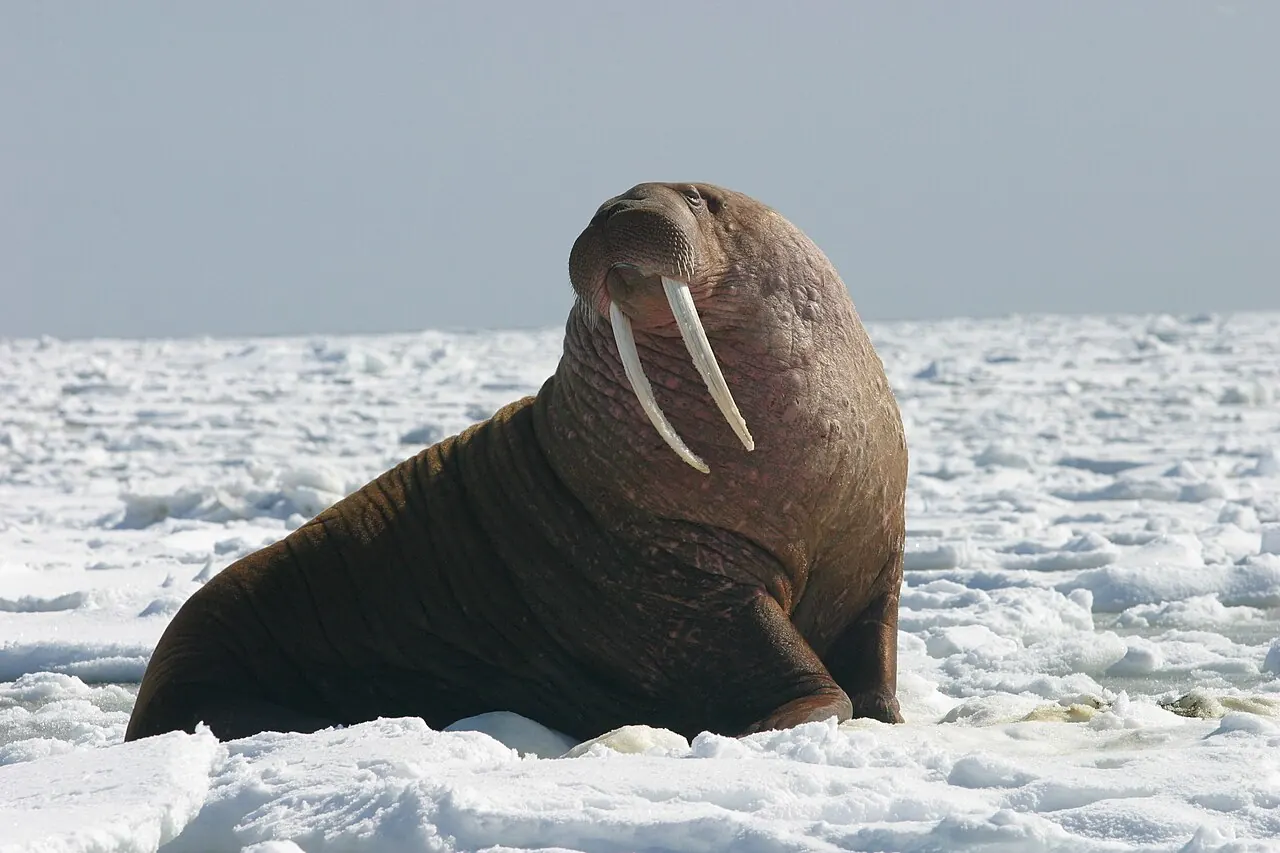
Walrus
Odobenus rosmarus
The tusked Arctic giant that finds clams with its whiskers, sucks them out of their shells, and rests on sea ice between dives.
Photo: Joel Garlich-Miller, U.S. Fish and Wildlife Service / Public domain
3 things to know
- Both males and females have tusks, which are overgrown upper canine teeth.
- Walruses eat by suction, pulling clams out of their shells with a piston-like tongue.
- Its pregnancy lasts about 15 months, the longest of any seal or sea lion.
- Scientific name
- Odobenus rosmarus
- Depth
- 0 m – 50 m
0 – 164 ft - Size
- Pacific males up to about 3.7 m (12 ft) long; females smaller
- Weight
- Pacific males up to about 1,800 kg (2 tons); females can top 900 kg (1 ton)
- Lifespan
- Up to about 40 years
- Diet
- Clams, snails, worms, sea cucumbers and other seafloor animals; occasionally seals and seabirds
- Where
- Arctic Ocean and subarctic seas; Pacific walruses in the Bering and Chukchi seas
- IUCN status
- Vulnerable
- Depth zones
- Sunlight
Both male and female walruses carry tusks: upper canine teeth that keep growing throughout life. The genus name, Odobenus, means "tooth-walker," and walruses do use their tusks to pull themselves onto rocks or ice. They do not use them to dig for food. Their most common use is social, and when two bulls meet, the one with smaller tusks usually backs away.
Food is found by touch. A walrus has hundreds of short, sensitive whiskers that it sweeps over the seafloor to find clams, snails, worms and sea cucumbers. Apart from the tusks its teeth are flat, so it feeds by suction, pulling back its piston-like tongue fast enough to suck the soft body out of a clam and let the shell drop. Some walruses, mostly males, kill and eat seals and seabirds. Four male Pacific walruses tagged in Bristol Bay, Alaska, spent 46 percent of their trip time on deep, square-shaped feeding dives that averaged 41 meters (135 feet) and 7.2 minutes.
The species lives around the Arctic. Pacific walruses use the Bering and Chukchi seas between Alaska and Russia. Their bulls reach about 3.7 meters (12 feet) and up to about 1,800 kilograms (2 tons), and the hide can be 2.5 centimeters (1 inch) thick. Females start breeding at 6 or 7 and usually have a calf every two years, after a 15-month pregnancy, the longest of any pinniped. A calf stays with its mother about two years. Walruses can live to 40.
Sea ice is their resting platform between feeding trips. As the Chukchi Sea ice began retreating in late summer beyond the shallow continental shelf, walruses started gathering on Alaska's coast instead. A barrier island near the village of Point Lay held big herds in four of the five years up to 2011; that summer the count peaked at about 20,000 in mid-September, according to a field report by the US Fish and Wildlife Service and local partners. Crowded beaches are risky for the young, because calves and yearlings can be trampled when a startled herd rushes for the water.
The IUCN lists the walrus as Vulnerable. In the United States, commercial walrus hunting was banned in 1941, and the Marine Mammal Protection Act limits the harvest to Alaska Natives for food and handicrafts.



