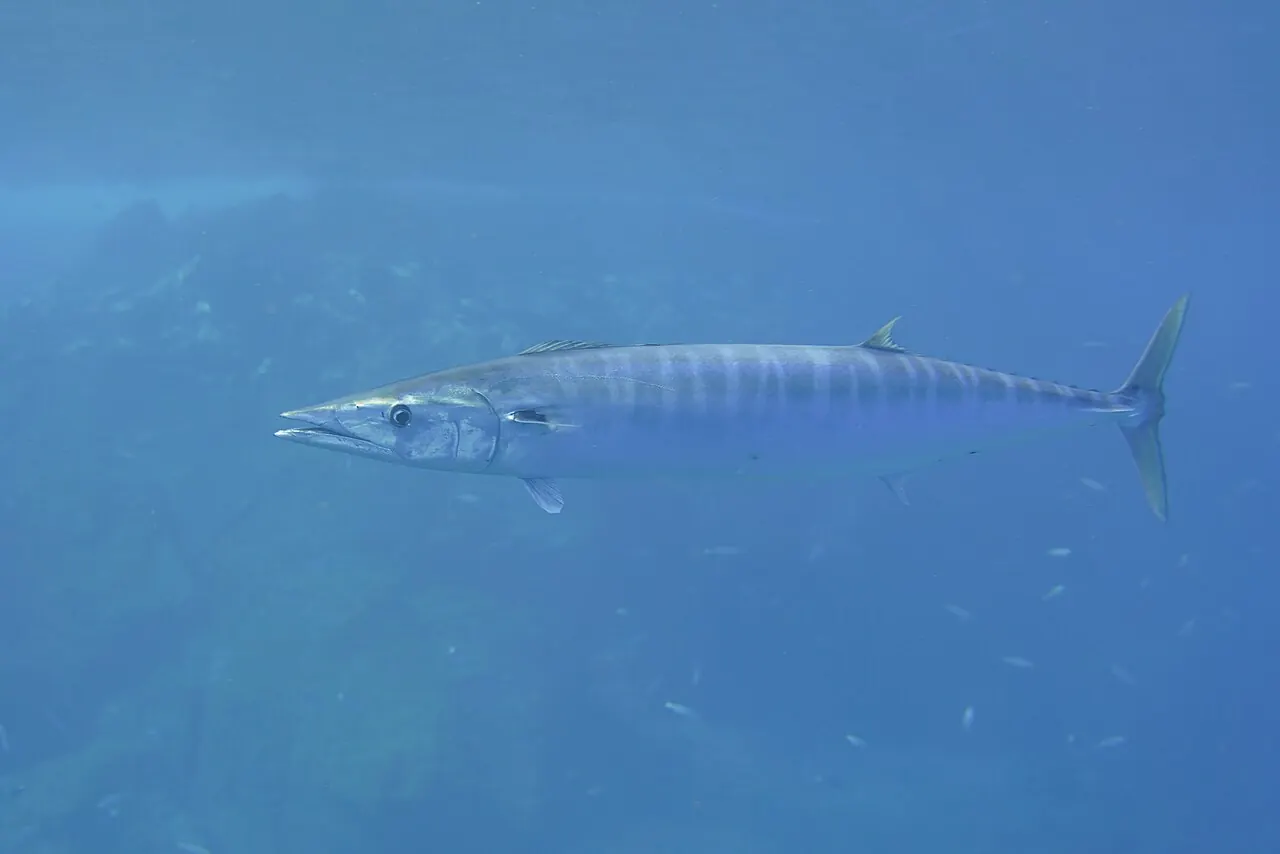
Wahoo
Acanthocybium solandri
A long, barred, razor-toothed relative of the mackerels that hunts alone near the surface and grows fast enough to spawn at a year old.
Photo: Bommerer / CC BY 4.0
3 things to know
- Its sides carry 24 to 30 dark blue vertical bars that fade quickly after death.
- Its snout is about as long as the rest of its head.
- One tagged wahoo traveled 1,700 miles in six and a half months.
- Scientific name
- Acanthocybium solandri
- Depth
- 0 m – 200 m
0 – 656 ft - Size
- Commonly 1 to 1.7 m (3.3 to 5.4 ft); up to about 2.5 m (8 ft) long
- Weight
- Up to 83 kg (182 lb) reported
- Lifespan
- About 5 to 6 years, possibly more
- Diet
- Fish such as frigate mackerel, butterfish, porcupinefish, flyingfish and herrings, plus squid
- Where
- Tropical and subtropical waters worldwide, including the Caribbean and the Mediterranean; farther from the equator in summer
- IUCN status
- Least Concern
- Depth zones
- Sunlight
A wahoo is built like a spear: long, slender and oval in cross section, steel blue above and pale below, with 24 to 30 wavy, dark blue vertical bars down its sides. The bars fade quickly once the fish dies. The jaws stretch into a beak-like snout about as long as the rest of the head, and the mouth is lined with strong, triangular teeth, flattened and finely serrated along the edges. Wahoo belong to Scombridae, the family of mackerels, tunas and bonitos. Most are 1 to 1.7 meters (3.3 to 5.4 feet) long. The largest reported reached 2.5 meters (8 feet) and 83 kilograms (182 pounds).
Wahoo live near the surface in tropical and subtropical seas around the world, including the Caribbean and the Mediterranean, and spread to higher latitudes in summer. Tags show they seldom go deep: off Baja California Sur, Mexico, tagged wahoo averaged about 18 meters (60 feet) down and spent 98 to 99% of their time above the thermocline, though one reached 253 meters (830 feet). They rarely form compact schools, traveling alone or in small, loose groups, often near banks, pinnacles, drifting debris and Sargassum.
Those teeth matter for what they eat. Wahoo feed on fish such as frigate mackerel, butterfish, porcupinefish, flyingfish and herrings, plus squid, competing with tunas for the same food. NOAA says scientists have theorized that a wahoo can eat fish larger than itself by slicing them into bite-size pieces.
Wahoo grow fast. Once they pass about 1 meter, they can add 3 to 4 centimeters (1.2 to 1.5 inches) a month, and they can breed at about a year old. In the Atlantic a female releases anywhere from half a million to 45 million eggs a year over many spawnings. NOAA puts the lifespan at 5 or 6 years. The Florida Museum lists 18 kinds of parasites, among them the cookiecutter shark.
Where wahoo go is still largely a blank. NOAA says scientists know little about their migrations, though one tagged and recaptured fish had covered 1,700 miles (2,700 kilometers) in six and a half months. Most of the US catch, more than 95%, comes from the Pacific, mainly Hawaii. The Atlantic stocks have not been assessed, but catch limits are in place, and the IUCN lists the wahoo as Least Concern.
Sources
- fisheries.noaa.gov/species/atlantic-wahoo
- fisheries.noaa.gov/species/pacific-wahoo
- floridamuseum.ufl.edu/discover-fish/species-profiles/acanthocybium-solandri
- fishbase.se/summary/Acanthocybium-solandri.html
- Study: doi:10.1007/s00227-010-1618-y
- Study: doi:10.1007/s00227-012-2010-x
- iucnredlist.org/species/170331/46938521



