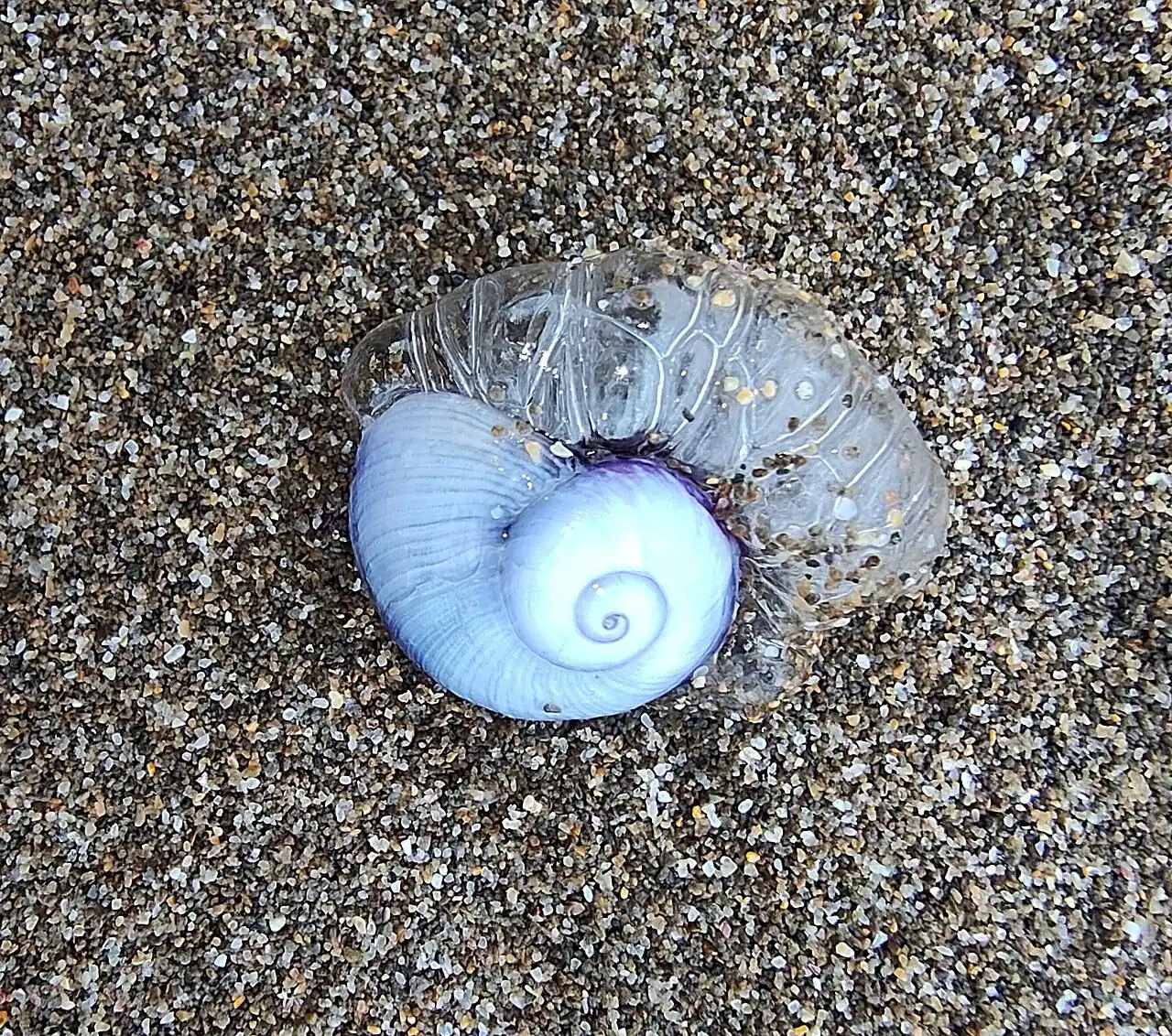
Violet Sea Snail
Janthina janthina
A purple sea snail that never touches the bottom, floating its whole life on a raft of bubbles it builds from its own mucus.
Photo: Basustako / CC BY 4.0
3 things to know
- It stays afloat by trapping air in quick-setting mucus to build a raft of bubbles.
- It eats floating relatives of jellyfish, including by-the-wind sailors.
- Its ancestors were sea-floor snails called wentletraps.
- Scientific name
- Janthina janthina
- Depth
- At the surface
- Size
- Shell about 3 cm (1.2 in) across; SeaLifeBase gives a maximum of 3.7 cm (1.5 in)
- Weight
- Unknown
- Lifespan
- Unknown
- Diet
- Floating relatives of jellyfish, such as by-the-wind sailors and Portuguese man o' war
- Where
- Tropical and subtropical waters of the Atlantic, Pacific and Indian oceans
- IUCN status
- Not Evaluated
- Depth zones
- Sunlight
Janthina janthina is a sea snail that, in the Australian Museum's words, spends most of its life floating on the ocean surface, hanging beneath a raft of bubbles it builds itself and going wherever wind and currents take it. Its thin, rounded shell is purple and about 3 centimeters (1.2 inches) across. The species lives in tropical and subtropical waters of the Atlantic, Pacific and Indian oceans. Violet snails sometimes wash ashore in large numbers, and the Australian Museum notes strandings around Sydney in summer.
The raft is the snail's lifeline. University of Michigan graduate student Celia Churchill and colleagues describe how these snails trap air inside quick-setting mucus to make bubbles that stick together. In a 2021 study of floating animals collected in the Sargasso Sea, Rebecca Helm photographed the steps: the snail reaches its foot up to the surface, curls it around a pocket of air, glues the new bubble onto the raft and, after adding several, smooths the surface over.
Its food floats too. Violet snails eat drifting relatives of jellyfish, such as by-the-wind sailors and the Portuguese man o' war. Helm found that large J. janthina often fed along the edges of by-the-wind sailors and man o' war, while a related species, J. pallida, ate only by-the-wind sailors. In a 2023 study, Fiona Chong and colleagues found floating animals denser inside the Great Pacific Garbage Patch than on its edges, with Janthina more abundant where there was more plastic.
According to the Australian Museum, all violet snails begin life as males and later become females. In some related species, females carry their eggs on the raft, but in J. janthina the female makes no egg mass and instead broods the eggs inside her body.
That difference helped solve the raft's origin. In a 2011 paper in Current Biology, Churchill, Diarmaid Ó Foighil, Ellen Strong of the Smithsonian Institution and Adriaan Gittenberger traced the rafting snails back to wentletraps, snails that live on the sea floor and feed as parasites of corals and sea anemones. They concluded that bubble rafting evolved from modified egg masses, which kept carrying eggs in some species and became pure floats in others, such as J. janthina. The species has not been assessed by the IUCN.
Sources
- australian.museum/learn/animals/molluscs/violet-snail
- sealifebase.se/summary/Janthina-janthina.html
- sciencedaily.com/releases/2011/10/111011112925.htm
- Study: doi:10.1016/j.cub.2011.08.011
- Study: doi:10.1007/s12526-021-01233-5
- commons.wikimedia.org/wiki/File:Janthina_janthina_constructing_a_bubble_raft.jpg
- Study: doi:10.1371/journal.pbio.3001646
- api.gbif.org/v1/species/2299286/iucnRedListCategory



