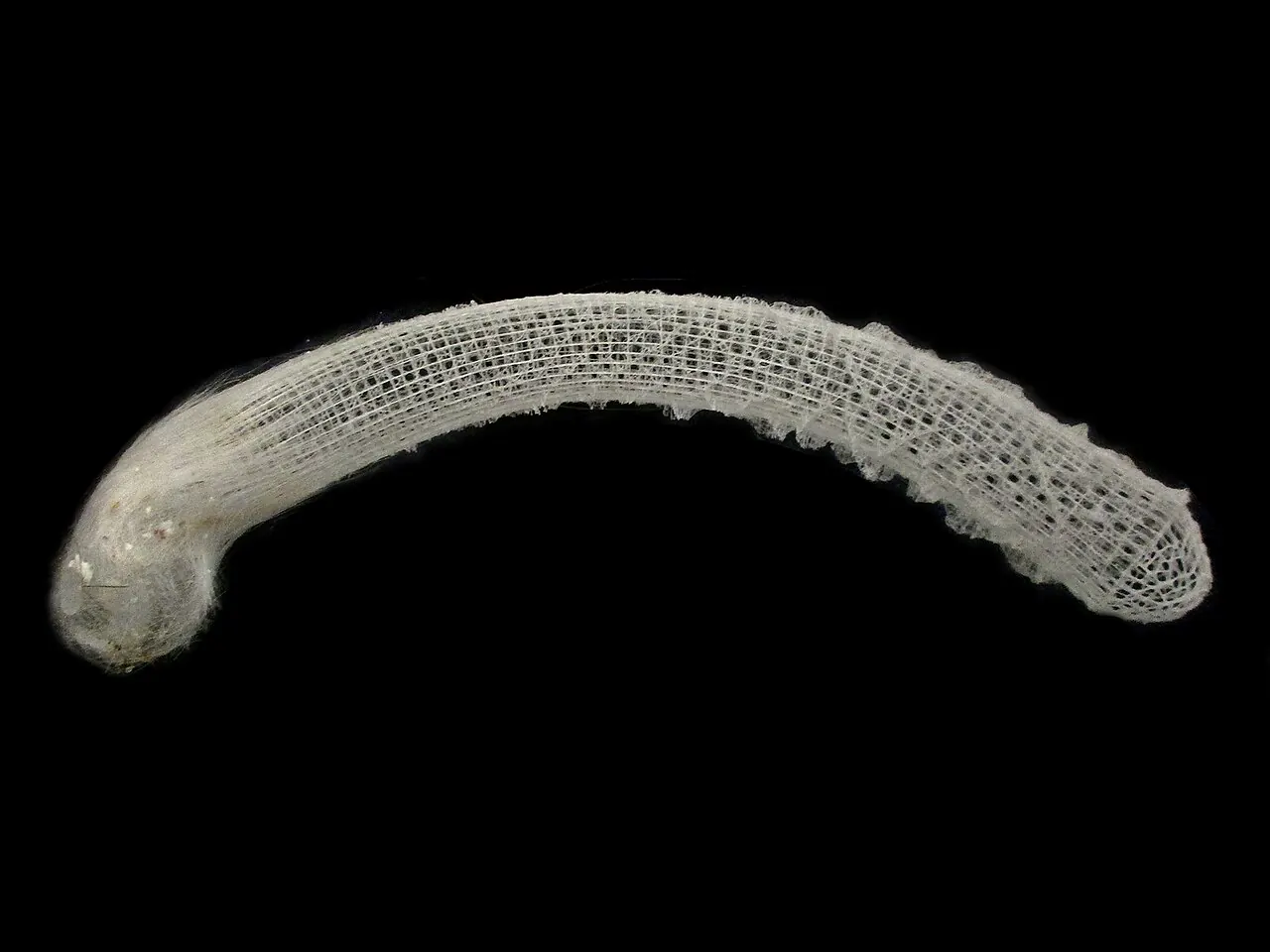
Venus' Flower Basket
Euplectella aspergillum
A deep-sea glass sponge whose lattice skeleton often holds a pair of shrimp for life. Spicules from its genus carry light like optical fibers.
Photo: Bj.schoenmakers / CC BY 4.0
3 things to know
- Its skeleton is made of silica, the main ingredient of glass.
- A male and a female shrimp often live inside, and grow too large to get out.
- Researchers at Bell Labs reported in 2003 that spicules from its genus, Euplectella, carry light much like telecommunication fibers.
- Scientific name
- Euplectella aspergillum
- Depth
- 100 m – 1,000 m
328 – 3,281 ft - Size
- Most about 10–30 cm (4–12 in) tall, according to Animal Diversity Web
- Weight
- Unknown
- Lifespan
- Unknown
- Diet
- Bacteria, plankton and organic particles filtered from seawater
- Where
- Western Pacific, including the Philippines; forms have also been described from Indonesian and Australian waters
- IUCN status
- Not Evaluated
- Depth zones
- Sunlight · Twilight
Glass holds up the Venus' flower basket. Euplectella aspergillum is a hexactinellid, or glass sponge, and its silica spicules are fused into a curved tube of square-meshed lattice, reinforced by diagonal ridges that wind around the outside. Animal Diversity Web's account puts most at 10 to 30 centimeters (4 to 12 inches) tall. At the base grows a tuft of glass fibers about as thick as a human hair, which anchors the sponge in the soft seafloor.
It lives in the western Pacific, including around the Philippines, at depths of roughly 100 to 1,000 meters (330 to 3,300 feet), and forms of the species have been described from Indonesian and Australian waters. It filters bacteria, plankton and organic particles from the water passing through its body. How it breeds and how long it lives are not well known.
The lattice often holds a pair of small shrimp, one male and one female. The Australian Museum says they enter while small. According to NOAA, they grow too big to escape and spend their lives inside, cleaning the sponge and feeding on its waste, while their tiny young leave to find baskets of their own. In Japan the sponge is called kairou douketsu, which a 2021 research team translates as "together for eternity." In some Pacific cultures, the museum adds, the pair has come to symbolize marriage, and the basket is given as a wedding gift.
Materials scientists have studied the skeleton for years. In 2003 Vikram Sundar, Joanna Aizenberg and colleagues at Bell Labs reported that the glass spicules of Euplectella, its genus, carry light with properties surprisingly close to those of commercial telecommunication fibers, though the sponge forms them under normal ambient conditions. In 2005 Aizenberg's team traced the skeleton of a Euplectella from nanometer-sized silica spheres up to the whole cage and found that the design overcomes the brittleness of glass. In 2021 Giacomo Falcucci and colleagues simulated water flowing around and through the basket on a grid of more than 50 billion points. The ridges and lattice reduced the stress from the current and set up slow, swirling flows inside the body cavity, which the team suggested could help with filter feeding and reproduction.
The species has not been assessed by the IUCN.
Sources
- oceanservice.noaa.gov/facts/glass-sponge.html
- arxiv.org/pdf/2305.10901
- Study: doi:10.1038/s41586-021-03658-1
- animaldiversity.org/accounts/Euplectella_aspergillum
- sealifebase.se/summary/Euplectella-aspergillum.html
- Study: doi:10.11646/zootaxa.1866.1.3
- Study: doi:10.1038/424899a
- Study: doi:10.1126/science.1112255
- Study: doi:10.1016/j.jsb.2006.10.027
- phys.org/news/2005-07-deep-sea-sponge-yields-substantial-mechanical.html
- australian.museum/Invertebrates-Collection-Deepsea-Glass-Sponge
- churaumi.okinawa/en/fishbook/1459383412



