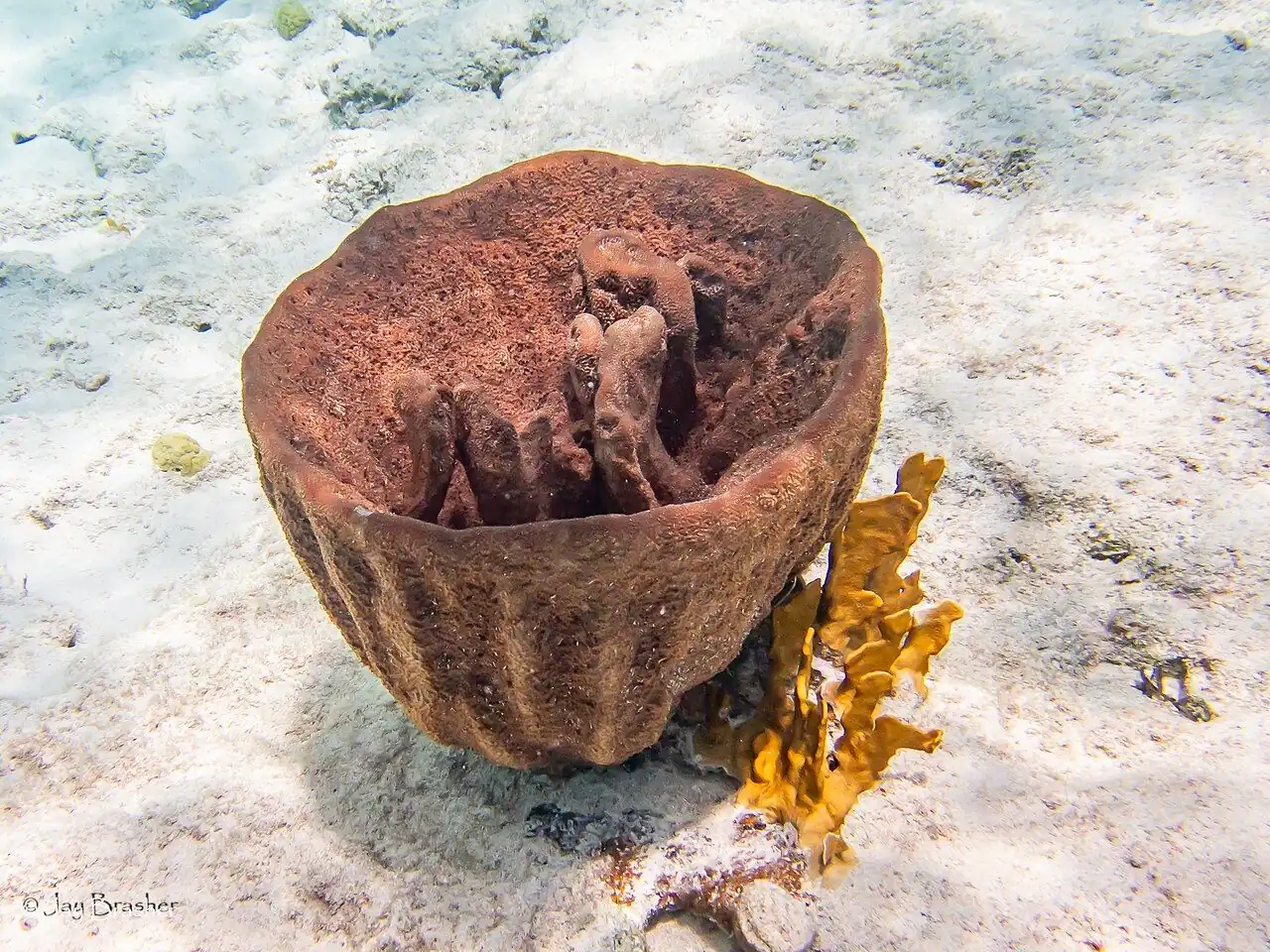
Vase Sponge
Ircinia campana
A rubbery, vase-shaped sponge of Florida and the Caribbean. After a 1991 bloom in Florida Bay, more than 80 percent died on one set of study sites.
Photo: Jay Brasher / CC BY 4.0
3 things to know
- It makes no spicules of its own; its skeleton is a mesh of fibers holding sand and bits of other sponges' spicules.
- In lab tests, fish refused food laced with its extracts from every site sampled, from the southeastern US to the Caribbean.
- Juvenile spiny lobsters in Florida Bay use it and other large sponges as shelter.
- Scientific name
- Ircinia campana
- Depth
- 1 m – 18 m
3 – 59 ft - Size
- Up to about 60 cm (24 in) tall and 40 cm (16 in) across the top
- Weight
- Unknown
- Lifespan
- Unknown
- Diet
- Particles and dissolved organic matter filtered from seawater
- Where
- North Carolina and the Gulf of Mexico through the Caribbean to Brazil; also reported from the Mediterranean
- IUCN status
- Not Evaluated
- Depth zones
- Sunlight
Shaped like a vase, cup or bowl, sometimes closer to a cylinder, Ircinia campana grows up to about 60 centimeters (24 inches) tall and 40 centimeters (16 inches) across the top, with walls 0.5 to 3 centimeters thick. It is brown, greenish brown or reddish brown, rubbery and hard to cut. It makes no spicules of its own. Its skeleton is an irregular mesh of fibers with sand grains and broken spicules from other sponges caught in it.
The Porifera Tree of Life guide gives its range as North Carolina and the Gulf of Mexico through the Caribbean to Brazil, and also lists the Mediterranean. It is common on shallow hard bottoms, seagrass beds and inshore reefs in as little as 1 meter (3 feet) of water. A Caribbean reef guide puts its depth at 1 to 18 meters (3 to 60 feet), and SeaLifeBase lists it down to 79 meters (260 feet). Like other sponges it feeds by pumping seawater through its body. A 2017 study on a Florida Keys reef found that the water flowing out of vase sponges carried a distinct mix of dissolved organic compounds.
The sponge is also chemically defended. In 2017 Clark Marino, Joseph Pawlik and colleagues sampled vase sponges at five sites from the South Atlantic Bight, off the southeastern US, to the Caribbean. The microbes living in the sponges differed from region to region, yet crude extracts from every site were rejected in lab feeding tests by the bluehead (Thalassoma bifasciatum), a small reef wrasse.
Vase sponges took a heavy blow in Florida Bay, the shallow lagoon between the Florida mainland and the Keys. In 1991 blooms of cyanobacteria spread over the bay and coincided with the death of sponges over hundreds of square kilometers. Butler and colleagues had mapped nearly every vase sponge and loggerhead sponge on 27 study sites. When they returned after the bloom faded in February 1992, more than 80 percent of the vase sponges, candle sponges and commercial sponges had died. Juvenile Caribbean spiny lobsters, which shelter in sponges, shifted into the remaining shelters, and their numbers fell on sites without artificial shelters.
The vase sponge has not been assessed by the IUCN.
Sources
- guide.poriferatreeoflife.org/sp_86.html
- reefguide.org/irciniacampana.html
- sealifebase.se/summary/Ircinia-campana.html
- Study: doi:10.3354/meps129119
- int-res.com/articles/meps/129/m129p119.pdf
- Study: doi:10.3354/meps12015
- Study: doi:10.7717/peerj.2870
- Study: doi:10.1080/11250003.2011.577565
- api.gbif.org/v1/species/2239030/iucnRedListCategory
- fishbase.se/summary/Thalassoma-bifasciatum.html



