Vaquita
Phocoena sinus
The world's most endangered marine mammal, a small porpoise of Mexico's upper Gulf of California with roughly ten left.
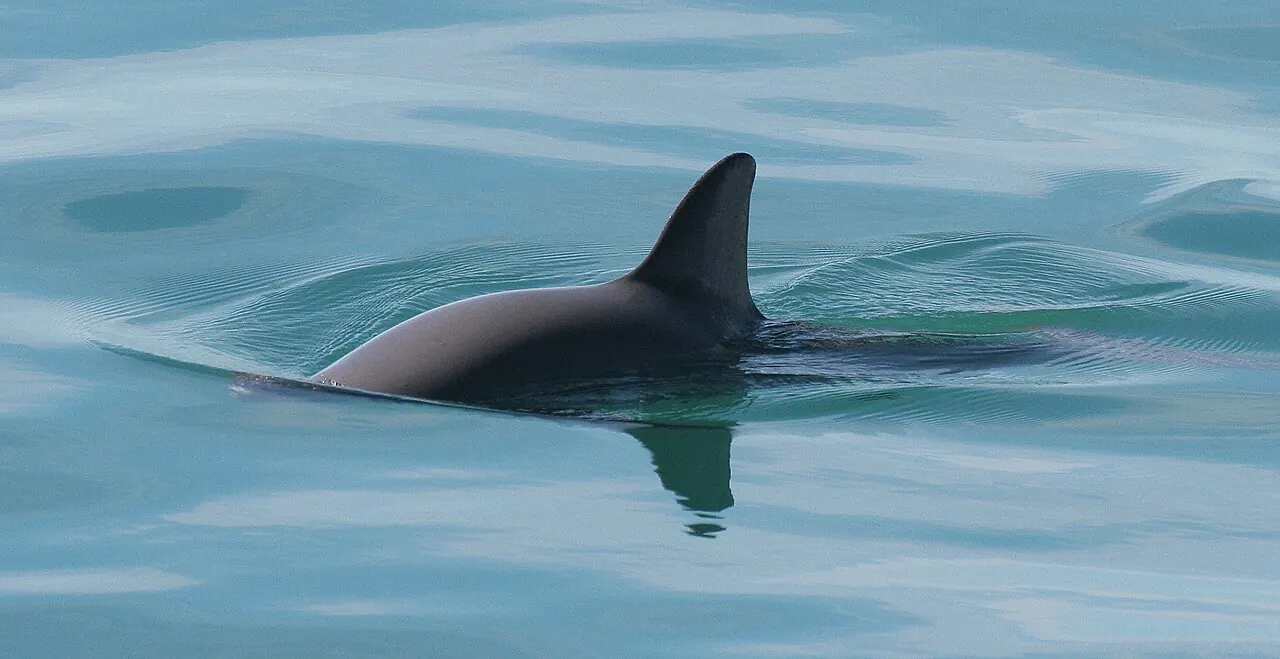
Photo: Paula Olson, NOAA / Public domain
3 things to know
- It has the smallest range of any whale, dolphin or porpoise.
- Its dorsal fin is taller and wider than other porpoises' fins.
- In 2025 observers saw an estimated 7 to 10 different vaquitas, including at least one calf.
- Scientific name
- Phocoena sinus
- Depth
- 0 m – 50 m
0 – 164 ft - Size
- About 1.2–1.5 m (4–5 ft) long
- Weight
- About 30–55 kg (65–120 lb)
- Lifespan
- At least 21 years
- Diet
- Small fish, shrimp and other crustaceans, squid and octopuses
- Where
- Only the northern Gulf of California, Mexico
- IUCN status
- Critically Endangered
- Depth zones
- Sunlight
At about 1.2 to 1.5 meters (4 to 5 feet) long, the vaquita is one of the smallest members of the whale, dolphin and porpoise family. It is a small, sturdy porpoise with a rounded, beakless head and dark patches around its eyes and lips. Its triangular dorsal fin is taller and wider than other porpoises' fins, which might help it shed heat in warm water. Females are longer than males, but males have bigger fins.
No other marine mammal has a smaller range. Vaquitas live only in the northern Gulf of California, mostly east of the town of San Felipe in an area of about 3,900 square kilometers (1,519 square miles), less than a quarter the size of metropolitan Los Angeles. They keep to shallow, murky water less than 50 meters (165 feet) deep. They travel alone or in pairs, and avoid boats with running engines. They eat small fish, shrimp and other crustaceans, squid and octopuses. Vaquitas live at least 21 years, mature at 3 to 6, and usually give birth between February and April to a single calf about 76 centimeters (2.5 feet) long.
Gillnets are the only known threat, and vaquitas die in every type. Legal fishing, mostly for shrimp sold to the United States, cut the population from about 600 in 1997 to about 200 in 2008. Around 2011, illegal fishing for the totoaba, a big fish whose swim bladder is smuggled to China and earns fishermen up to $8,500 a kilogram, caused a crash of close to half the population each year. Mexico banned most gillnets in 2017, but illegal netting went on. In 2022 the Mexican Navy seeded the core protected area with concrete blocks carrying 3-meter metal hooks to stop gillnetting, and nets have since nearly disappeared from it. The IUCN lists the vaquita as Critically Endangered.
Recent surveys give minimum counts rather than population totals. In September 2025 observers aboard two Sea Shepherd ships, guided by underwater listening devices, saw an estimated 7 to 10 different vaquitas, compared with 6 to 8 in 2024. At least one calf was seen; its mother, Frida, recognizable by her bent dorsal fin, also had a calf in 2023. Genetics offers some hope. In 2022 Jacqueline Robinson and colleagues sequenced the genomes of 20 vaquitas and reported in Science that the species carries few harmful mutations and can recover if deaths in nets stop immediately.
Sources
- fisheries.noaa.gov/species/vaquita
- iucnredlist.org/species/17028/214541137
- sealifebase.se/summary/Phocoena-sinus.html
- seashepherd.org/2025/10/28/results-of-the-2025-vaquita-monitoring-effort
- iucn-csg.org/joint-visual-and-acoustic-survey-finds-vaquitas-surviving-and-reproducing-…
- iucn-csg.org/wp-content/uploads/2025/11/Report-vaquita-acoustic-and-visual-survey-2025-…
- Study: doi:10.1126/science.abm1742
- en.wikipedia.org/wiki/Vaquita



