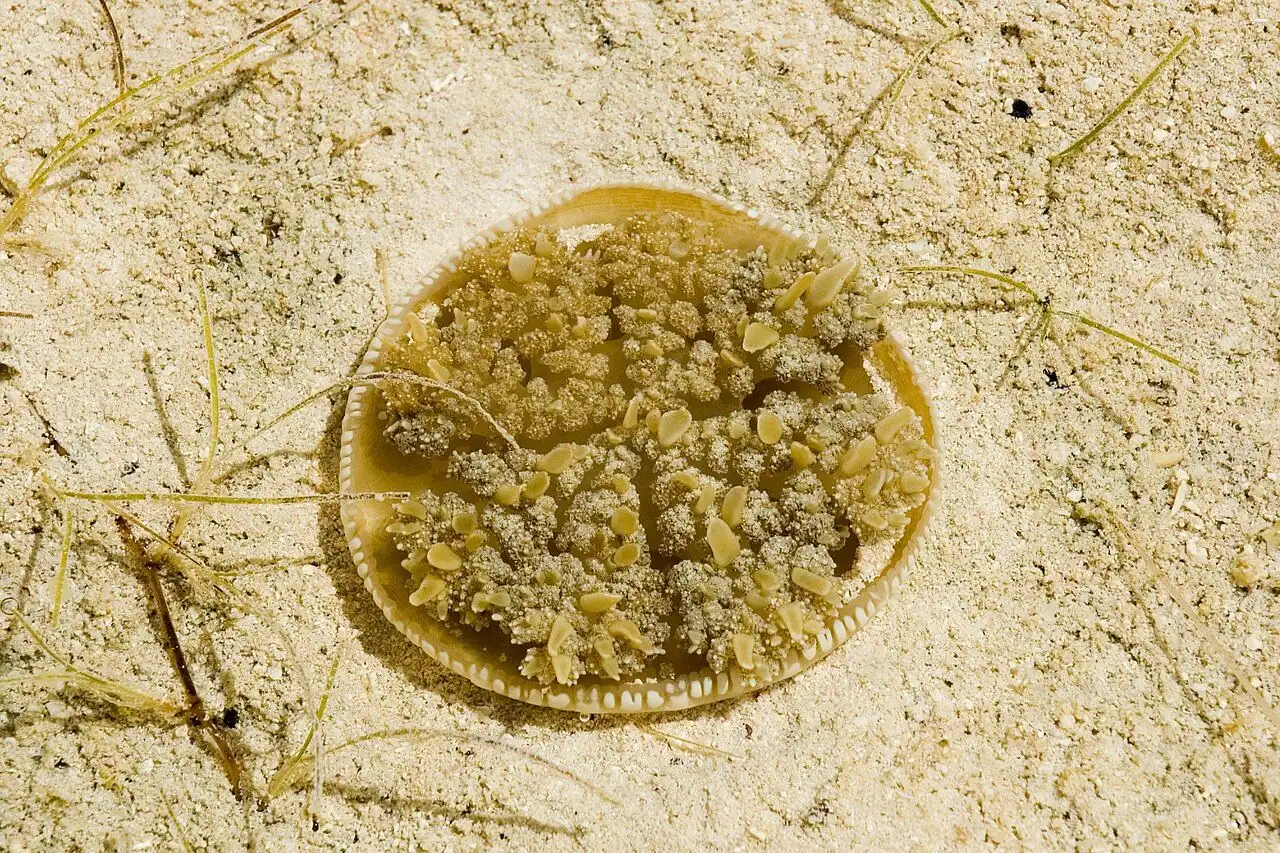
Upside-Down Jellyfish
Cassiopea spp. (genus of 11 species, family Cassiopeidae)
Jellyfish that lie bell-down on shallow seafloors so the algae in their arms get sunlight, and that show a sleep-like state at night.
Photo: Paul Asman and Jill Lenoble / CC BY 2.0
3 things to know
- Algae living in its tissues supply most of its food.
- In 2017 Caltech researchers reported a sleep-like state in this jellyfish, which has no brain.
- Its mucus carries tiny stinging balls, called cassiosomes, that can sting without the jellyfish touching you.
- Scientific name
- Cassiopea spp. (genus of 11 species, family Cassiopeidae)
- Depth
- 0 m – 10 m
0 – 33 ft - Size
- Bell about 15 cm (6 in) across in the western Atlantic C. xamachana; up to about 30 cm (12 in) in the Indo-Pacific C. andromeda
- Weight
- Unknown
- Lifespan
- Unknown
- Diet
- Mostly food made by algae living in its tissues, plus small animals caught with stinging cells
- Where
- Warm, shallow coasts around the world, including Florida and the Caribbean; introduced to Hawaii and the Mediterranean
- IUCN status
- Not Evaluated
- Depth zones
- Sunlight
An upside-down jellyfish spends most of its time lying on the bottom with its bell down and its frilly arms facing up, pulsing gently. The pose serves its lodgers. Algae living in the jellyfish's tissues need sunlight, and according to the Smithsonian they supply most of its nutrition. Members of the genus Cassiopea live in calm, warm, shallow water, often in mangrove-lined lagoons, on sandy mudflats and among seagrass. The western Atlantic C. xamachana is found from the surface to about 10 meters (33 feet) and grows to about 15 centimeters (6 inches) across, while the Indo-Pacific C. andromeda reaches about 30 centimeters (12 inches).
Telling the species apart has long been contentious. In 2004 Brenden Holland of the University of Hawaiʻi and colleagues compared genes from Florida Keys, Bermuda, Panama, Hawaii, the Red Sea and the western Pacific. They found signs of hidden species and at least two separate introductions to the Hawaiian Islands, where upside-down jellies arrived during World War II. The World Register of Marine Species now accepts 11 species in the genus.
The jellyfish has no brain, yet a Caltech team led by Ravi Nath, Claire Bedbrook and Michael Abrams reported in 2017 that it has a sleep-like state. They tracked 23 jellies from a stock originally collected in the Florida Keys over six days and nights. All of them pulsed less at night, about 32% less on average, and food could quickly bring them back to daytime activity. When the team disturbed them through a full 12-hour night, their activity dropped by about 17% the following day.
Snorkelers in mangrove waters where C. xamachana lives sometimes feel a prickling called stinging water. In 2020 Cheryl Ames of the Smithsonian's National Museum of Natural History and the US Naval Research Laboratory, with colleagues, traced it to what they named cassiosomes: tiny balls of stinging cells wrapped around a core of algae, released in the jellyfish's mucus. In the lab they killed brine shrimp, and the team found similar structures in four related jellyfish species. None of the 11 Cassiopea species has been assessed for the IUCN Red List.
Sources
- marinespecies.org/aphia.php
- sealifebase.se/summary/Cassiopea-xamachana.html
- sealifebase.se/summary/Cassiopea-andromeda.html
- Study: doi:10.1007/s00227-004-1409-4
- Study: doi:10.1016/j.cub.2017.08.014
- pmc.ncbi.nlm.nih.gov/articles/PMC5653286
- Study: doi:10.1038/s42003-020-0777-8
- eurekalert.org/news-releases/494988
- en.wikipedia.org/wiki/Cassiopea
- api.gbif.org/v1/species/2264599/iucnRedListCategory



