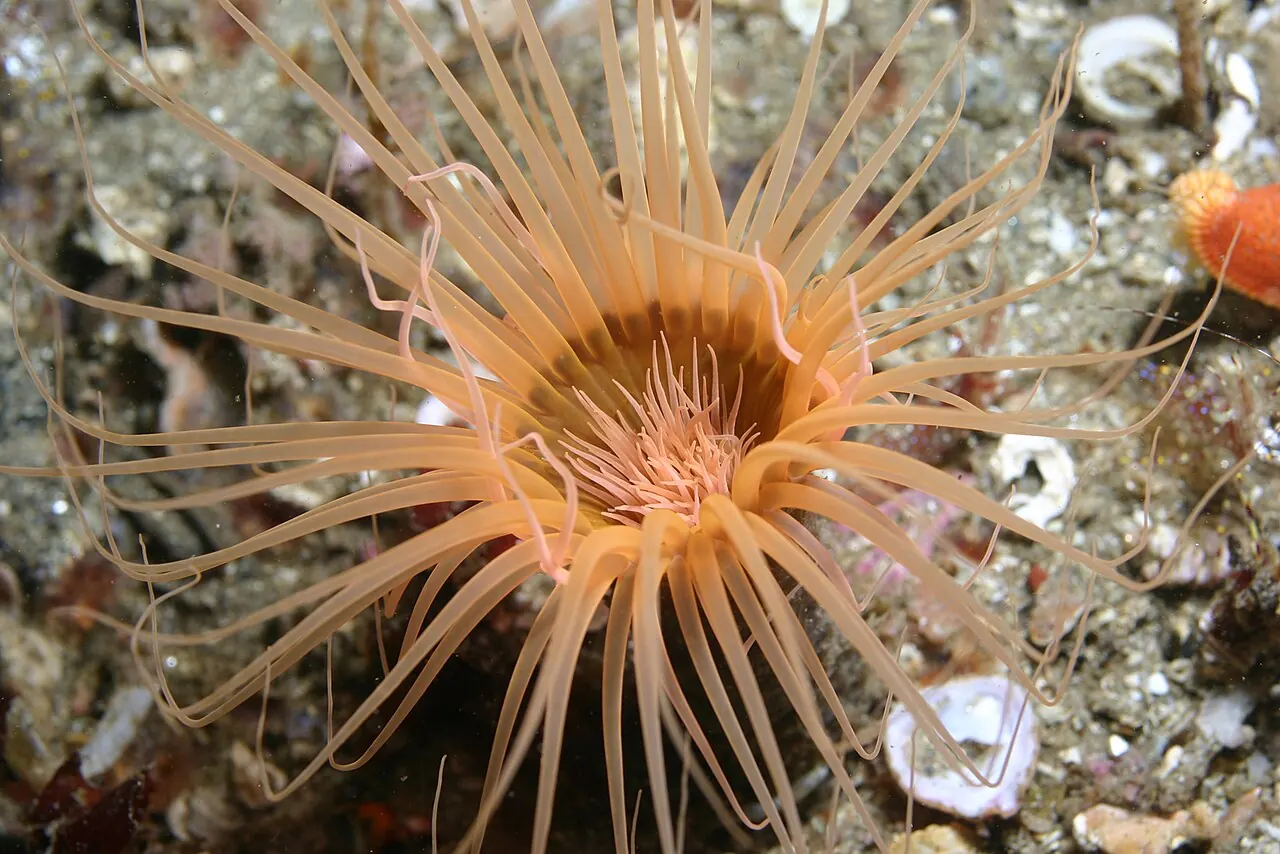
Tube Anemone
Subclass Ceriantharia (54 species in 8 genera, including Pachycerianthus and Cerianthus)
Burrowing anthozoans that live in tubes made from threads of a special cnida, the ptychocyst, and keep their mitochondrial DNA in pieces.
Photo: Chad King / NOAA MBNMS / Public domain
3 things to know
- Tube anemones are not true sea anemones; they form their own group, Ceriantharia.
- Their tubes are built from the threads of a special kind of cnida called a ptychocyst.
- In 2019 one species had the largest animal mitochondrial genome yet reported.
- Scientific name
- Subclass Ceriantharia (54 species in 8 genera, including Pachycerianthus and Cerianthus)
- Depth
- 0 m – 21 m
0 – 69 ft - Size
- Varies by species; the Pacific Pachycerianthus fimbriatus grows to about 34 cm (13.5 in) tall, with a tube reaching about 60 cm (2 ft) into the sand
- Weight
- Unknown
- Lifespan
- Unknown
- Diet
- Small invertebrates and plankton
- Where
- Soft seafloors in the Atlantic and Pacific oceans and the Mediterranean; US species live along the Pacific coast and from the Atlantic coast to the Gulf of Mexico
- IUCN status
- Not Evaluated (species checked)
- Depth zones
- Sunlight
A tube anemone looks like a sea anemone with a wild head of hair: long, slender outer tentacles around a tuft of short ones at the mouth, all rising from a tube buried in sand or mud. Despite the name, tube anemones are not true sea anemones. They make up their own group of anthozoans, the subclass Ceriantharia, defined by those two sets of tentacles and by the tube. It is built from the threads of a special kind of cnida, the ptychocyst.
On the US West Coast, the Monterey Bay Aquarium shows Pachycerianthus fimbriatus, a species that SeaLifeBase lists from Alaska to the Galapagos. It grows to about 34 centimeters (13.5 inches) tall and lives on sand and soft mud from the low intertidal zone down to about 21 meters (69 feet), the depth range used in the header. Its leathery tube runs about 60 centimeters (2 feet) into the sand. When a predator such as a barber slug comes to clip its tentacles, the anemone shoots back down the tube, sometimes pulling the slug in with it, and the lost tentacles grow back. It eats small invertebrates and plankton.
On the other coast, Ceriantheopsis americana lives from Atlantic Canada and the US East Coast to the Gulf of Mexico and the Caribbean, 2 to 250 meters (7 to 820 feet) deep. In a 2020 world catalog, Sérgio Stampar and colleagues called it probably the most studied tube anemone, yet noted that photos from robot submarines below 400 meters may show it in the deep sea, where no specimen has been collected. Their catalog counts 54 valid species in eight genera, says most still need detailed study, and argues that the West Coast animals may be a species of their own, separate from Philippine P. fimbriatus.
Their DNA is unusual too. In 2019, Stampar, Marymegan Daly and colleagues sequenced the mitochondrial genomes of two tube anemones, Isarachnanthus nocturnus and Pachycerianthus magnus. Instead of a single loop, the genes appeared to sit on several separate linear pieces, five in one species and eight in the other, something never before reported among anthozoans. At 80,923 DNA base pairs, the I. nocturnus mitochondrial genome was the largest yet reported for any animal. Where tube anemones belong among the corals and anemones remains unsettled.
None of the species we checked has been assessed for the IUCN Red List.
Sources
- montereybayaquarium.org/animals/animals-a-to-z/tube-anemone
- zookeys.pensoft.net/article_preview.php
- sealifebase.se/summary/Pachycerianthus-fimbriatus.html
- sealifebase.se/summary/Cerianthus-membranaceus.html
- Study: doi:10.1038/s41598-019-42621-z
- nature.com/articles/s41598-019-42621-z
- api.gbif.org/v1/species/2258602/iucnRedListCategory
- api.gbif.org/v1/species/2258556/iucnRedListCategory



