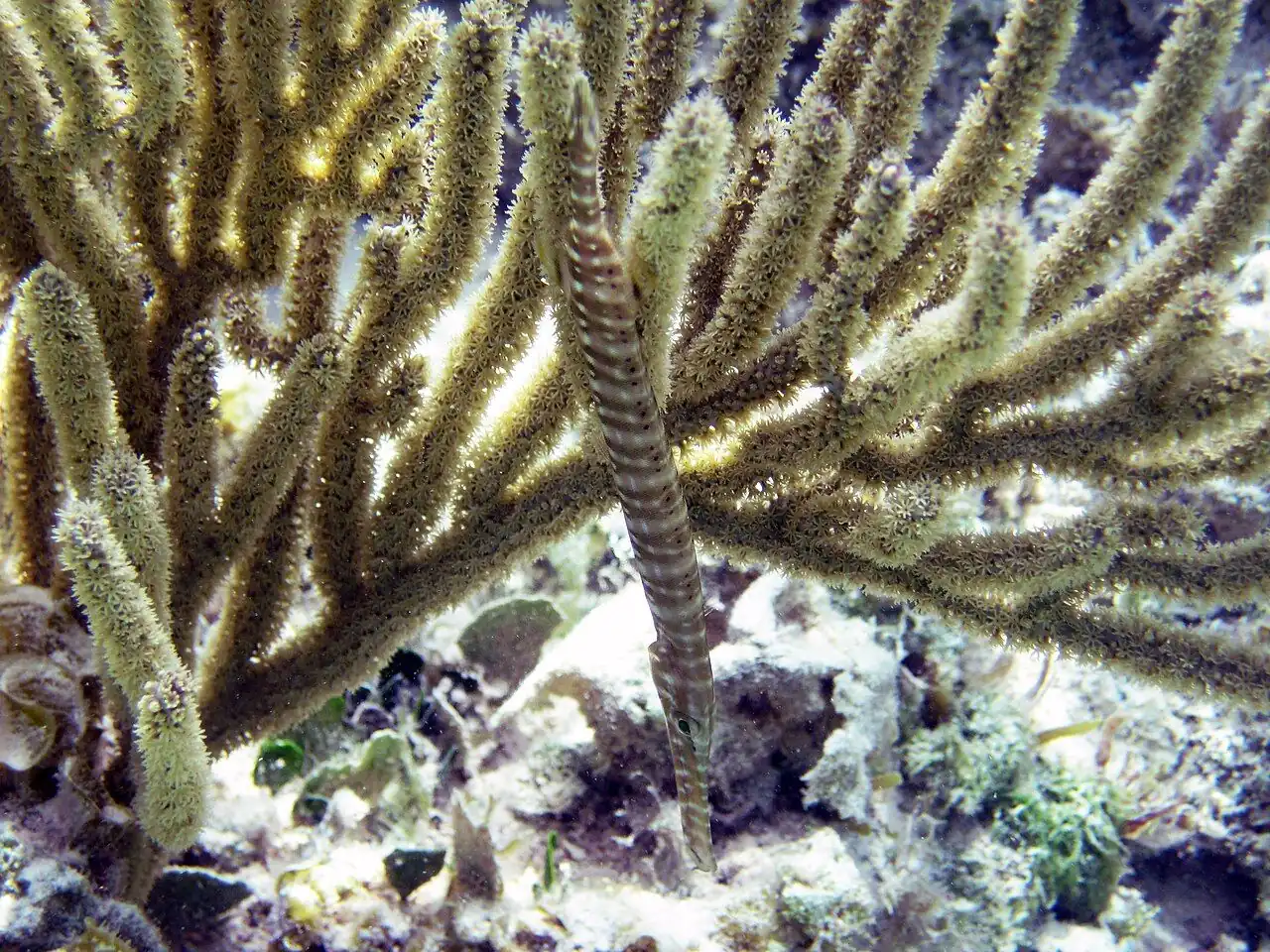
Trumpetfish
Aulostomus maculatus
A stick-shaped Atlantic reef predator that hangs head down among sea rods and sneaks up on prey by swimming alongside other fish.
Photo: James St. John / CC BY 2.0
3 things to know
- Its mouth can open as wide as its body to suck in prey.
- It hides from prey by swimming tight against larger, harmless fish.
- The IUCN listed it as Near Threatened in a 2024 global assessment.
- Scientific name
- Aulostomus maculatus
- Depth
- 2 m – 25 m
7 – 82 ft - Size
- Up to 1 m (39 in) long; usually about 60 cm (24 in)
- Weight
- Not well known
- Lifespan
- Unknown
- Diet
- Small fish and crustaceans
- Where
- Western Atlantic from southern Florida and Bermuda to northern South America; also St. Paul's Rocks
- IUCN status
- Near Threatened
- Depth zones
- Sunlight
A trumpetfish often hangs head down among sea rods and sea whips, its long, stiff body lined up with the branches. It is built like a stick: very long and somewhat flattened, with a long, tube-shaped snout, a barbel on the chin, and a row of 8 to 12 separate spines in front of the dorsal fin. Most are mottled reddish brown, but individuals can be blue-gray, bright yellow or green, and they change color to match their surroundings. The Atlantic species reaches 1 meter (39 inches) and is more often about 60 centimeters (2 feet).
It lives in the western Atlantic from southern Florida and Bermuda to northern South America, and at St. Paul's Rocks in the middle of the Atlantic, on reefs and in weedy areas 2 to 25 meters (7 to 82 feet) deep. Its family has a single genus with three species.
It hunts small fish and crustaceans by ambush. Elastic tissue lets the mouth open to the width of the body, and the fish sucks prey in. Documented prey includes ocean surgeon, blue chromis, French grunts, squirrelfish, spotted goatfish, blennies and gobies. Groupers and snappers eat trumpetfish in turn.
It also hunts by hiding behind other fish. A trumpetfish swims tight against a larger, harmless fish such as a parrotfish, a habit called shadowing, and strikes from that cover. Sam Matchette, James Herbert-Read and colleagues tested the idea off Curaçao, in work published in 2023, by pulling 3D-printed models past colonies of bicolor damselfish. A trumpetfish model alone made the damselfish approach and then flee to shelter. A trumpetfish model attached to the side of a parrotfish model drew the same response as the parrotfish alone. An earlier citizen-science survey of divers, led by Matchette, found that reports of shadowing cluster in particular parts of the Caribbean.
The IUCN's global assessment, made in 2024 and published in 2026, lists it as Near Threatened. It replaces a 2013 assessment of Least Concern, the status FishBase and the Florida Museum still show. The assessment records a decreasing population and declining habitat quality, and lists invasive species, habitat change, temperature extremes and storms among the threats. It is caught incidentally in traps and seines, sold locally as food, and shown in public aquariums.
Sources
- fishbase.se/summary/Aulostomus-maculatus.html
- floridamuseum.ufl.edu/discover-fish/species-profiles/aulostomus-maculatus
- Study: doi:10.1016/j.cub.2023.05.075
- cam.ac.uk/research/news/stealth-swimmers-the-fish-that-hide-behind-others-to-hunt
- Study: doi:10.1007/s00227-022-04057-4
- iucnredlist.org/species/16421352/86549556



