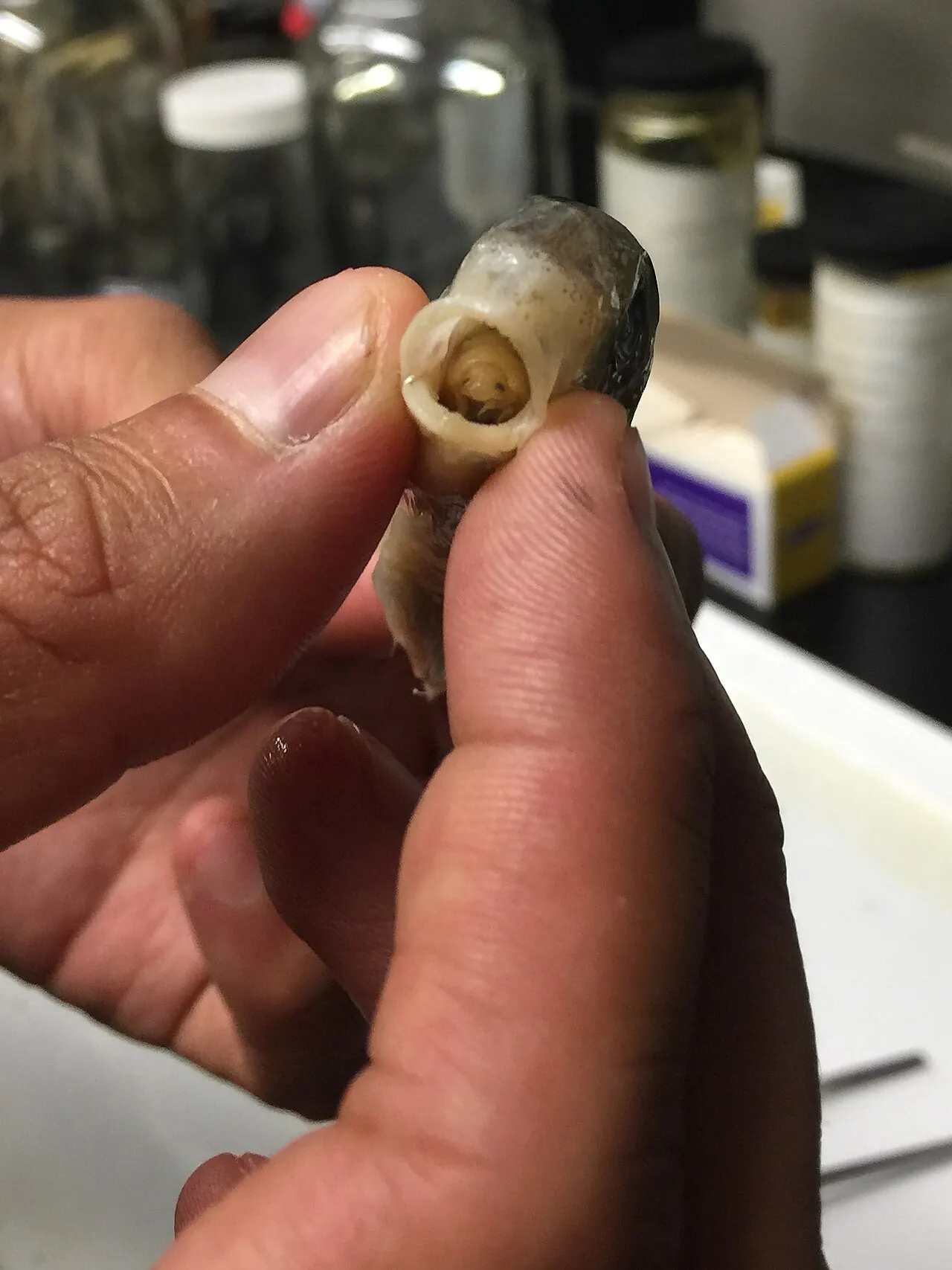
Tongue-Eating Louse
Cymothoa exigua
A small parasitic isopod of the eastern Pacific that destroys a fish's tongue and then sits in its place, possibly doing the tongue's job.
Photo: Frank Schulenburg / CC0
3 things to know
- A 1983 paper called it the first known case of a parasite functionally replacing part of its host.
- Each one lives first as a male in the fish's gills and later becomes a female in its mouth.
- In a year of sampling off Michoacán, Mexico, 165 of 691 snappers carried it.
- Scientific name
- Cymothoa exigua
- Depth
- 2 m – 20 m
7 – 66 ft - Size
- Females 21 to 37 mm (0.8 to 1.5 in) and males 8 to 19 mm (0.3 to 0.75 in) long in one Mexican sample
- Weight
- Egg-bearing females about 0.8 to 1.2 g in one Mexican sample
- Lifespan
- Unknown
- Diet
- Parasite of fishes; how the large females living in the fish's mouth get their food is not settled
- Where
- Eastern Pacific, from the Gulf of California and southwest Baja California south to northern Ecuador
- IUCN status
- Not Evaluated
- Depth zones
- Sunlight
Open the mouth of a spotted rose snapper from the Gulf of California and you may find something where its tongue should be. Cymothoa exigua is a parasitic isopod, a crustacean in the family Cymothoidae, and the female clings to the floor of a fish's mouth in place of a tongue she has caused to waste away.
Richard Brusca of the Allan Hancock Foundation at the University of Southern California and Matthew Gilligan of Savannah State College described the arrangement in Copeia in 1983. In November 1979, Gilligan examined 37 hook-and-line snappers from near Guaymas, in Sonora, Mexico. Two carried the isopod, and in both over 90 percent of the tongue was gone. Each isopod gripped the tongue stub and mouth floor with seven pairs of hooked legs, and its back fit the curve of the fish's palate so closely that the fish's teeth had scuffed it.
Both fish looked healthy, with full guts and fat reserves; one had a 20-by-50-millimeter piece of fish in its stomach. The authors proposed that the isopod works as a stand-in tongue, holding prey against the teeth, and called it the first known case of a parasite functionally replacing part of its host. In a related isopod, earlier work had blamed the tongue's loss on blood feeding, but where the big females in the mouth get their energy was unknown, and some cymothoids may not feed at all.
Like most cymothoids it changes sex, entering the gills as a male and later becoming a female in the mouth. Brusca's 1981 monograph gives its range as the Gulf of California to just north of Ecuador's Gulf of Guayaquil, in water less than 60 meters (200 feet) deep and mostly 2 to 20 meters (7 to 66 feet), on hosts such as snappers, grunts and croakers. Sampling commercial catches off Michoacán, Mexico, in 1984, A. Ruiz and J. Madrid found 236 adults in 165 of 691 red snappers (Lutjanus peru). Females measured 21 to 37 millimeters and carried 480 to 720 eggs. They judged the harm to the snappers minor, though the parasite probably raises deaths among young fish.
Its fame has caused confusion: the Australian Museum notes that blogs and videos often label any mouth-dwelling isopod C. exigua, though about 100 species in eight genera attach inside fish mouths worldwide. This one lives only in the eastern Pacific. The IUCN has not assessed it.
Sources
- Study: doi:10.2307/1444352
- isopods.nhm.org/pdfs/2799/2799.pdf
- Study: doi:10.1111/j.1096-3642.1981.tb01592.x
- isopods.nhm.org/pdfs/2794/2794.pdf
- Study: doi:10.7773/cm.v18i1.885
- cienciasmarinas.com.mx/index.php/cmarinas/article/download/885/807
- australianmuseum.net.au/blogpost/AMRI-Fish-Tongue-Biters-more-than-just-one-of-a-kind
- api.gbif.org/v1/species/2210260/iucnRedListCategory



