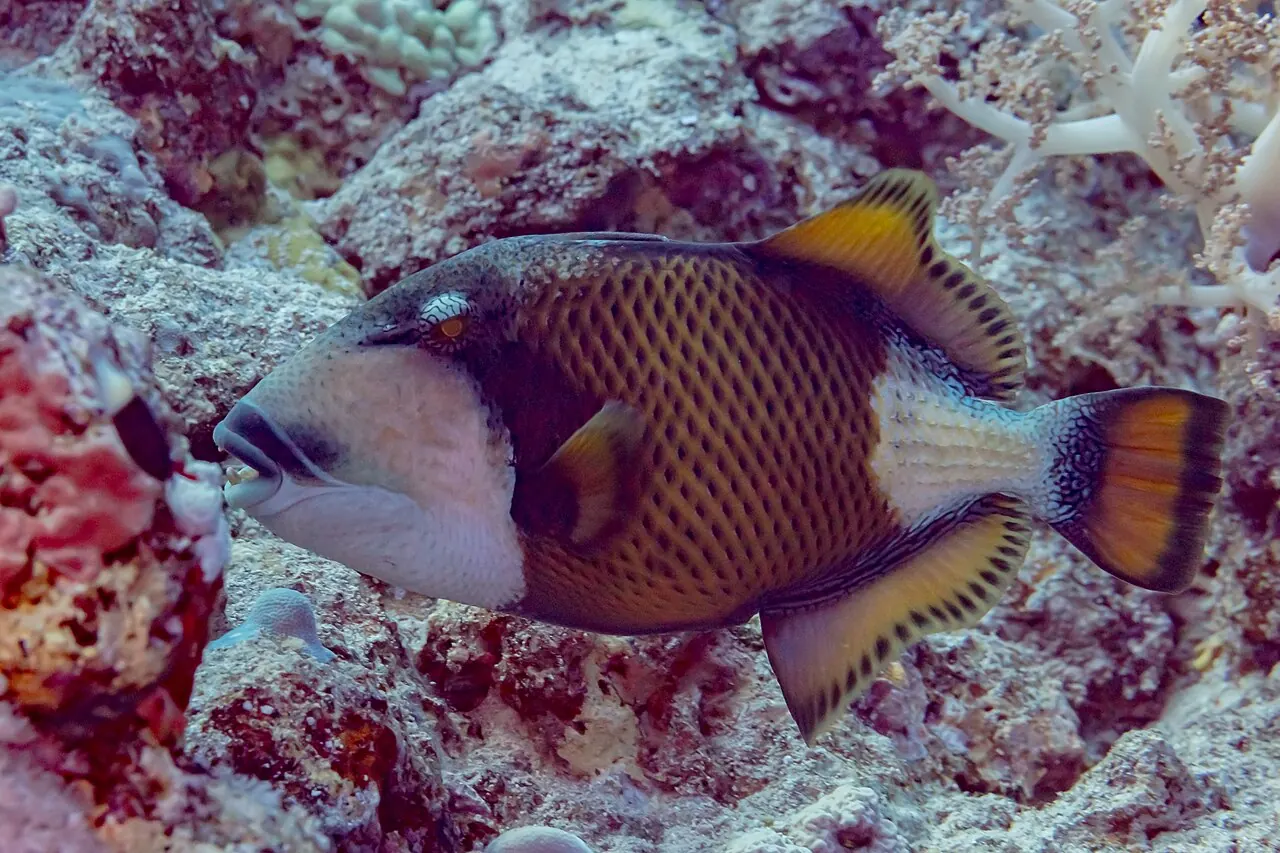
Titan Triggerfish
Balistoides viridescens
The largest triggerfish, a coral-crunching reef fish whose nest-guarding females are known for chasing and biting divers.
Photo: Diego Delso / CC BY-SA 4.0
3 things to know
- It is the largest of the triggerfishes, growing to about 75 centimeters (30 inches).
- Females guarding their nests have attacked divers, and their strong teeth can cause painful injuries.
- One was seen partly beaching itself to chase a ghost crab, a first for its order of fishes.
- Scientific name
- Balistoides viridescens
- Depth
- 1 m – 50 m
3 – 164 ft - Size
- Up to about 75 cm (30 in) long
- Weight
- Not well known
- Lifespan
- Unknown
- Diet
- Sea urchins, coral, crabs and other crustaceans, mollusks and tube worms
- Where
- Indo-Pacific from the Red Sea and East Africa east through northern Australia to the Line and Tuamotu islands, north to southern Japan
- IUCN status
- Least Concern
- Depth zones
- Sunlight
Female titan triggerfish guarding their nests in the breeding season have attacked many divers, according to Fishes of Australia, and their strong teeth can inflict a painful injury. FishBase adds that the fish may attack without being provoked while it is caring for eggs. It is the largest of the triggerfishes, reaching about 75 centimeters (30 inches).
It has a dark, heavily scaled body, a deep groove in front of each eye, a bare patch of skin around the lips and about five rows of small, forward-curving spines on each side near the tail. It ranges from the Red Sea and East Africa east to the Line and Tuamotu islands and north to southern Japan, in lagoons and on seaward reefs, mostly between 1 and 50 meters (3 and 164 feet) deep. Juveniles stay near patches of branching coral or rubble in shallow, sandy, protected spots. Adults travel alone or in pairs along the slopes of deep lagoons and outer reefs.
Those teeth do heavy work on the reef, too. The titan eats sea urchins, coral, crabs and other crustaceans, mollusks and tube worms, and it breaks apart coral rock to reach them. In a 2025 study, William Allison described the fish as an ecosystem engineer after watching it feed in the Maldives, Lakshadweep and Indonesia. One of its preferred foods there is clams that bore into dead coral and weaken the reef from inside. On Kunfunadhoo Reef in the Maldives, the rock a titan wore away rivaled what a single parrotfish removes, though parrotfish as a group eroded far more.
It will even hunt at the water's edge. In 2020 Matthew Tietbohl and colleagues at King Abdullah University of Science and Technology reported a titan triggerfish partly beaching itself while trying to catch a Red Sea ghost crab. It was the first record of the behavior in the order Tetraodontiformes, which also includes pufferfishes and boxfishes.
The IUCN lists the titan triggerfish as Least Concern, from a 2022 assessment. It is caught and sold fresh or dried and salted, although FishBase notes reports of ciguatera poisoning from eating it.



