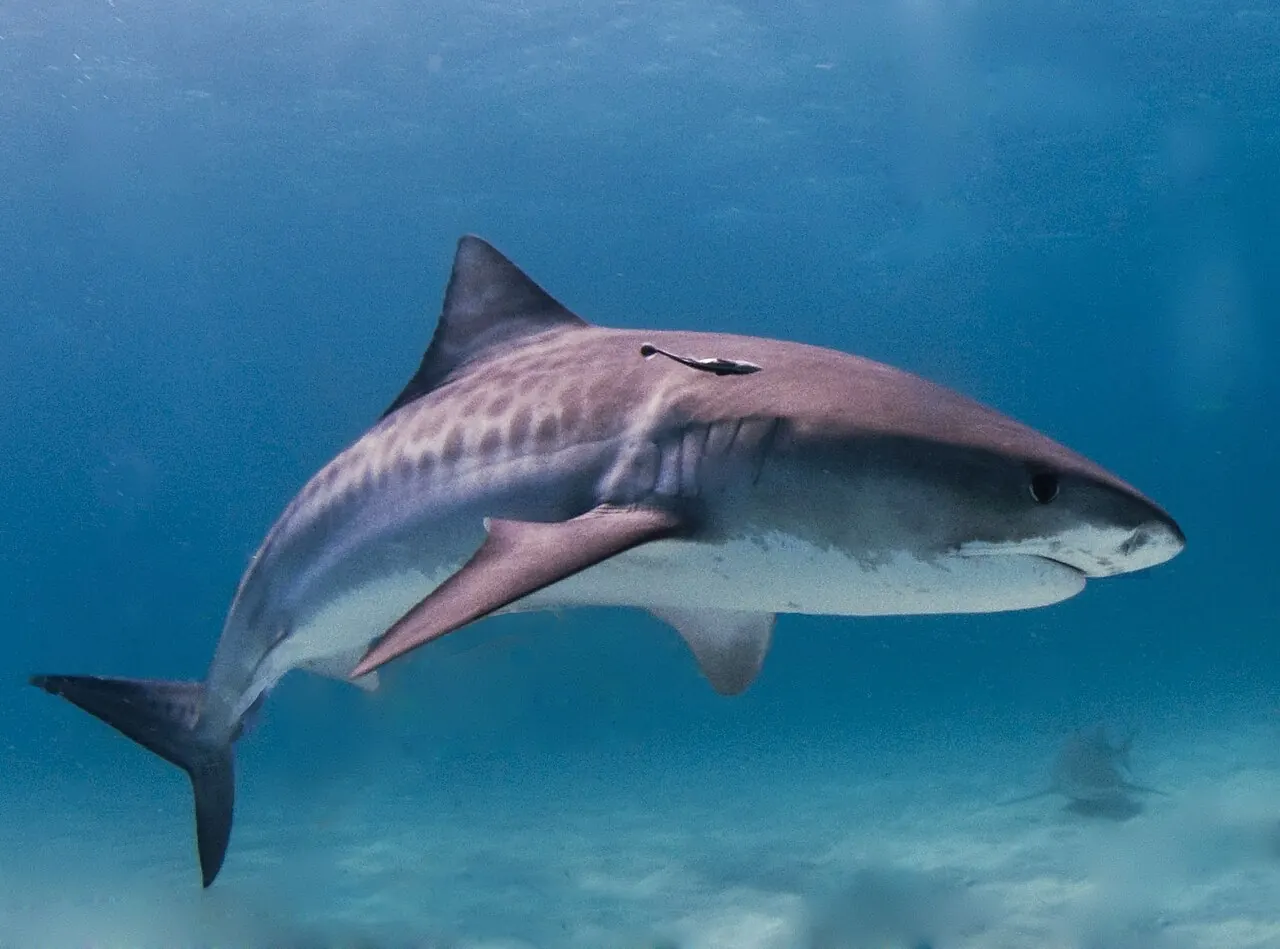
Its stripes are boldest on young sharks and fade as they grow.
A single litter can hold as many as 82 pups.
Young tiger sharks in the Gulf of Mexico have been found with backyard songbirds in their stomachs.
Scientific name
Galeocerdo cuvier
Depth
0 m – 140 m 0 – 459 ft
Size
Commonly 3.25–4.25 m (10–14 ft) long; the largest over 5.5 m (18 ft)
Weight
Commonly 385–635 kg (850–1,400 lb); the heaviest published weight is about 807 kg (1,780 lb)
Lifespan
Maximum reported age about 50 years
Diet
Almost anything: sea turtles, rays, other sharks, bony fish, seabirds, dolphins, squid, crustaceans and carrion
Where
Tropical and temperate seas worldwide, including the Gulf of Mexico, the Caribbean and Hawaii
IUCN status
Near Threatened
Depth zones
Sunlight
Dark vertical bars and blotches give the tiger shark its name. They are boldest on young sharks and fade with age, so on a big adult they are less distinct against a gray back and white belly. Other giveaways are the short, blunt snout and the teeth, which are curved and serrated, with a deep notch on the outer edge. By shaking its head from side to side, the shark saws chunks out of animals much larger than itself.
Tiger sharks live in tropical and temperate seas around the world. In the western Atlantic they range from Massachusetts to Uruguay, including the Gulf of Mexico and the Caribbean, and in the Pacific they reach Hawaii. They favor murky coastal water, river mouths, harbors and the lagoons of island chains, usually within about 140 meters (460 feet) of the surface. Adults commonly measure 3.25 to 4.25 meters (10 to 14 feet), and the largest top 5.5 meters (18 feet).
Few predators eat a wider range of food. The Florida Museum of Natural History lists sea turtles, rays, other sharks, bony fish, seabirds, dolphins, squid, crustaceans and carrion, and sharks caught near harbors often have garbage in their stomachs. Most hunting happens at night, when tiger sharks move inshore and closer to the surface. In the Gulf of Mexico, a survey led by Marcus Drymon of Mississippi State University found bird remains in 41 of 105 young tiger sharks. The birds were mostly land species such as sparrows, woodpeckers and doves, probably tired migrants that had dropped into the sea.
Females give birth to live young after carrying them for 13 to 16 months, with anywhere from 10 to 82 pups in a litter, each 51 to 76 centimeters (about 20 to 30 inches) long. There is no placenta. Once an embryo has used up its yolk, it feeds on fluid inside the uterus.
The tiger shark ranks second only to the white shark in reported bites on people. It is also caught for its fins, meat and liver oil, and taken as bycatch around the world. Catch rates in the mid-Atlantic region have fallen since the mid-1980s, and the IUCN lists the species as Near Threatened.