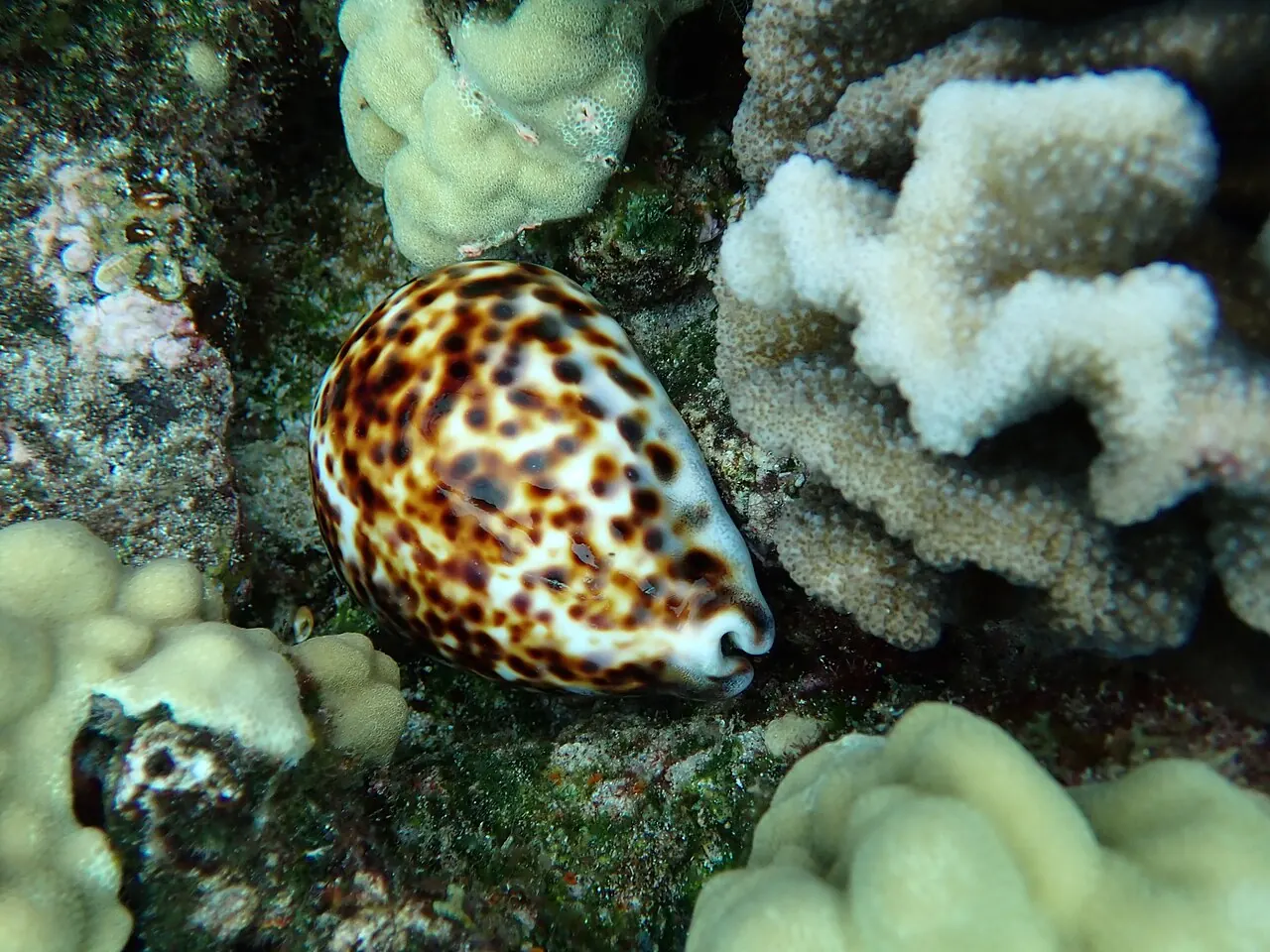
Tiger Cowrie
Cypraea tigris
A large, glossy cowrie of Indo-Pacific reefs whose spotted shell stays polished because the snail keeps wrapping its own mantle over it.
Photo: Kyle Nessen / CC0
3 things to know
- The snail can wrap its fleshy mantle around the outside of its shell, hiding the spots.
- In Hawaiian, cowries are called leho.
- Heavy collecting has made it scarce on some reefs or pushed it deeper than 10 m (33 ft).
- Scientific name
- Cypraea tigris
- Depth
- 0 m – 30 m
0 – 98 ft - Size
- Commonly about 9 cm (3.5 in) long; up to 16 cm (6.3 in)
- Weight
- Not well known
- Lifespan
- Not well known
- Diet
- Omnivore: juveniles eat algae, adults eat small invertebrates; cowries in general eat sponges, snails, seaweed and carrion
- Where
- Indo-Pacific, from the east coast of Africa to the Hawaiian Islands
- IUCN status
- Not Evaluated
- Depth zones
- Sunlight
On a reef, a tiger cowrie often looks nothing like a polished shell. The snail can stretch its fleshy mantle out of the shell and wrap it around the outside, and the mantle is studded with hundreds of short projections that help it blend in. When threatened, it pulls the mantle back in, and the shell appears: a smooth, egg-shaped dome covered in dark spots, commonly about 9 centimeters (3.5 inches) long. SeaLifeBase gives a maximum of 16 centimeters (6.3 inches), and a NOAA sanctuary photo caption gives 18 centimeters (7 inches).
That mantle explains the gloss. According to the University of Colorado Boulder's Museum of Natural History, its constant motion over the shell, covering and uncovering it, keeps the surface polished.
Cypraea tigris lives on warm reefs across the Indo-Pacific, from the east coast of Africa to the Hawaiian Islands, from the shallows to about 30 meters (100 feet). It is found on sand, among rocks and on branching corals, often near seaweed, and SeaLifeBase describes it as active by day. Young tiger cowries eat algae and adults prey on small invertebrates. Cowries in general have been seen eating sponges, live snails, seaweed and dead animals.
In Hawaii, where cowries are called leho, the tiger cowrie is one of the most common species, and the Colorado museum says Hawaiian animals grow larger than those elsewhere, up to about 15 centimeters (6 inches) against an average of 10 centimeters (4 inches). Cowrie shells were the bait in a traditional Hawaiian octopus lure, the leho heʻe. The Penn Museum describes it as a wooden stem, a stone sinker, a cowrie shell, a hook and a hackle of ti leaves, worked in deep water by raising and lowering it in a steady rhythm.
People take tiger cowries for food in many parts of their range and use the shells for crafts. SeaLifeBase warns that frequent overcollecting, along with reef destruction by dynamite fishing, may have left the species nearly gone in some places or confined to water deeper than 10 meters (33 feet). It has not been assessed by the IUCN, and the Colorado museum notes it is still a common sight on reefs across the Indo-Pacific.



