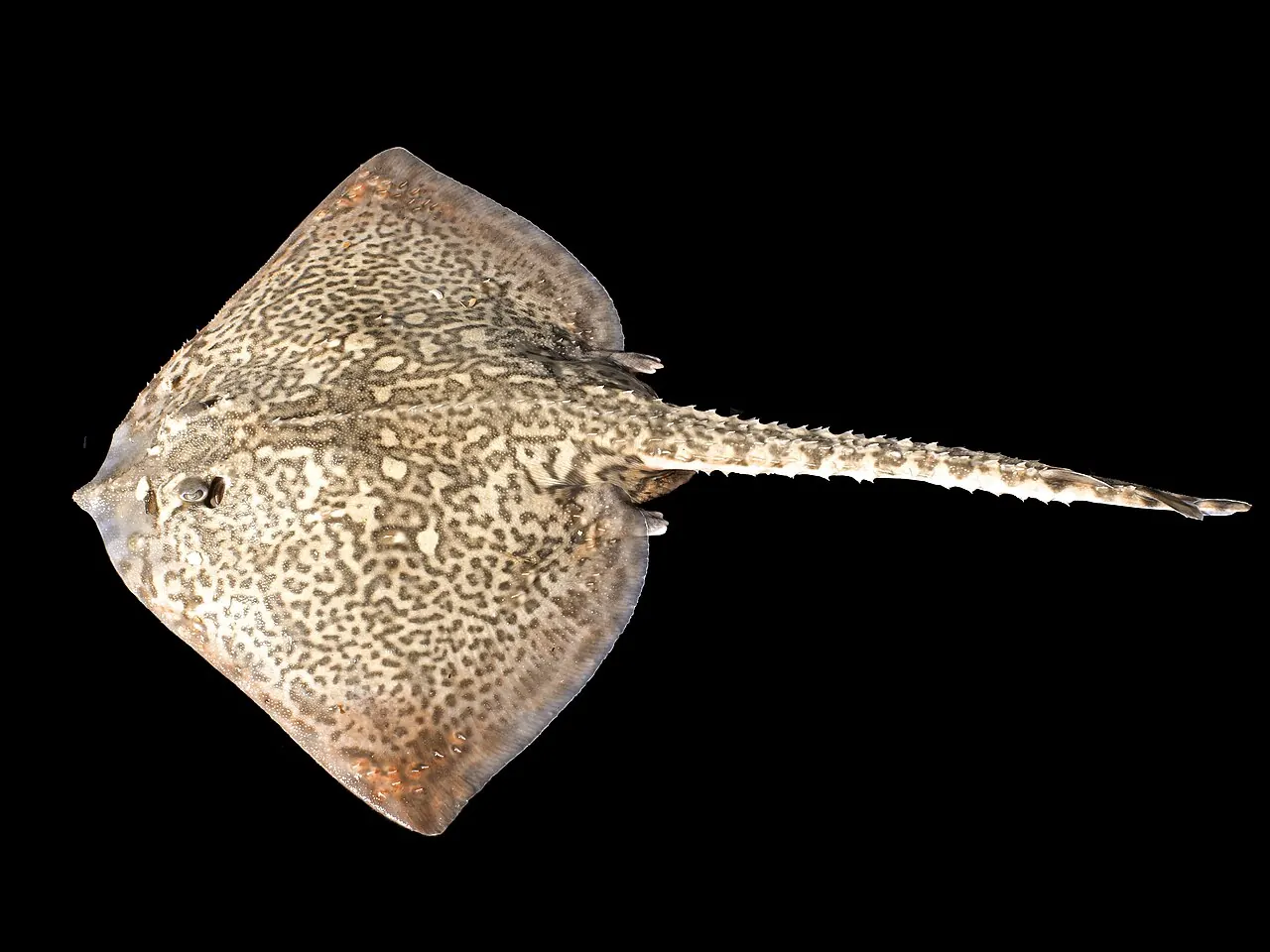
Thornback Ray
Raja clavata
A prickly, mottled skate of European coasts and the ray most often met around the British Isles, which lays horned egg cases on the seabed.
Photo: Hans Hillewaert / CC BY-SA 4.0
3 things to know
- A row of 30 to 50 thorns runs down the middle of its back.
- One female can lay up to 170 egg cases in a year, though most lay far fewer.
- Its egg cases hatch after about four to five months.
- Scientific name
- Raja clavata
- Depth
- 10 m – 60 m
33 – 197 ft - Size
- Commonly about 85 cm (2.8 ft) long; females up to about 1.4 m (4.6 ft)
- Weight
- Up to about 18 kg (40 lb)
- Lifespan
- At least 15 years
- Diet
- Bottom animals, especially crabs, shrimps and other crustaceans; also fish
- Where
- Eastern Atlantic and southwest Indian Ocean, from Iceland to Madagascar, including the Mediterranean
- IUCN status
- Near Threatened
- Depth zones
- Sunlight
Run a hand along a thornback's back and the name explains itself. Between 30 and 50 thorns form a row from the nape to the first dorsal fin, and adults also carry large "buckler" thorns with swollen bases scattered over the upper side. The disc is roughly diamond-shaped, with pointed wingtips and a short, rounded snout. Color varies a lot, through every shade of brown with darker and lighter spots and blotches, over a white underside. Large females are prickly underneath as well. The IUCN calls it the thornback skate, and like other skates it lays eggs instead of giving birth.
It is found from Iceland to Madagascar, including the Mediterranean, on mud, sand and gravel over the continental shelf and upper slope. FishBase records it from 5 to 1,020 meters (16 to 3,350 feet) deep, though it is most common in coastal water 10 to 60 meters (33 to 200 feet) deep. It is active at night and eats almost any bottom animal, especially crustaceans, along with fish. Adults follow a yearly migration cycle and can cover 54 to 117 kilometers (34 to 73 miles) in a month, while the young stay put in inshore nursery grounds. Britain's Wildlife Trusts call it the ray most commonly encountered around the British Isles.
Pairs mate in an embrace, and females lay their eggs two at a time on shallow sand, mud, pebble or gravel, in spring in northwestern Europe. Each egg sits in a separate oblong capsule 5 to 9 centimeters (2 to 3.5 inches) long, not counting the horns, with a stiff pointed horn at each corner and a sticky film that anchors it to the bottom. One female can lay up to 170 egg cases in a year, though 48 to 74 is more typical. The embryos live on yolk, and after about four to five months pups 11 to 13 centimeters (4 to 5 inches) long hatch out. The oldest thornback on record was 15.
Thornbacks are taken in commercial fisheries, and FishBase rates their vulnerability to fishing as high. The IUCN's 2023 global assessment lists the species as Near Threatened, one step short of the threatened categories.



