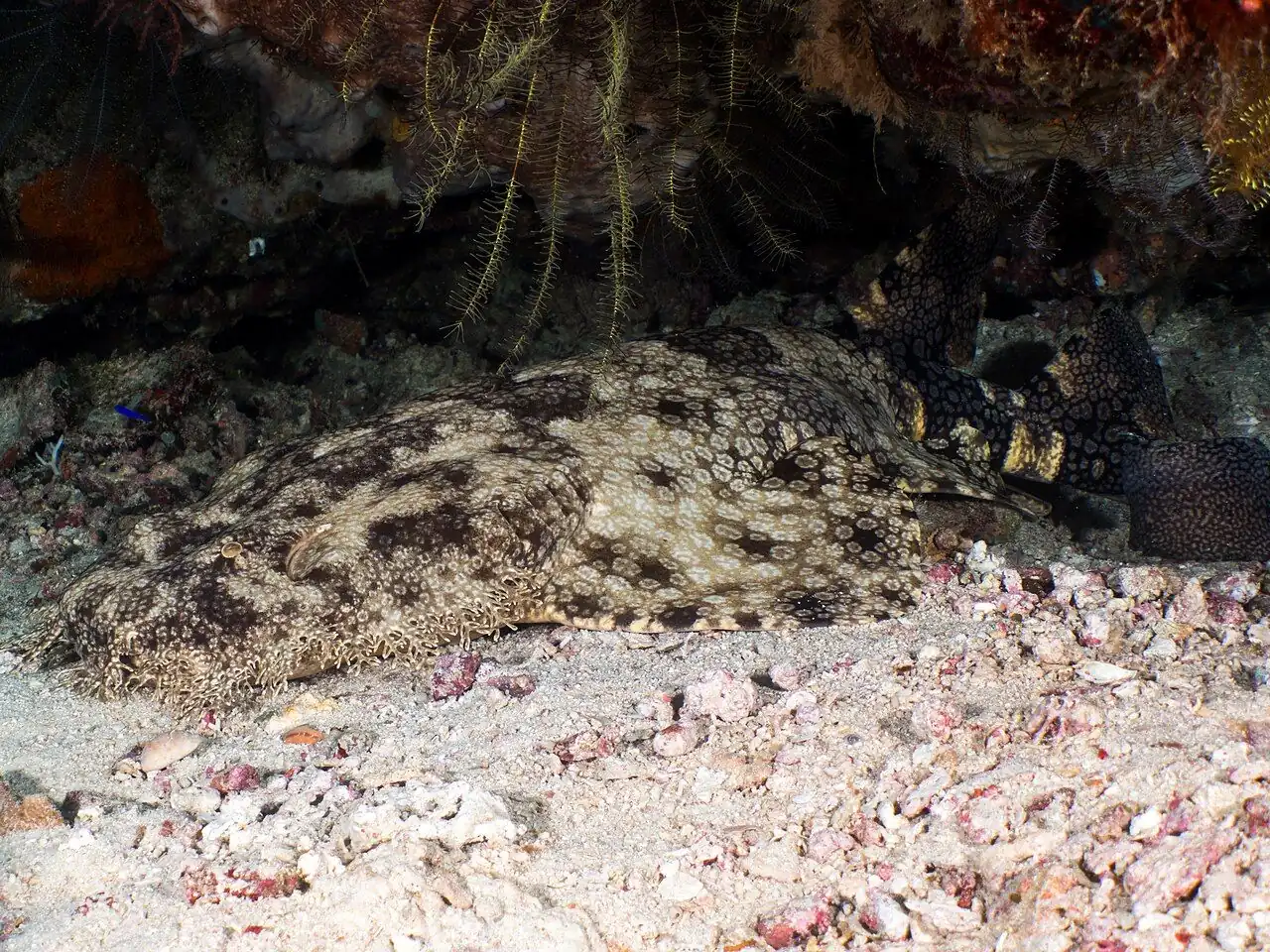
Tasselled Wobbegong
Eucrossorhinus dasypogon
A flat reef shark with a beard of branching skin flaps that lies camouflaged under ledges and ambushes fish, and now and then another shark.
Photo: Rickard Zerpe / CC BY 2.0
3 things to know
- A fringe of 24 to 26 pairs of branched skin flaps runs from the tip of its snout to its pectoral fins.
- In 2011, researchers on the Great Barrier Reef found one with a 1 m (3.3 ft) bamboo shark headfirst in its mouth.
- A female gives birth to 20 or more live pups, each about 20 cm (8 in) long.
- Scientific name
- Eucrossorhinus dasypogon
- Depth
- 2 m – 50 m
7 – 164 ft - Size
- Up to about 1.25 m (4 ft); a single report of 3.66 m (12 ft) is considered doubtful
- Weight
- Unknown
- Lifespan
- Unknown
- Diet
- Bottom fishes and probably invertebrates, including night-active fishes such as squirrelfish, soldierfish and sweepers; occasionally other sharks
- Where
- Eastern Indonesia, Papua New Guinea and northern Australia, including the Great Barrier Reef
- IUCN status
- Least Concern
- Depth zones
- Sunlight
From above, a tasselled wobbegong looks more like a patch of reef than a shark. Its body is flat and broad, and its head is fringed with 24 to 26 pairs of highly branched skin flaps that run from the tip of the snout back to the pectoral fins, with more branched lobes hanging under the chin. A net of narrow dark lines covers its lighter back, with dark spots where the lines meet. It grows to about 1.25 meters (4 feet); FishBase treats a single report of a 3.66-meter (12-foot) animal as uncertain.
It lives on coral reefs, in reef channels and on reef faces off eastern Indonesia, Papua New Guinea and northern Australia, including the Great Barrier Reef, at about 2 to 50 meters (7 to 164 feet) deep. By day it rests in caves and under ledges. At night it comes out to feed on bottom fishes and probably invertebrates, including night-active fishes that share its caves, such as squirrelfish, soldierfish and sweepers. When a fish comes within reach, it opens its jaws and sucks the prey onto needle-like teeth. Females give birth to 20 or more live pups, each about 20 centimeters (8 inches) long.
At midday on August 1, 2011, Daniela Ceccarelli and David Williamson of the ARC Centre of Excellence for Coral Reef Studies were counting fish on the fringing reef of Great Keppel Island, on the southern Great Barrier Reef. Ceccarelli told Live Science they first noticed a white bamboo shark that seemed to have its head tucked under a ledge. As they came closer, they saw the head was inside the mouth of a well-camouflaged tasselled wobbegong. The wobbegong was about 125 centimeters long; its prey, a brown-banded bamboo shark, was about 100 centimeters long and dead. Neither animal moved during 30 minutes of watching, and the pair estimated in their 2012 report in Coral Reefs that finishing the meal would take at least several more hours. Larger wobbegong species were already known to eat other sharks now and then. The authors credit a jaw built to dislocate, a large gape and sharp, backward-pointing teeth that let them grasp large prey before swallowing it whole.
Divers usually photograph tasselled wobbegongs without incident, though one may bite in self-defense or if it mistakes a foot for prey. The IUCN lists the species as Least Concern.
Sources
- floridamuseum.ufl.edu/discover-fish/species-profiles/eucrossorhinus-dasypogon
- fishbase.se/summary/Eucrossorhinus-dasypogon.html
- link.springer.com/article/10.1007/s00338-012-0878-z
- livescience.com/18486-wobbegong-shark-eats-bamboo-shark.html
- nationalgeographic.com/animals/article/120213-sharks-swallows-whole-great-barrier-reef-…
- api.gbif.org/v1/species/2417535/iucnRedListCategory
- iucnredlist.org/species/41873/124423827



