Swordfish
Xiphias gladius
A fast ocean hunter with a flat, sword-shaped bill and a built-in heater that keeps its brain and eyes warm on deep, cold dives.
Photo: Naturalis Biodiversity Center / CC0
3 things to know
- Adult swordfish have no scales and no teeth.
- A heater made from eye-muscle tissue keeps its eyes and brain up to 10 to 15°C (18 to 27°F) warmer than the water.
- A single female can carry from 1 million to 29 million eggs.
- Scientific name
- Xiphias gladius
- Depth
- 0 m – 600 m
0 – 1,969 ft - Size
- Up to about 4.5 m (14.9 ft) long, including the bill
- Weight
- Up to about 650 kg (1,400 lb); North Atlantic fish reach about 530 kg (1,165 lb)
- Lifespan
- Not well known; at least 9 years
- Diet
- Fish and squid
- Where
- Tropical, temperate and sometimes cold oceans worldwide, including the Mediterranean
- IUCN status
- Near Threatened
- Depth zones
- Sunlight · Twilight
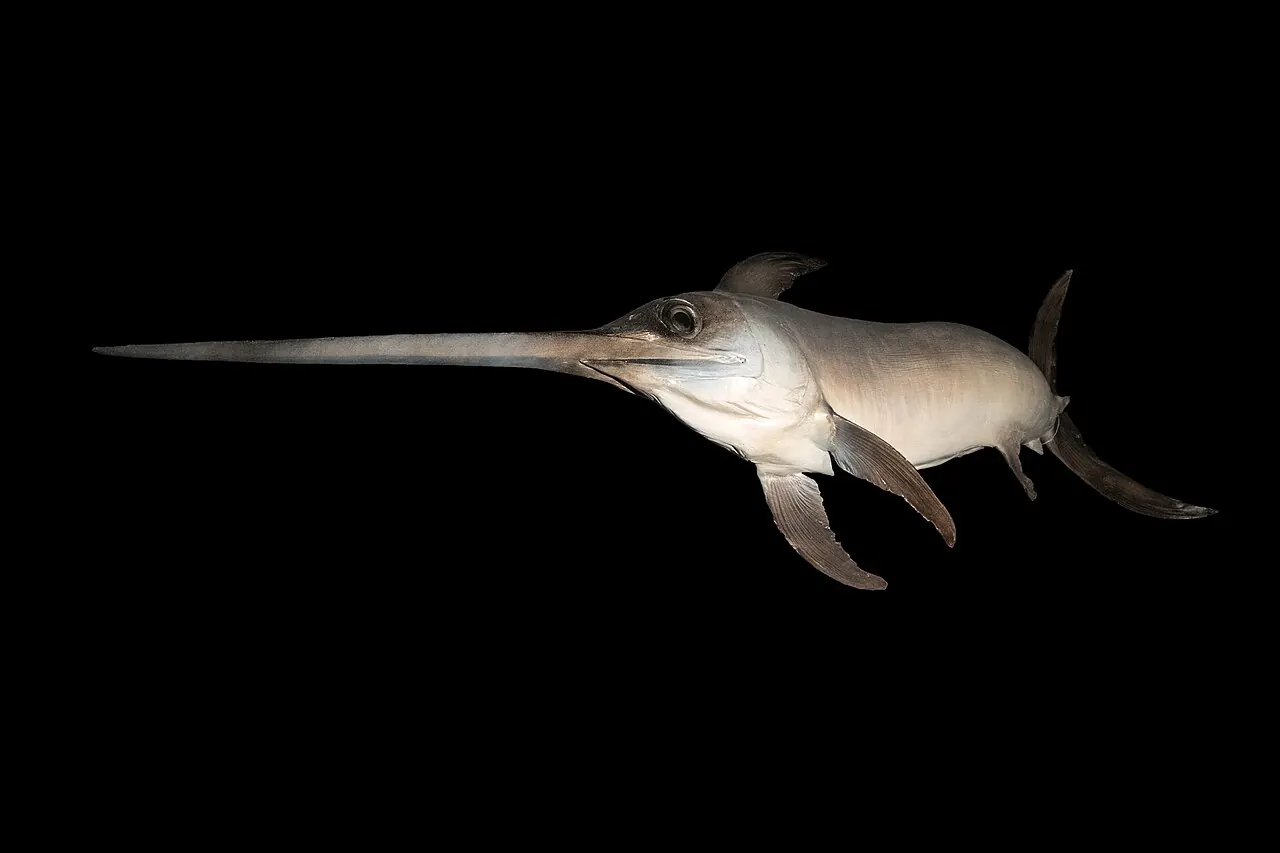
A swordfish's bill is long even by billfish standards, and it is flat, a flattened oval in cross section, where a sailfish's bill is round. The body is stout and rounded, blackish brown on top and paler below, with large eyes, a tall, rigid first dorsal fin and a broad, crescent-shaped tail. Adults have no scales, no teeth and no pelvic fins.
They range through tropical, temperate and sometimes cold oceans worldwide, including the Mediterranean. A swordfish is often seen at the surface, but it is mainly a midwater fish, usually found 200 to 600 meters (650 to 1,970 feet) down, and it is believed to dive to 650 meters (2,100 feet) or more, where the water may be just above freezing. They grow to about 4.5 meters (14.9 feet) and 650 kilograms (1,400 pounds), and nearly all fish over 140 kilograms (300 pounds) are females. NOAA Fisheries says most swordfish caught in the Atlantic fishery weigh 50 to 200 pounds.
Swordfish eat mostly fish and squid. They slash at prey with the bill, and squid pulled from swordfish stomachs often carry the cuts. Small prey is swallowed whole.
Spawning happens in warm water near the surface, and a female may hold anywhere from 1 million to 29 million eggs. The floating eggs hatch into larvae about 4 millimeters long, which at first have a short snout. NOAA puts the lifespan at about 9 years. The IUCN lists the swordfish as Near Threatened, while NOAA's 2022 assessment found the North Atlantic stock is not overfished.
Their strangest feature sits behind the eyes. In 1982, Francis Carey of Woods Hole Oceanographic Institution described a heater built from tissue on one of the eye muscles, rich in mitochondria and fed by a heat-exchanging bundle of blood vessels. It keeps the brain and eyes up to 10 to 15°C (18 to 27°F) warmer than the surrounding water. In 2005, Kerstin Fritsches and colleagues showed that warm retinas follow fast movement much better, in some conditions more than ten times better than retinas at water temperature.
Sources
- fisheries.noaa.gov/species/north-atlantic-swordfish
- floridamuseum.ufl.edu/discover-fish/species-profiles/xiphias-gladius
- fishbase.se/summary/Xiphias-gladius.html
- Study: doi:10.1126/science.7079766
- Study: doi:10.1016/j.cub.2004.12.064
- news.uq.edu.au/2005-01-11-warm-eyes-give-deep-sea-predators-super-vision
- whoi.edu/who-we-are/about-us/people/obituary/francis-carey



