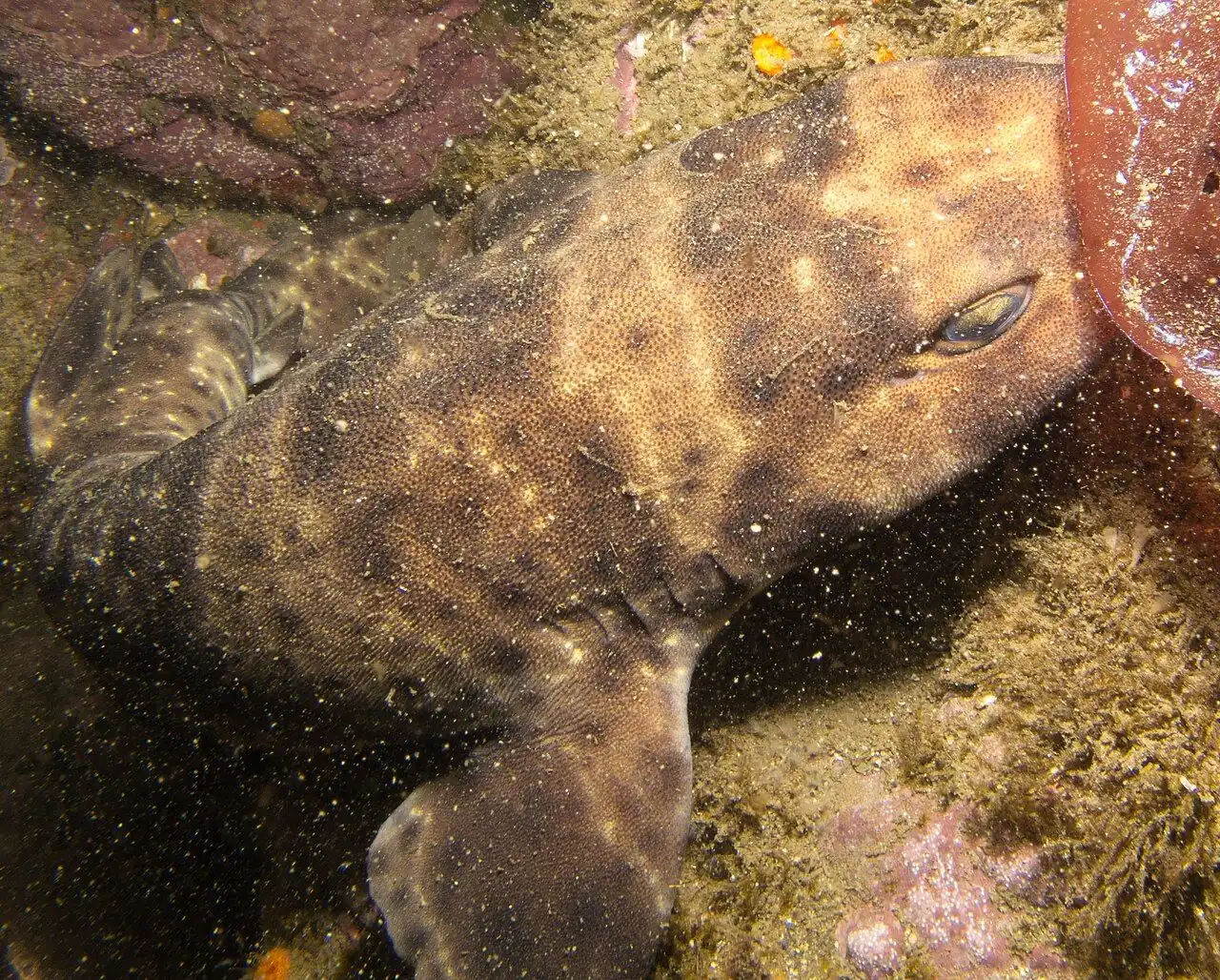
Swell Shark
Cephaloscyllium ventriosum
A small, spotted catshark of California's kelp beds that gulps water to double its size when threatened, and whose skin glows green.
Photo: Ed Bierman / CC BY 2.0
3 things to know
- When threatened, it gulps water and swells to about twice its normal size.
- Its eggs hatch after 9 to 12 months inside tough cases anchored to rocks and seaweed.
- Its skin glows bright green, and its eyes are most sensitive to blue-green light.
- Scientific name
- Cephaloscyllium ventriosum
- Depth
- 5 m – 37 m
16 – 121 ft - Size
- Commonly about 90 cm (35 in) long; up to 1.1 m (43 in)
- Weight
- Not well known
- Lifespan
- Not well known
- Diet
- Small bony fishes, alive and dead, plus mollusks and crustaceans
- Where
- Eastern Pacific from central California to the Gulf of California and southern Mexico; also central Chile
- IUCN status
- Least Concern
- Depth zones
- Sunlight
When a swell shark feels threatened, it bends into a U, grabs its own tail in its mouth and swallows water until its body swells to about twice its normal size. Wedged in a crevice, it becomes very hard for a predator to bite or pull out. When the danger passes it lets the water go, with what the Florida Museum describes as a dog-like bark. Hauled up by a fisher, it can puff itself up with air the same way.
It is a small, stout catshark with a flat, broad head, a very large mouth, and yellow-brown skin marked with darker blotches and white spots. Adults are commonly about 90 centimeters (35 inches) long and reach 1.1 meters (43 inches). Swell sharks live in the eastern Pacific from central California to the Gulf of California and southern Mexico, with another population off central Chile. They prefer rocky, algae-covered bottoms and kelp beds, usually 5 to 37 meters (16 to 121 feet) down, though they have been found at 457 meters (1,500 feet).
By day a swell shark hides in caves and crevices, sometimes resting in piles with others. At night it moves onto nearby sand to hunt small fish, mollusks and crustaceans, either sucking prey in or lying still with its mouth open until something wanders in. Sometimes it climbs into lobster traps for an easy meal. There is no commercial fishery for swell sharks, though some are caught as bycatch in traps, gillnets and trawls, and the IUCN's 2024 assessment lists the species as Least Concern.
Females lay eggs two at a time, in rubbery, pale cases 9 to 13 centimeters (3.5 to 5 inches) long, with tendrils that catch on rocks and seaweed. The cases harden and darken within the first few hours. The embryo lives on yolk for 9 to 12 months, depending on water temperature, then uses enlarged denticles on its back to break out, emerging about 15 centimeters (6 inches) long. Some never make it: marine snails bore through the cases and eat the embryos.
Swell sharks are biofluorescent: their skin glows bright green. In a 2016 study, David Gruber and colleagues found that the shark's eyes contain a single visual pigment, most sensitive to blue-green light. They built a camera that matched that sensitivity, and its images showed the glow adding contrast to the shark's patterns as another swell shark would see them.



