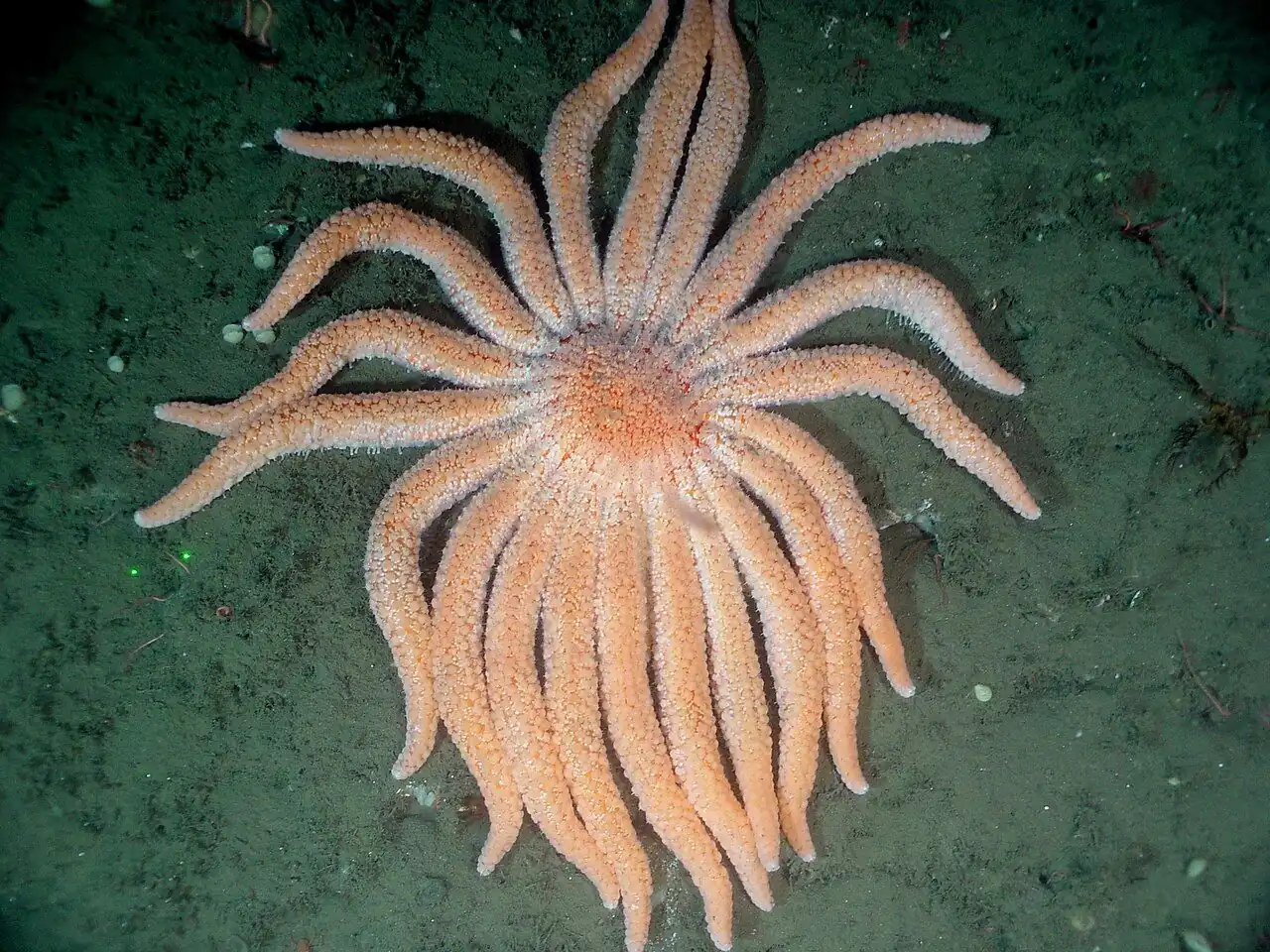
Sunflower Sea Star
Pycnopodia helianthoides
One of the largest sea stars in the world, a many-armed Pacific predator that lost about 90% of its population to wasting disease.
Photo: Ed Bowlby, NOAA/Olympic Coast NMS / Public domain
3 things to know
- Adults commonly have 16 to 20 arms, and young ones add arms in pairs as they grow.
- Sea star wasting disease killed as many as 5.75 billion of them after 2013.
- In 2025, scientists showed that the bacterium Vibrio pectenicida can cause the disease.
- Scientific name
- Pycnopodia helianthoides
- Depth
- 0 m – 435 m
0 – 1,427 ft - Size
- Over 1 m (3.3 ft) across, arm tip to arm tip
- Weight
- Up to about 5 kg (11 lb)
- Lifespan
- Unknown
- Diet
- Sea urchins, snails, clams, mussels, crabs, sea cucumbers and other bottom animals
- Where
- Northeast Pacific, from the Aleutian Islands, Alaska, to at least northern Baja California, Mexico
- IUCN status
- Critically Endangered
- Depth zones
- Sunlight · Twilight
Sixteen to 20 soft arms and a span of more than a meter (3.3 feet) from tip to tip put Pycnopodia helianthoides among the largest sea stars in the world. Young sunflower stars start with fewer than a dozen arms and add more in pairs as they grow, and big adults can weigh about 5 kilograms (11 pounds).
It lives along the Pacific coast of North America from the Aleutian Islands of Alaska to at least northern Baja California, Mexico. It ranges from the low intertidal zone down to 435 meters (1,430 feet), but it is most common shallower than 25 meters (82 feet) and rare below 120 meters (390 feet). It roams kelp forests, eelgrass meadows, rock, sand and mud.
Adults eat sea urchins, snails, crabs, sea cucumbers, clams and mussels, and dig clams out of soft bottoms with their arms. They find prey by chemical cues in the water. What they eat depends on what is around: urchins made up most of the diet on Washington's outer coast in one study, while snails dominated in central California kelp forests. The sexes are separate and spawn into the water, so mates need to be close together. Nobody knows how long they live in the wild.
Starting in 2013, sea star wasting disease hit more than 20 species from Mexico to Alaska, and none harder than this one. A study led by Sarah Gravem of Oregon State University used more than 61,000 surveys to estimate a 90.6% decline and as many as 5.75 billion deaths. In 2020 the IUCN listed the species as Critically Endangered, and in 2023 NOAA Fisheries proposed listing it as threatened under the Endangered Species Act. Without these stars, purple sea urchins have boomed in many places, adding to the pressure on kelp forests.
In 2025, a team led by Melanie Prentice and Alyssa-Lois Gehman showed that a bacterium, Vibrio pectenicida, can cause the disease in sunflower stars. Knowing the culprit should make it possible to screen for it in labs and in the field.



