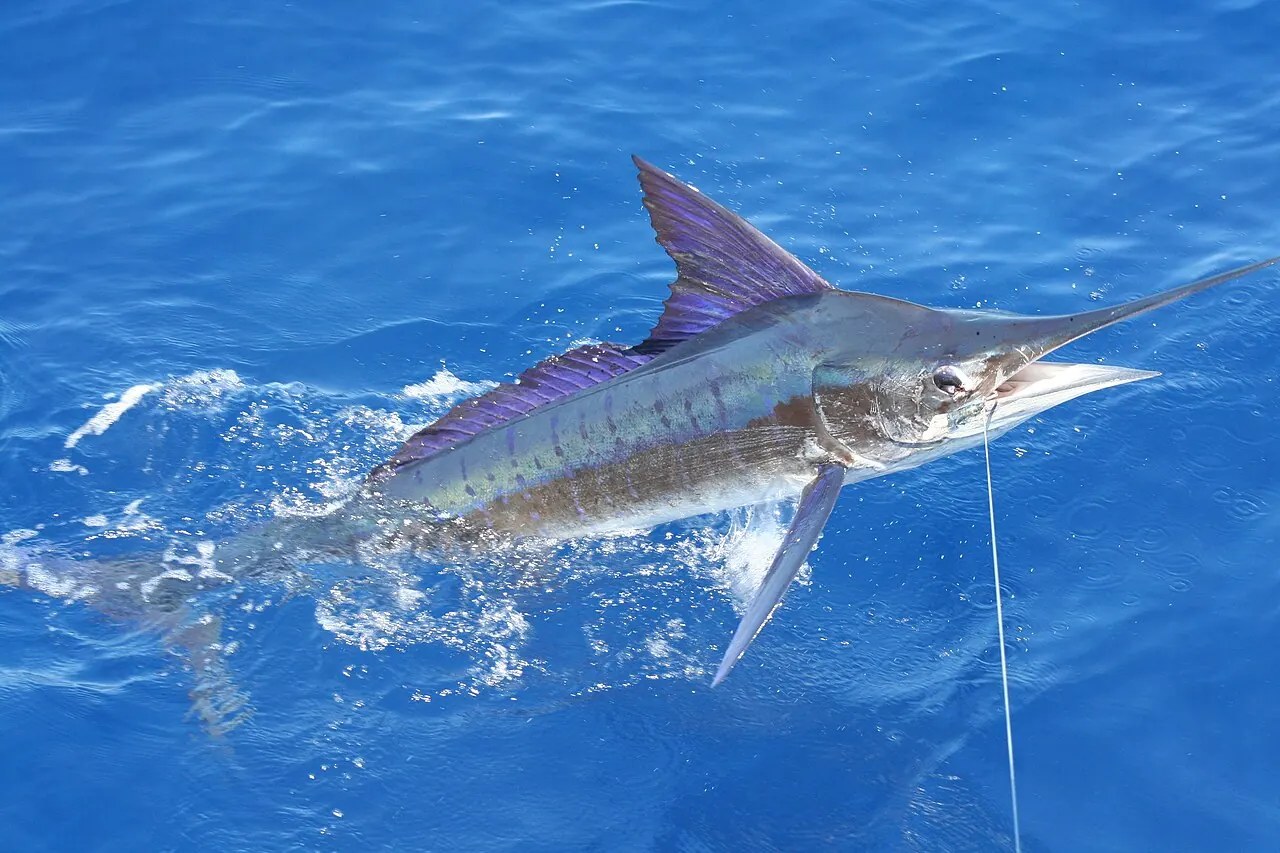
Striped Marlin
Kajikia audax
The most widespread billfish, a marlin that hunts sardine schools in groups where each fish takes its turn but some eat far more than others.
Photo: Jackiemora01 / CC BY-SA 3.0
3 things to know
- Its first dorsal fin is taller than its body is deep.
- Divers have told individual striped marlin apart by their stripes and fin shapes.
- In filmed hunts, the half that attacked most often caught 70 to 80 percent of the fish.
- Scientific name
- Kajikia audax
- Depth
- 0 m – 200 m
0 – 656 ft - Size
- Commonly about 2.9 m (9.5 ft); up to about 3.7 m (12 ft) long, including the bill
- Weight
- More than 200 kg (450 lb)
- Lifespan
- Not well known; the oldest reported age is 9 years
- Diet
- Schooling fish such as sardines, anchovies and mackerel, plus squid and crustaceans
- Where
- Tropical, subtropical and temperate waters of the Pacific and Indian oceans
- IUCN status
- Least Concern
- Depth zones
- Sunlight
A striped marlin's first dorsal fin rises higher than its body is deep, a tall blue-black flag above a dark blue back and silvery belly. Down each side run about 15 to 20 rows of cobalt-blue stripes, made of small dots or narrow bands. The bill is round. NOAA says striped marlin are smaller than other marlins, though they can still reach 12 feet (3.7 meters) and more than 450 pounds (200 kilograms).
FishBase calls it the most dominant and widely distributed of all billfishes. It lives across the Pacific and Indian oceans, generally in cooler water than black or blue marlin, about 20 to 25°C (68 to 77°F). In the Pacific its range forms a horseshoe, from the northwest Pacific through the eastern Pacific to the southwest Pacific, a pattern FishBase describes as unique among billfishes and tunas. Acoustic tracking shows it spends 86% of its time in the surface layer above the thermocline. Spawning happens in the central Pacific and off central Mexico, and juveniles head east toward Mexico, where they are abundant around the tip of the Baja Peninsula. Off southern California they often feed at the surface on small fish and squid.
Striped marlin eat mackerel, sardines, anchovies, other fish and squid, and they can hunt in groups. In November 2018 and 2019, Matthew Hansen of Germany's Leibniz Institute of Freshwater Ecology and Inland Fisheries and colleagues snorkeled 10 to 30 kilometers off Baja California, filming marlin attacking schools of sardines and mackerel with cameras recording 120 frames per second. They told 54 marlin apart by their stripe patterns and dorsal fin shapes. Their 2022 study found that a group would surround the school while individuals took turns dashing through it. The sharing was lopsided: the half of the marlin that attacked most often caught 70 to 80% of the fish. Neither body size nor aggression explained the gap, though newly arrived marlin got more access, perhaps because they were hungrier.
The IUCN lists the striped marlin as Least Concern. NOAA reports that the Central Western Pacific stock is rebuilding but was still subject to overfishing in its 2023 assessment. FishBase rates its flesh the best of any billfish for sashimi.



