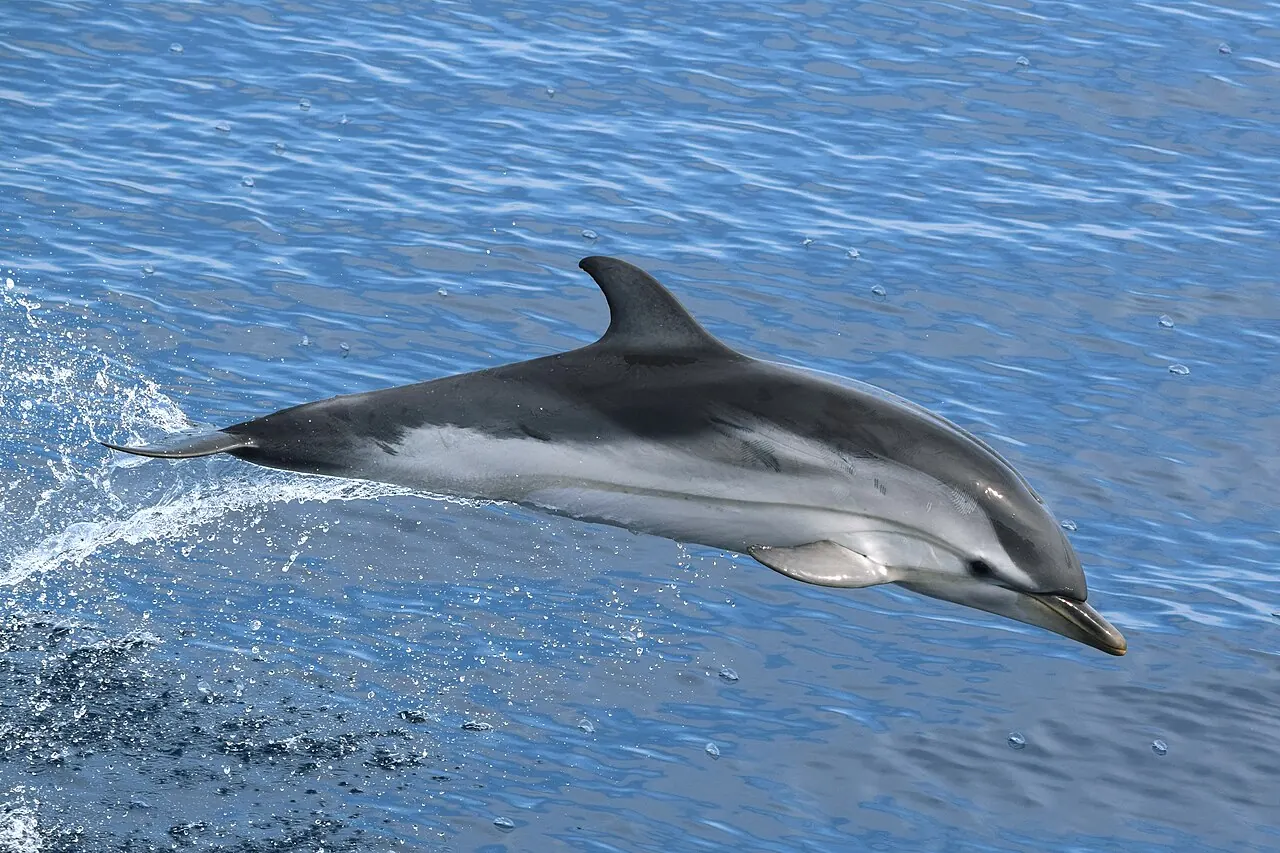
Striped Dolphin
Stenella coeruleoalba
One of the most abundant dolphins on Earth, marked with thin dark stripes, that leaps up to 6 m high and spins its tail in midair.
Photo: Wanax01 / CC BY-SA 4.0
3 things to know
- It can leap up to 6 m (20 ft) above the surface.
- In the early 1990s, a virus killed more than 1,000 striped dolphins in the Mediterranean Sea.
- It can dive to at least 700 m (2,300 ft).
- Scientific name
- Stenella coeruleoalba
- Depth
- 0 m – 700 m
0 – 2,297 ft - Size
- Up to about 2.4 m (8 ft) for females and 2.7 m (9 ft) for males
- Weight
- Up to about 150 kg (330 lb) for females and 160 kg (350 lb) for males
- Lifespan
- Up to about 58 years
- Diet
- Fish and cephalopods such as squid and octopus
- Where
- Deep tropical to warm temperate waters worldwide, mainly between 50° N and 40° S
- IUCN status
- Least Concern
- Depth zones
- Sunlight · Twilight
Thin dark stripes give this dolphin its name. One runs from the eye to the flipper and another runs down the side of the body toward the tail. Above the side stripe, a pale blaze curves up from the shoulder toward the dorsal fin, set against a dark blue-gray back, beak and flippers, and the belly is white to pinkish. NOAA Fisheries gives males up to about 2.7 meters (9 feet) and 160 kilograms (350 pounds), and females up to 2.4 meters (8 feet) and 150 kilograms (330 pounds). Each jaw carries 43 to 50 pairs of small, sharp teeth.
It is among the most abundant and widespread dolphins in the world, found in deep tropical to warm temperate water, mostly seaward of the continental shelf between 50° north and 40° south. Striped dolphins are drawn to upwelling areas and to convergence zones where currents meet. In the United States they live off the West Coast, in the northwestern Atlantic, in the Gulf of Mexico and around Hawaii, and like all marine mammals they are protected under the Marine Mammal Protection Act.
Groups usually hold 25 to 100 dolphins, sometimes thousands, and they rarely mix with other species. They are fast and athletic, leaping as high as 6 meters (20 feet). They also roto-tail, spinning the tail hard while airborne. In the eastern tropical Pacific, biologists and fishermen call them "streakers" because they race away from boats. They feed through the water column on fish, squid and octopus, and can dive to at least 700 meters (2,300 feet).
Females give birth to a single calf about 1 meter (3 feet) long every three to four years, after a pregnancy of about a year, and nurse it for 12 to 18 months. Striped dolphins may live as long as 58 years.
Striped dolphins have been killed in drive hunts in Japan and hunted in Sri Lanka and the Caribbean, and in the mid-20th century, NOAA says, as many as 21,000 a year were caught and killed. In the early 1990s a morbillivirus outbreak killed more than 1,000 striped dolphins in the Mediterranean Sea, and NOAA notes it may have been triggered by pollution such as organochlorines and by a shortage of prey. NOAA lists entanglement in fishing gear as one of the main threats today. The IUCN's assessment, published in 2019, lists the species as Least Concern.



