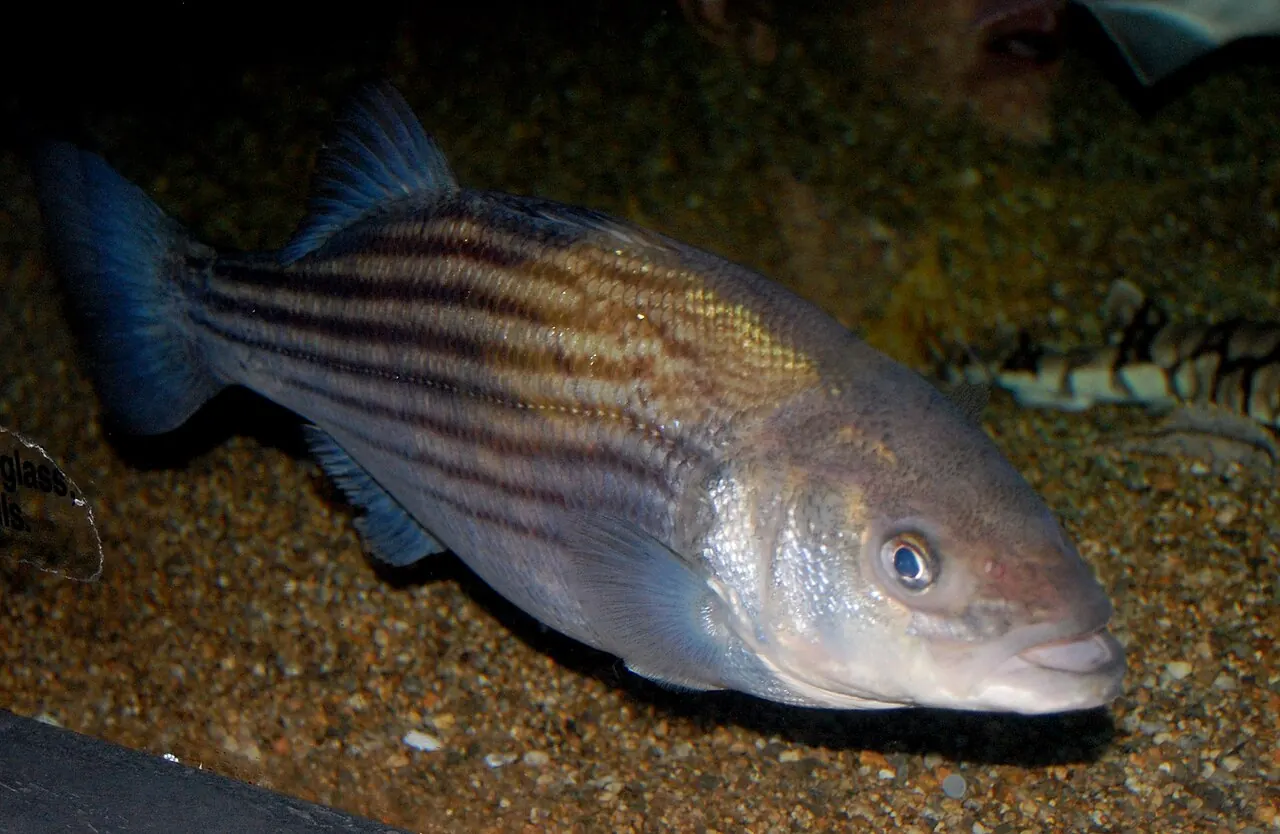
Striped Bass
Morone saxatilis
A striped coastal fish that swims up rivers to spawn, can live past 30 and was planted in San Francisco Bay in 1879.
Photo: Steven G. Johnson / CC BY-SA 3.0
3 things to know
- A striped bass tagged in North Carolina in 1995 was caught again in 2020, an estimated 31 years old.
- Maryland's 2026 survey found the eighth straight year of below-average striped bass spawning in Chesapeake Bay.
- Striped bass were first released on the US West Coast in 1879, in San Francisco Bay.
- Scientific name
- Morone saxatilis
- Depth
- 0 m – 30 m
0 – 98 ft - Size
- Up to about 1.5 m (5 ft) long
- Weight
- Up to about 35 kg (77 lb), per NOAA; FishBase lists a maximum published weight of 57 kg (125 lb)
- Lifespan
- Up to about 30 years, per NOAA; a North Carolina tag return showed a fish of about 31
- Diet
- Adults eat fish and invertebrates, especially crabs and squid; young eat zooplankton, insect larvae and small crustaceans
- Where
- Atlantic coast from the St. Lawrence River in Canada to northern Florida, and Gulf of Mexico rivers from Florida to Louisiana; introduced on the US Pacific coast
- IUCN status
- Least Concern
- Depth zones
- Sunlight
Seven or eight dark stripes run unbroken from the gills to the tail of a striped bass. Above them the back can be light green, olive, steel blue, black or brown, and the belly is white or silver. NOAA Fisheries puts the largest at about 1.5 meters (5 feet) and 35 kilograms (77 pounds), and says they can live up to 30 years.
Striped bass are anadromous: they live in the ocean and bays but spawn in fresh or brackish water. Each spring mature fish run up rivers to release their eggs, and the larvae drift down to nursery areas in river deltas, sounds and estuaries. Juveniles stay in estuaries for 2 to 4 years. Some adults then spend their lives in rivers and estuaries, while others migrate up and down the coast each year. The native range runs from the St. Lawrence River in Canada to northern Florida, plus Gulf rivers from Florida to Louisiana. Young fish eat zooplankton, insect larvae and small crustaceans, and adults eat almost any small fish, along with crabs and squid.
On April 29, 2020, Clark Purvis caught a 40-inch (1-meter) striped bass in the Roanoke River carrying a tag from May 8, 1995. It had been a 21-inch male, about 6 years old, when state biologists tagged it on the Albemarle-Roanoke spawning grounds, so it was about 31. The state Division of Marine Fisheries called it one of the two oldest striped bass recorded on the East Coast.
Maryland has seined for young striped bass in Chesapeake Bay every summer since 1954, and its 2026 index was 5.5, the best since 2018 but still the eighth below-average year in a row; the long-term average is 10.8. NOAA describes the Atlantic stock as overfished but not subject to overfishing, and federal waters, from 3 to 200 miles offshore, are closed to all striped bass fishing. Worldwide, the IUCN lists the species as Least Concern.
Striped bass reached the Pacific with human help. In 1879 about 130 young fish shipped from New Jersey were released in San Francisco Bay, and 300 more followed a few years later. A 1978 NOAA report gives 132 fish and 1882 for the second planting; the Smithsonian's invasions database gives 135 and 1883. By the late 1880s they were well established, and the San Francisco estuary is still their Pacific stronghold.
Sources
- fisheries.noaa.gov/species/atlantic-striped-bass
- fishbase.se/summary/Morone-saxatilis.html
- iucnredlist.org/species/192942/46956781
- deq.nc.gov/blog/2020-08-14/one-remarkable-fish-tag-return-shows-north-carolina-striped-…
- content.govdelivery.com/accounts/MDDNR/bulletins/42fa420
- invasions.si.edu/nemesis/species_summary/167680
- spo.nmfs.noaa.gov/sites/default/files/pdf-content/MFR/mfr401/mfr4014.pdf
- commons.wikimedia.org/wiki/File:Striped_bass,_Boston_Aquarium.JPG



