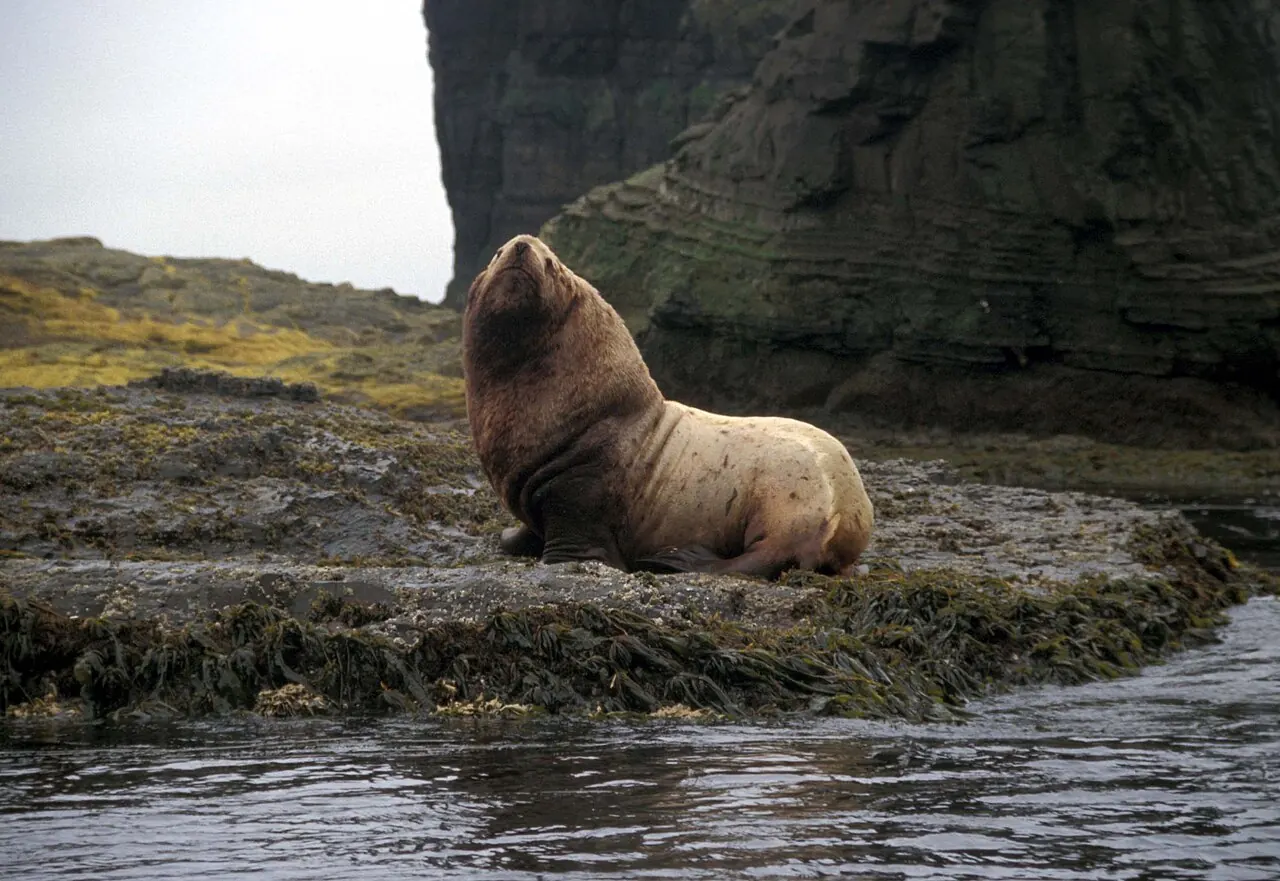
Steller Sea Lion
Eumetopias jubatus
The largest sea lion, whose bulls roar rather than bark; its western population in Alaska fell about 80 percent and is still listed as endangered.
Photo: Anne Morkill/U.S. Fish and Wildlife Service / Public domain
3 things to know
- It is the largest member of the eared seal family, which includes all sea lions and fur seals.
- The deepest documented dive is about 427 m (1,400 ft).
- The eastern population recovered and was removed from the US endangered species list in 2013.
- Scientific name
- Eumetopias jubatus
- Depth
- 0 m – 20 m
0 – 66 ft - Size
- Males up to about 3.4 m (11 ft); females about 2.3–2.9 m (7.5–9.5 ft)
- Weight
- Males up to about 1,130 kg (2,500 lb); females up to about 360 kg (800 lb)
- Lifespan
- Females up to about 30 years; males up to about 20
- Diet
- More than 100 species of fish, such as walleye pollock, Atka mackerel, salmon, Pacific cod and herring, plus squid and octopus
- Where
- Rim of the North Pacific, from northern Japan through the Bering Sea and Alaska to central California
- IUCN status
- Near Threatened
- Depth zones
- Sunlight
Steller sea lion bulls roar rather than bark like California sea lions, and they are built to match: up to about 3.4 meters (11 feet) and 1,130 kilograms (2,500 pounds), with a massive chest and neck and long, coarse hair on the shoulders. Females reach about 2.9 meters (9.5 feet) and 360 kilograms (800 pounds). Both sexes are light blond to reddish brown. The species is the largest of the eared seals, the family that holds all sea lions and fur seals, and it is named for Georg Wilhelm Steller, the naturalist on the Bering expedition who described it in 1742.
They live around the rim of the North Pacific, from northern Japan through the Sea of Okhotsk, the Bering Sea and the Aleutians, along southern Alaska and down to central California. Most foraging happens at night, on more than 100 species of fish, including walleye pollock, Atka mackerel, salmon, Pacific cod and herring, plus squid and octopus. Most dives are short and shallow: in an Alaska Department of Fish and Game study of tagged females, more than 60 percent lasted under 2 minutes and stayed above 20 meters (66 feet). The deepest documented dive is about 427 meters (1,400 feet). Resting at the surface, they sometimes hold a flipper in the air to soak up warmth.
In Alaska the species crashed. According to NOAA Fisheries, the western population, west of Cape Suckling, fell by about 77 to 81 percent from the 1970s to the early 2000s, declines NOAA describes as unexplained. Steller sea lions were listed under the Endangered Species Act in 1990, and in 1997 NOAA split them into an eastern population, listed as threatened, and a western one, listed as endangered. The eastern population grew about 4 percent a year between 1987 and 2017 and was taken off the list in December 2013. The western population is still endangered: it has grown slowly overall since 2003 but is still declining in the central and western Aleutians, and the 2014 to 2016 marine heat wave was associated with fewer pups and lower survival of adult females.
Bulls defending breeding territories may go one to two months without eating. Pups are born from mid-May to mid-July, mostly in June, and some nurse for as long as three years. Females can live about 30 years and males up to 20. The IUCN lists the species as Near Threatened.
Sources
- fisheries.noaa.gov/species/steller-sea-lion
- federalregister.gov/documents/2013/11/04/2013-25261/endangered-and-threatened-species-d…
- Study: doi:10.2305/IUCN.UK.2016-1.RLTS.T8239A45225749.en
- en.wikipedia.org/wiki/Steller_sea_lion
- adfg.alaska.gov/static/home/library/pdfs/wildlife/research_pdfs/movements_diving_behavi…



