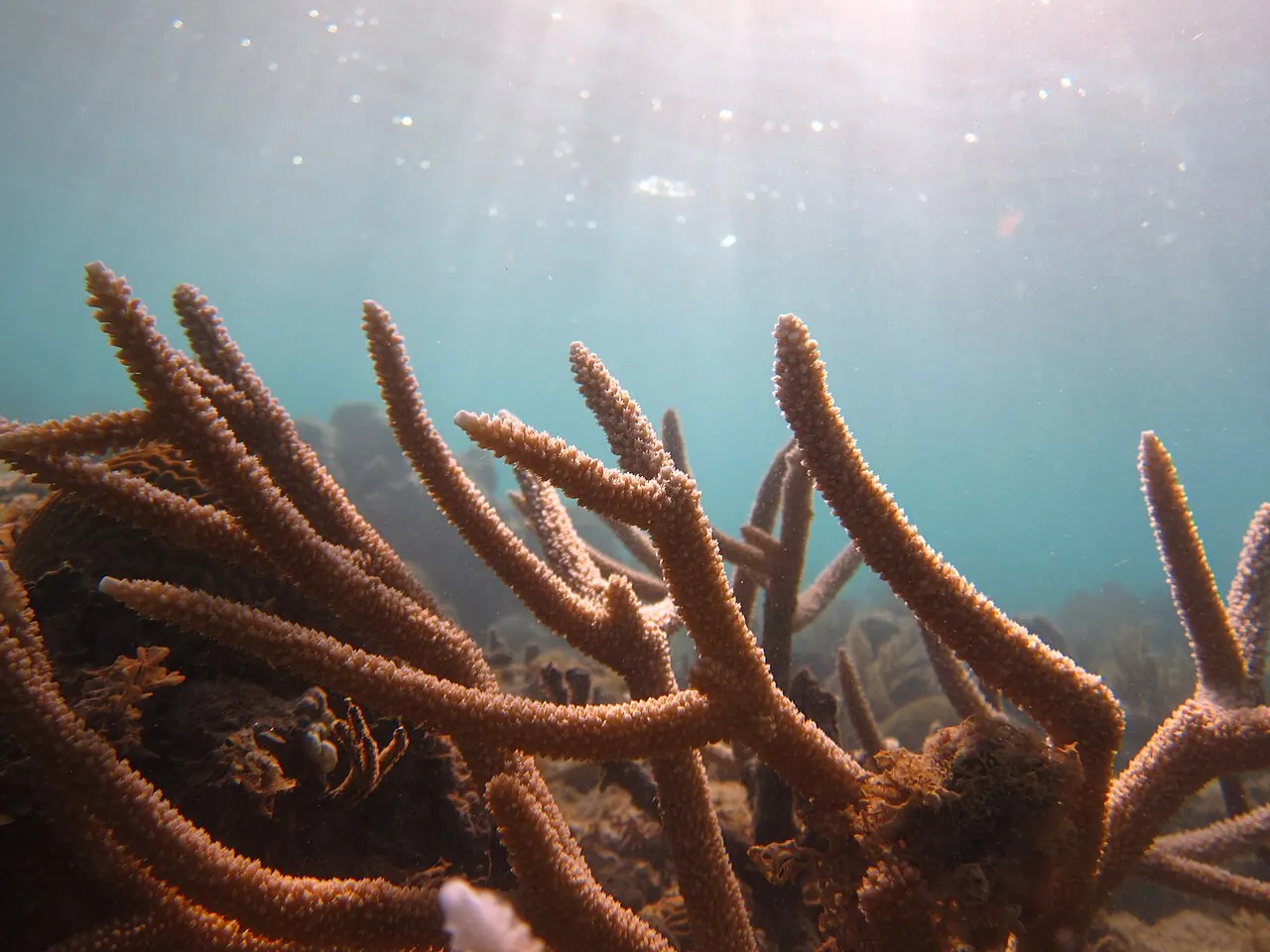
Staghorn Coral
Acropora cervicornis
A fast-growing Caribbean coral with antler-like branches that once formed vast thickets and has lost about 97% of its population since the 1980s.
Photo: Roban Kramer / CC BY-SA 2.0
3 things to know
- When healthy it can add up to 8 inches (20 cm) of branch length a year, making it one of the fastest-growing corals.
- A colony can start reproducing when it is only about 7 inches (18 cm) tall.
- Its population has fallen about 97% since the early 1980s.
- Scientific name
- Acropora cervicornis
- Depth
- 5 m – 18 m
16 – 59 ft - Size
- Colonies at least 1.2 m (4 ft) tall and 1.8 m (6 ft) across
- Weight
- Unknown
- Lifespan
- Unknown
- Diet
- Food made by algae living in its tissues, plus plankton caught by its polyps
- Where
- Bahamas, Florida and the Caribbean; north to Palm Beach County, Florida
- IUCN status
- Critically Endangered
- Depth zones
- Sunlight
Branching stalks like a deer's antlers, typically 1 to 3 inches (2.5 to 7.6 centimeters) thick, angle upward from a central trunk in a staghorn coral colony. Like its close relative elkhorn coral, Acropora cervicornis is golden tan or pale brown with white tips, colored by the algae that live in its tissue and supply it with food. Its polyps also catch plankton. A colony can reach at least 4 feet (1.2 meters) tall and 6 feet (1.8 meters) across, and many colonies together form dense thickets that give fish complex places to hide.
It is found on reefs throughout the Bahamas, Florida and the Caribbean, typically in clear water 15 to 60 feet (4.6 to 18 meters) deep. Palm Beach County, Florida, marks its northern limit. It grows in many reef settings, from spur-and-groove and patch reefs to limestone ridges and terraces.
When healthy, staghorn is one of the fastest-growing corals, adding up to 8 inches (20 centimeters) of branch length a year, and a colony can begin reproducing when it is only about 7 inches (18 centimeters) tall. Each colony makes both eggs and sperm and spawns once a year after the full moon in late summer. Branches broken off by ship groundings and other knocks can reattach and grow into new colonies, and restoration programs use this, raising fragments in nurseries and planting them back on reefs.
Its numbers are a small fraction of what they were. White band disease swept through in the early 1980s and cut the population by about 97%. NOAA says most of what remains is isolated colonies or small groups, with the old vast thickets still standing at only a handful of known sites, and successful reproduction is very rare. The species was listed as threatened under the Endangered Species Act in 2006 and was assessed as Critically Endangered on the IUCN Red List in 2021. Warming water is the greatest threat. In Florida's 2023 marine heat wave, 97.8 to 100% of staghorn and elkhorn colonies in the Florida Keys and Dry Tortugas died, according to a 2025 study in Science, and the authors described both corals as functionally extinct on Florida's reef.



