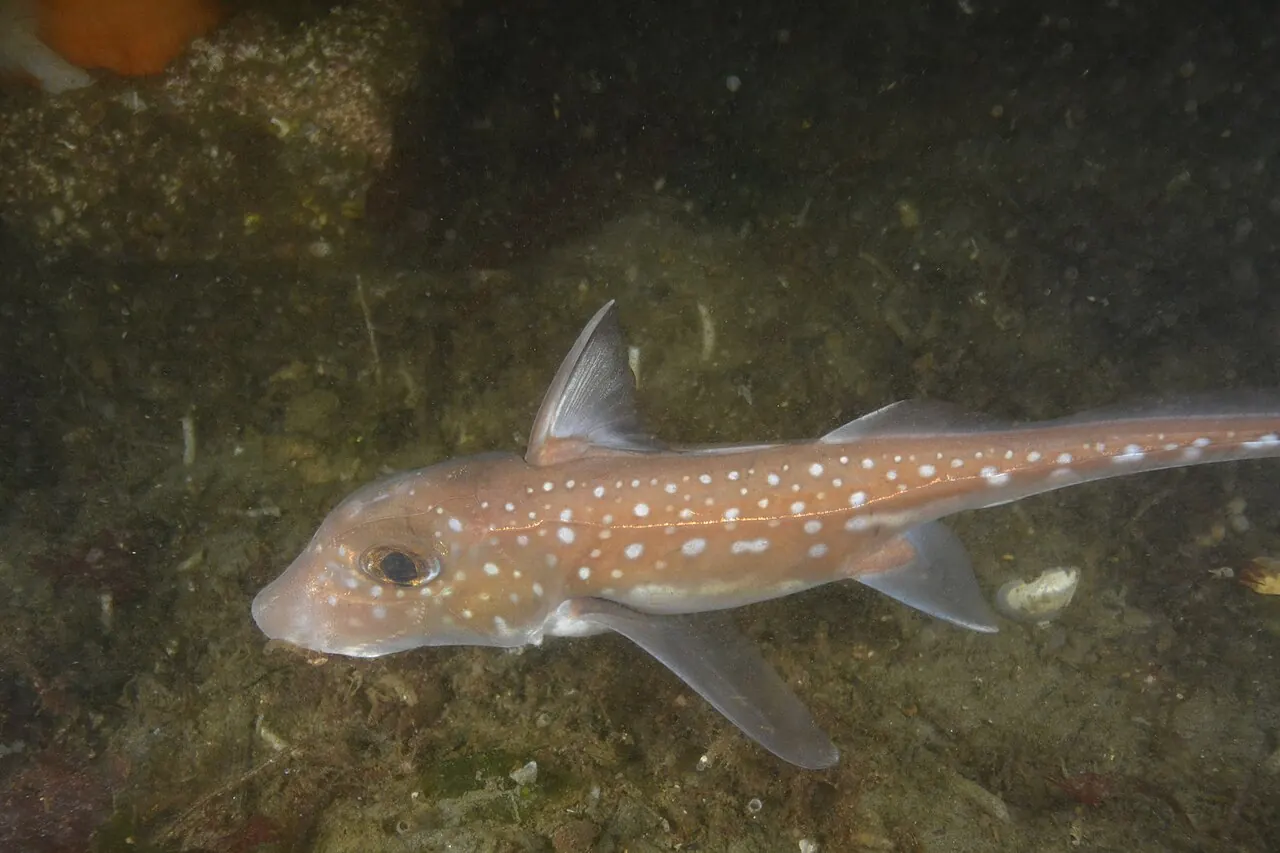
Spotted Ratfish
Hydrolagus colliei
A big-eyed, white-spotted chimaera of the Pacific Northwest whose males grip their mates with a toothed clasper on the forehead.
Photo: Stosh Morency (via iNaturalist) / CC BY 4.0
3 things to know
- Adult males carry a clasper on the forehead armed with seven or eight rows of hooked teeth.
- A spine in front of its first dorsal fin can cause a painful wound.
- It is one of the most abundant fish in Puget Sound.
- Scientific name
- Hydrolagus colliei
- Depth
- 50 m – 400 m
164 – 1,312 ft - Size
- Up to about 1 m (3.3 ft) for females; males are much smaller
- Weight
- Not well known
- Lifespan
- Not well known
- Diet
- Clams and other mollusks, crabs and shrimps, worms, sea stars and small fish
- Where
- Northeastern Pacific, from southwestern Alaska to Baja California and the Gulf of California
- IUCN status
- Least Concern
- Depth zones
- Sunlight · Twilight
Ratfish are chimaeras, cartilaginous fish that split from the shark family tree long ago and kept their own odd body plan. The spotted ratfish has a short, blunt snout, large green eyes, and a brown or reddish-brown body sprinkled with small white spots. Its long, slender tail makes up about half its length. Chimaeras have no scales, and instead of the shark's rows of replaceable teeth they have fused tooth plates. A long spine stands in front of the first dorsal fin. The Monterey Bay Aquarium calls it venomous, and FishBase warns that it can cause a painful wound.
It ranges from southwestern Alaska to Baja California and the Gulf of California, near the bottom from close inshore down to about 913 meters (2,995 feet), usually between 50 and 400 meters (165 and 1,310 feet). In Monterey Bay it is most common at 30 to 61 meters (98 to 200 feet), and in Puget Sound it is one of the most abundant fish. It eats clams and other mollusks, crabs, shrimps, worms, sea stars and small fish. According to FishBase, fishermen are said to fear its bite more than its spine.
A female lays her eggs two at a time, each in its own capsule, and can take up to 30 hours to push them out. The cases then hang from her body on a long filament for another four to six days before they end up planted upright in the mud or lying on the bottom. Females carrying eggs turn up in every season.
The strangest part of a ratfish sits between a male's eyes. Adult males have a tenaculum, a small cartilage appendage on the forehead lined with seven or eight rows of hooked teeth. A male flares it to warn rivals and uses it to grip a female's pectoral fin during mating. In September 2025, Karly Cohen of the University of Washington's Friday Harbor Labs, with Gareth Fraser of the University of Florida and Michael Coates of the University of Chicago, reported in PNAS that these are true teeth, rooted in a band of tissue called the dental lamina, not leftover skin denticles. Only mature males have the full set. The IUCN lists the species as Least Concern, though ratfish are caught by accident in trawl fisheries.



